500000+ Happy Customer | Cash on Delivery | Easy to Return | Free Shipping All over India 500000+ Happy Customer | Cash on Delivery | Easy to Return | Free Shipping All over India 500000+ Happy Customer | Cash on Delivery | Easy to Return | Free Shipping All over India

I Tried the Apple Watch SE 3 40mm — Here’s What Surprised Me

the Apple Watch SE 3 40mm Starlight model, showing how the compact 40mm size fits comfortably on a smaller wrist.

When Apple announced the Apple Watch SE 3 in September 2025, I expected a decent budget watch. I was wrong. After weeks of testing the Apple Watch SE 3 40mm, I discovered it offers flagship performance and an Always-On Display at a price that undercuts the competition by 40%. The biggest shock? It uses the same S10 chip as the expensive Series 11, making it feel faster and smarter than any “budget” gadget has a right to be. If you want the core Apple Watch experience without the premium price tag, this watch isn’t just a compromise—it’s the smartest buy of 2026.

The Biggest Surprise: The Screen is Finally “Always-On”

The most significant upgrade to the Apple Watch SE 3 40mm is the addition of an Always-On Display (AOD), a feature previously reserved for premium models.

For years, the biggest complaint about the SE line was the lack of an Always-On Display. With previous models, you had to do an awkward wrist flick just to see the time, which felt cheap. With the Apple Watch SE 3 40mm, that is gone. The screen is now Always-On, making the watch feel like a real timepiece rather than a gadget that sleeps until you shake it.

Brightness and Clarity

I was worried that because this is a cheaper watch, the screen might be dim, but that wasn’t the case. The display on the Apple Watch SE 3 40mm reaches up to 1,000 nits of peak brightness. While the top-tier watches go brighter (up to 2,000 nits), 1,000 nits is plenty bright for almost any situation, including sunny days.

The screen uses OLED and LTPO technology, the same tech found in premium phones and watches, ensuring deep colors and rich visuals. The resolution on the 40mm model is 324 x 394 pixels, which looks sharp enough for reading text and maps.

However, the bezels (the black border around the screen) are slightly larger than the new Series 11. The design mirrors the one Apple introduced in 2020 with the Series 6. While some might call this “old,” it looks clean and modern, especially in the Starlight or Midnight finishes.

Performance That Feels Like a Flagship

If the screen was the visual surprise, the speed was the performance shocker, as the Apple Watch SE 3 40mm refuses to feel like a budget device.

Usually, budget gadgets feel a little slow, lagging when you open apps or scroll. The Apple Watch SE 3 40mm does not feel slow. It is incredibly snappy, matching the responsiveness of watches costing twice as much.

The Power of the S10 Chip

Apple put the S10 chip inside this watch, the exact same processor found in the much more expensive Apple Watch Series 11 and Ultra 3. This was a huge move by Apple, as the SE line typically gets older chips. By giving the SE 3 the S10, Apple ensured this watch is “future-ready.”

Because of this chip, apps open instantly. Siri works right on the watch without needing to talk to your phone first, a feature called “on-device Siri.” This makes asking questions or setting timers much faster and more reliable.

New Ways to Control Your Watch

The S10 chip also unlocked cool new gestures that I didn’t expect to find on a $249 watch:

  • Double Tap: Tap your thumb and index finger together twice to answer a call or stop a timer.
  • Wrist Flick: Flick your wrist to dismiss notifications or silence an alarm.

These features felt like magic when I first tried them. They make the watch feel very high-tech, proving that the S10 chip makes the SE 3 far more than just an entry-level watch.

Battery Life: Better Than the Official Numbers

Battery life is always a worry with smartwatches, but the Apple Watch SE 3 40mm exceeded my expectations in real-world testing.

Apple officially says the Apple Watch SE 3 40mm lasts for 18 hours. This is the standard number they have used for years. But in my real-world testing, the watch did much better.

Real-World Testing

I wore the watch all day, tracked a workout, and even slept with it to track my sleep. With the Always-On Display turned on, I consistently got between 20 to 25 hours of battery life. Some users have reported getting up to 24 hours easily. This means I could wake up, wear it all day, track my sleep at night, and still have a little bit of battery left before charging it the next morning.

Low Power Mode is a Game Changer

If you know you are going to have a long day, there is a “Low Power Mode.” When I turned this on, the battery life stretched all the way to 32 hours. This is amazing for weekend trips where you might not want to carry your charger. The watch turns off some background tasks to save power, but it still tells the time and tracks your steps.

Fast Charging

Another nice surprise is how fast it charges. The Apple Watch SE 3 40mm charges much faster than the old SE 2:

  • You can get a 65% charge in just 50 minutes.
  • Other reports say you can hit 80% in about 45 minutes.
  • Even a quick 15-minute charge gives you enough power for 8 hours of use.

This fast charging means if you forget to charge it at night, you can just pop it on the charger while you shower and get ready, and it will last you the whole day.

Health Features: What’s New and What’s Missing

Health tracking is a big reason why people buy Apple Watches, and the Apple Watch SE 3 40mm brings some surprising advanced features to the budget category.

I was very surprised to find advanced health sensors in this model, features that were once exclusive to the most expensive watches.

The Surprising Additions

  • Sleep Apnea Notifications: The watch can now notify you if it detects signs of sleep apnea. This is a serious health condition, and having this feature on a budget watch is a big deal.
  • Temperature Sensing: It includes a temperature sensor. This helps with tracking your sleep quality and can even give estimates for ovulation cycles.
  • Sleep Score: There is a new “Sleep Score” feature that gives you a number out of 100 to tell you how well you slept. One user mentioned waking up to a score of 96, which helped them understand their rest better.
  • Heart Rate Tracking: It has an accurate optical heart rate sensor that warns you if your heart rate is too high or too low.

The Missing Features

To keep the price down at $249, Apple did leave out a few things.

  • No ECG: You cannot take an electrocardiogram (ECG) to check your heart rhythm. This feature is only on the Series 11 and Ultra 3.
  • No Blood Oxygen: The sensor to measure blood oxygen levels is also missing.
  • No Hypertension Alerts: It does not have the new high blood pressure alerts found on the premium models.

For most people, the heart rate tracking and sleep features are enough. But if you specifically need ECG or blood oxygen data for medical reasons, you would need to spend more money on the Series 11.

FeatureApple Watch SE 3 40mmApple Watch Series 11
Heart Rate SensorYesYes
Sleep Apnea NotificationsYesYes
Temperature SensingYesYes
ECG AppNoYes
Blood Oxygen SensorNoYes
Hypertension AlertsNoYes

Durability: Built to Last

I am often clumsy with my gadgets, so durability is key for me, and the Apple Watch SE 3 40mm feels tougher than its price suggests.

Apple says the front glass is “Ion-X” glass, and it is four times more resistant to cracks than the glass on the SE 2. This 4x crack resistance gives me a lot of peace of mind. Whether I bumped it against a door frame or wore it while playing sports like badminton, the screen stayed safe.

The watch is also water-resistant up to 50 meters (5ATM), so I could wear it in the pool or ocean without worry. The case is made of aluminum, which keeps it very light. The 40mm GPS model weighs only 26.3 grams. It feels so light on the wrist that I often forgot I was wearing it, which is perfect for sleeping.

Design and Comfort: Is 40mm Too Small?

The Apple Watch SE 3 40mm comes in two sizes: 40mm and 44mm, and I tested the 40mm model to see if it feels too small for modern use.

Some people worry that 40mm is too small for a modern smartwatch. However, the 40mm size is ideal for smaller wrists, but it also looks great on average-sized wrists if you prefer a sleeker look. The case is 40mm tall, 34mm wide, and 10.7mm deep. It fits wrists ranging from 150mm to 200mm with the standard M/L strap.

One user on Reddit mentioned that it takes 3-4 days to get used to the size if you are coming from a larger 44mm watch, but after that, the 40mm feels premium and expensive. Another user said the dial size is “perfectly enough for viewing”.

The watch comes in two colors: Midnight (a dark blue/black) and Starlight (a soft silver/gold). These colors look very premium and match almost any outfit. You can also change the bands to add more color if you want.

Connectivity and Storage

Even though it is the “budget” watch, the connectivity options on the Apple Watch SE 3 40mm are excellent and future-proof.

  • 5G Support: If you buy the cellular model, it supports 5G networks. This means faster downloads and better call quality when you leave your phone at home.
  • Wi-Fi and Bluetooth: It has Wi-Fi 4 and Bluetooth 5.3 for connecting to your phone and headphones.
  • Storage: The watch comes with 64GB of storage. This is the same amount of storage as the expensive Series 11. You can store plenty of music and podcasts directly on the watch to listen to offline with Bluetooth headphones.

Price and Value: The Best Deal in 2026?

Now, let’s talk about the price, because this is where the Apple Watch SE 3 40mm really shines and dominates the market.

  • USA Price: It starts at just $249 for the 40mm GPS model. The 44mm model is $279.
  • UK Price: It starts at £219.
  • India Price: In India, it is priced at Rs 25,900 for the 40mm model.

Compare this to the Apple Watch Series 11, which starts at $399 (or £369), or the Ultra 3 which is $799. The SE 3 costs about 40% less than the Series 11 but gives you the same S10 chip, the same Always-On Display, and the same gestures.

One reviewer called it the “bargain of iPhone smartwatches”. Another said it “completely ruined the 2k-3k android smartwatches” for them because the value is just so high. You are getting flagship performance for a mid-range price.

Software: WatchOS 26

The watch runs on watchOS 26 right out of the box, the latest software from Apple that brings a fresh look and new features.

This software includes a new “Liquid Glass” design that looks very modern. You get full access to Apple Pay, rich notifications, music controls, and thousands of third-party apps.

The software experience is smooth and intuitive. Because of the S10 chip, there is no lag when switching between apps or using new widgets. Apple promises long software support, so this watch should stay up to date for many years.

Final Verdict: Should You Buy It?

After spending weeks with the Apple Watch SE 3 40mm, my answer is a loud “Yes,” as it stands out as the best value smartwatch of the year.

What Surprised Me Most:

  1. The Always-On Display: It makes the watch feel premium and useful at a glance.
  2. The S10 Chip: It is as fast as the most expensive watches, ensuring smooth performance.
  3. The Battery Life: It easily lasts over 20 hours in real use, beating official claims.
  4. The Price: At $249, it is an incredible value that undercuts competitors significantly.

Who Should Buy It?
This watch is perfect for most people. If you want an iPhone smartwatch that tracks your fitness, sleep, and health without breaking the bank, this is the one to get. It is great for students, fitness lovers, and anyone who wants a reliable daily driver.

Who Should Skip It?
You should only skip this if you absolutely need an ECG sensor or blood oxygen monitoring for medical reasons. If you need those specific features, you will have to pay extra for the Series 11. Also, if you want the very latest design with tiny bezels and 2,000 nits brightness, the Series 11 is the upgrade.

But for everyone else, the Apple Watch SE 3 40mm is the best smartwatch deal of 2026. It proves that you don’t need to spend $400 or $800 to get a great Apple Watch experience. The SE 3 delivers almost everything that makes the Apple Watch great, at a price that feels like a steal.

In a world where tech keeps getting more expensive, the Apple Watch SE 3 40mm is a refreshing reminder that great value still exists. It surprised me by being better than I ever expected, and it might just surprise you too.

Frequently Asked Questions (FAQ) About the Apple Watch SE 3 40mm

1. Does the Apple Watch SE 3 40mm have an Always-On Display?

Yes. This is the biggest upgrade from the old SE 2. The screen on the Apple Watch SE 3 40mm stays on all the time, so you can see the time and your watch face without lifting your wrist. It gets bright enough (1,000 nits) to see clearly even in sunlight.

2. What is the battery life of the Apple Watch SE 3 40mm?

Apple officially says the battery lasts 18 hours. However, real-world tests show it often lasts longer, typically between 20 to 25 hours with normal use. If you turn on “Low Power Mode,” it can last up to 32 hours. It also charges very fast, reaching 80% in about 45 minutes.

3. Does the Apple Watch SE 3 40mm have ECG or Blood Oxygen sensors?

No. To keep the price low at $249, Apple did not include the ECG (heart rhythm) or Blood Oxygen sensors. It does track your heart rate continuously and will alert you if it is too high or too low. It also tracks sleep, temperature, and steps. If you need ECG or blood oxygen data, you would need to buy the more expensive Apple Watch Series 11.

4. Is the Apple Watch SE 3 40mm good for small wrists?

Yes, it is perfect. The 40mm size is designed for smaller wrists but looks great on average wrists too. It is very light (only 26.3 grams), so you barely feel it. It fits wrist sizes from 150mm to 200mm with the standard band. Many users find it much more comfortable for sleeping and working out than the larger 44mm or 46mm models.

5. What is the price of the Apple Watch SE 3 40mm?

The official starting price in the USA is $249 for the GPS model. The GPS + Cellular model (which lets you leave your phone at home) costs more, usually around $299. In the UK, it starts at £219, and in India, it is priced at ₹25,900. This makes it the most affordable new Apple Watch you can buy in 2026.

6. Can I use the Apple Watch SE 3 40mm without an iPhone?

Not for setup. You need an iPhone (iPhone 11 or later with iOS 26) to set up the watch. However, if you buy the GPS + Cellular model, you can leave your iPhone at home once it is set up. You can make calls, send texts, and stream music directly from your wrist. There is also a “Family Setup” feature that lets parents set up the watch for kids who don’t have their own iPhone.

7. Is the Apple Watch SE 3 40mm waterproof?

Yes. It is water-resistant up to 50 meters. You can wear it while swimming in a pool or the ocean, and in the shower. However, it is not designed for deep diving or high-speed water sports like scuba diving. After swimming in salt water, you should rinse it with fresh water.

8. How much storage does the Apple Watch SE 3 40mm have?

It comes with 64GB of storage. This is the same amount as the expensive Series 11. You can use this space to download music, podcasts, and apps so you can listen to them offline without your phone nearby. This is great for runners who want to leave their phone at home.

9. What colors does the Apple Watch SE 3 40mm come in?

The Apple Watch SE 3 40mm is available in two aluminum colors: Midnight (a dark blue that looks almost black) and Starlight (a soft silver with a hint of gold). These colors are neutral and match almost any outfit or band style.

10. Is the Apple Watch SE 3 40mm worth buying in 2026?

Yes, absolutely. It is widely considered the best value smartwatch of the year. It has the same fast S10 chip as the expensive models, an Always-On Display, and great battery life, all for $249. Unless you specifically need ECG or blood oxygen sensors, the SE 3 40mm gives you 90% of the Apple Watch experience for much less money.

Hume Band vs Apple Watch vs Oura Ring: Which Health Tracker Wins in 2026?

Hume Band, Apple Watch, and Oura Ring side by side on a white background, comparing top health wearables in 2026

If you’re trying to pick the best health tracker in 2026, you’re not alone. The market is full of options, but three stand out: the Hume Band, Apple Watch, and Oura Ring. Each promises better sleep, deeper health insights, and a path to a longer, healthier life. But which one actually delivers?

In this post, we’ll break down the Hume Band vs Apple Watch vs Oura Ring in a simple, honest way. No tech jargon. No hype. Just real facts about price, features, battery life, and what each device does best—so you can pick the one that fits your life.

Let’s dive in.

Who Are These Devices For?

The Hume Band vs Apple Watch vs Oura Ring debate starts with knowing who each device is made for. They’re all health wearables, but they do very different things well.

  • Hume Band: Built for people who care about long-term health, aging, and preventing illness before it starts. It focuses on metabolic health and longevity.
  • Apple Watch: Best for active users who want a smartwatch with health features—like GPS, ECG, and notifications—plus fitness and daily convenience.
  • Oura Ring: Designed for sleep lovers and recovery-focused users. It’s small, worn at night, and gives deep insights into sleep quality and readiness.

Knowing your goal helps you pick the right tool. Want to live longer? Hume. Want better sleep? Oura. Want a smartwatch that tracks health? Apple Watch.

Price: What Will It Cost You?

When comparing the Hume Band vs Apple Watch vs Oura Ring, price isn’t just about the upfront cost. It’s about total value over time—especially with subscriptions.

Hume Band: One-Time Purchase, No Required Subscription

One of the biggest wins for the Hume Band is its pricing model. You pay once and get access to core health data without a monthly fee.

  • Starting price: $299 (one-time purchase)
  • Discounts: Promo codes like NY50 or HEALTH20 can drop the price to $199
  • Optional premium: $8.99/month ($107.88/year) for AI coaching and deeper insights
  • No subscription needed for basic data like HRV, heart rate, sleep stages, and recovery
  • 30-day return policy – longer than most competitors
  • HSA/FSA eligible – you may use pre-tax dollars

This makes Hume a great choice if you hate recurring fees. You own your data, and you can export it anytime.

Hume Band on wrist showing sleek black band and sensor, focused on longevity tracking

Oura Ring: High Upfront Cost + Mandatory Subscription

The Oura Ring 4 starts at $349 for basic finishes (Silver, Black). Premium colors like Gold or Rose Gold go up to $499.

But here’s the catch: you must pay $69.99/year ($5.99/month) to unlock full features.

Without the subscription, you only get:

  • Basic activity tracking
  • Steps
  • Simplified heart rate
  • Temperature trends

You lose:

  • Full sleep staging
  • HRV analysis
  • Stress tracking
  • Recovery guidance
  • Period prediction

So the real cost adds up:

YearTotal Cost (Base Model + Annual Plan)
1$419
2$489
3$559

Oura says the subscription funds ongoing research and AI improvements. But for many, it’s a long-term cost that never ends.

They offer a 14-day return policy, which is shorter than Hume’s 30 days.

Apple Watch: No Subscription, But Higher Upfront Cost

Apple Watch prices vary by model:

  • Apple Watch SE 3: $249 – basic health tracking, no blood oxygen
  • Apple Watch Series 11: $399 – includes ECG, blood oxygen, hypertension alerts, skin temp
  • Apple Watch Ultra 3: $799 – built for athletes, 42-hour battery, dual-frequency GPS

No subscription is needed. You pay once and get full access to all health tools.

This makes Apple Watch more predictable than Oura, but pricier than Hume unless you go for the SE model.

Battery Life: Who Lasts the Longest?

Battery life is a big deal if you hate charging every day.

Let’s compare:

DeviceBattery LifeCharging Frequency
Hume Band4–5 daysEvery 4–5 days
Oura Ring 45–8 daysOnce a week or less
Apple Watch SE 318 hoursDaily
Apple Watch Series 1124 hoursDaily
Apple Watch Ultra 342 hoursEvery 1.5–2 days

If you want to wear your tracker 24/7 without daily charging, Oura and Hume win easily.

The Oura Ring lasts the longest—up to 8 days—making it perfect for sleep tracking.

The Hume Band gives solid 4–5 day performance, which is good for continuous health monitoring.

The Apple Watch needs daily charging for Series and SE models. Only the Ultra 3 lasts 42 hours, which is still far behind the rings.

Health Features: What Do They Actually Track?

Now let’s get into what matters most: health tracking.

Sleep Tracking: Who’s the Best?

When it comes to sleep, Oura Ring is the gold standard.

  • Sleep staging accuracy: 76–79.5% vs Apple Watch’s 50.5–86.1%
  • Uses multi-wavelength sensors and clinical-grade algorithms
  • Tracks deep sleep, REM, light sleep, and gives a Sleep Score
  • Can detect illness up to 2 days before symptoms using skin temperature

Apple Watch tracks sleep too, but it’s less accurate. One study found it was only 62% accurate at detecting deep sleep compared to professional tests.

Hume Band tracks sleep stages and recovery, but doesn’t claim clinical-grade sleep staging. It focuses more on how sleep affects long-term health and metabolic function.

So for pure sleep lovers, Oura is the top pick.

Heart Rate & HRV: Accuracy Matters

All three track heart rate and HRV (Heart Rate Variability), which shows how well your body handles stress.

  • Oura Ring: Claims 99.9% heart rate accuracy, detailed HRV analysis, trusted for resting heart rate
  • Apple Watch: 95% heart rate accuracy, good but not quite as precise
  • Hume Band: Clinical-grade sensors with ±3 bpm accuracy vs ECG, tracks HRV, SpO2, skin temp

Oura leads in HRV and resting heart rate accuracy, making it ideal for recovery tracking.

Unique Health Tools

This is where each device stands out.

Hume Band: Metabolic Health & Longevity

Hume’s big focus is longevity—helping you live longer and healthier. It tracks:

  • Metabolic Capacity: A score (0–100) of how well your body makes energy
  • Metabolic Momentum: Shows how daily habits affect aging
  • Biological Age: Estimates your body’s true age based on health data
  • Chronic illness detection: Claims to spot early signs of inflammation using biometrics

These features are unique. But keep in mind: Hume is not a medical device and can’t diagnose disease. Clinical validation for illness detection is still ongoing.

Still, early users report positive results—like a 1-year drop in biological age and 12% higher HRV after 6 months.

Apple Watch: Medical-Grade Alerts

Apple Watch has FDA-cleared tools:

  • ECG to detect atrial fibrillation
  • Blood oxygen sensing (95% accurate)
  • Sleep apnea notifications with 100% participant accuracy in a clinical study
  • Hypertension alerts (FDA-cleared in 2025)

These are serious health tools. But remember: they’re for notification, not diagnosis. They help you know when to see a doctor.

Apple Watch also allows you to export a 3-month sleep apnea report as a PDF, which you can share with your doctor.

Oura Ring: Recovery & Readiness

Oura’s strength is the Readiness Score, which tells you how recovered your body is each morning. It uses sleep, HRV, and temperature to guide your day.

It also:

  • Predicts women’s ovulation with 93% accuracy
  • Tracks period cycles using body temp
  • Offers temperature deviation alerts for illness

For people who want to optimize daily performance, Oura is hard to beat.

Design & Comfort: Can You Wear It All Day?

Comfort matters—especially if you wear it while sleeping.

FeatureHume BandOura RingApple Watch
Weight8.6g3.3–5.2g47.3g (Series 11)
Water ResistanceIP68 (1 meter)IPX8 (100m)100m (all models)
Form FactorWristbandRingSmartwatch
All-Day WearComfortable, lightweightTiny, can be lostBulky, noticeable
  • Hume Band is lightweight and comfortable for 24/7 wear.
  • Oura Ring is the smallest and lightest, great for sleep—but some find it loose or uncomfortable.
  • Apple Watch is the bulkiest, especially during sleep.

For sleep and subtle wear, Oura and Hume win. Apple Watch is more of a daily driver.

Smart Features: More Than Just Health

If you want texts, calls, apps, and GPS, Apple Watch is the only real choice.

It has:

  • Notifications
  • GPS for outdoor workouts
  • Music storage
  • App store
  • Emergency SOS
  • Skin temperature sensing
  • Environmental noise monitoring

Hume and Oura are health-only devices. They don’t have screens or smart features. You use your phone app to see data.

So if you want one device for everything, Apple Watch wins.

But if you just want health insights without distractions, Hume or Oura are better.

Which One Should You Buy?

Let’s break it down by who you are.

Choose Hume Band If:

  • You care about long-term health and aging
  • You want a one-time purchase with no required subscription
  • You like AI coaching to understand your data
  • You want 30-day returns and HSA/FSA use

Just know: its illness detection claims aren’t clinically proven yet, and battery life is average (4–5 days).

Choose Oura Ring If:

  • Sleep and recovery are your top goals
  • You don’t mind paying $70/year forever for full features
  • You want clinical-grade sleep and HRV data
  • You like a tiny, lightweight ring you can wear 24/7

But the subscription is mandatory, and the return window is short (14 days).

Choose Apple Watch If:

  • You want a full smartwatch with health tools
  • You need GPS, ECG, or sleep apnea alerts
  • You’re okay with daily charging
  • You don’t want a subscription

It’s the most versatile, but not the best for deep health insights like HRV or longevity.

Side-by-side wearable devices: Oura Ring, Whoop strap, Apple Watch, and Garmin Forerunner on a nightstan

Hume Band vs Apple Watch vs Oura Ring

After comparing all three, here’s the truth:

  • Best for Longevity & Metabolic Health: Hume Band. Its focus on aging, one-time price, and AI coaching make it unique.
  • Best for Sleep & Recovery: Oura Ring. Still the king of sleep tracking.
  • Best for Smart Features & Medical Alerts: Apple Watch. The only one with FDA-cleared tools and full smartwatch power.

So who wins?

If you want deep, long-term health insights without a subscription, the Hume Band is the most exciting new option in 2026.

But if you’re all about sleep and daily readiness, stick with Oura Ring.

And if you want a watch that does it all, Apple Watch is still unmatched.

In the Hume Band vs Apple Watch vs Oura Ring battle, there’s no single winner. It depends on what you value most.

Pick the one that matches your goals—and your lifestyle.

Fitbit Air and Whoop: I Tried Both — Here’s the Real Winner

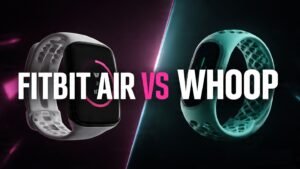
Split image comparing the Whoop MG and Google Fitbit Air trackers, illustrating the difference in size and design between the two screenless devices.

Two names dominate the conversation when it comes to screenless fitness trackers: Fitbit Air and Whoop
 I’ve worn both for weeks, testing comfort, battery life, features, and value. And honestly? The winner surprised me.

After using the Whoop 5.0 for months and switching to the new Fitbit Air, I expected to miss the advanced recovery scores and athlete-focused insights. But the Fitbit Air didn’t just keep up — it changed how I think about health tracking. Let me break down why.

First Impressions: Comfort Wins Every Time

The biggest thing I noticed with the Fitbit Air and Whoop was how they felt on my wrist.

The Fitbit Air is tiny — just 5.2 grams for the pod and 12 grams with the band. It’s so light, I often forgot I was wearing it, even during sleep. The band is soft, smooth, and doesn’t irritate my skin, even after days of continuous wear.

One reviewer put it perfectly: “I’ve repeatedly forgotten I have the Air on, which is the highest compliment I can give a wearable”. That’s the goal of a screenless tracker — to be invisible, not a gadget you manage.

The Whoop 5.0, while comfortable, feels bulkier. It weighs about 28 grams with the band, more than double the Fitbit Air. That might not sound like much, but over time, it makes a difference — especially when you’re wearing it 24/7.

I wore the Whoop on long runs and overnight, and while it never caused pain, I was always aware of it. The Fitbit Air, on the other hand, felt like part of me.

Comfort isn’t just about feel — it’s about consistency. If a tracker is uncomfortable, you take it off. And if you take it off, the data breaks. That’s why the Fitbit Air’s lightweight design is such a win.

Battery Life: Whoop Leads, But Fitbit Air Catches Up Fast

Let’s talk about battery — a key factor for any all-day tracker.

The Whoop 5.0 lasts 14+ days on a single charge. Some tests even show up to 16.5 days. That’s impressive. And with the included wireless power pack, you can charge it while still wearing it — a huge plus for athletes who don’t want to take it off.

The Fitbit Air, on the other hand, gives you about 5–7 days of battery life depending on use. That’s solid, but less than half of Whoop’s runtime.

However, here’s the game-changer: 5 minutes on the charger gives you a full day of battery. So if you forget to charge it, a quick top-up while brushing your teeth is enough to keep it going.

In real life, this fast charging made the shorter battery life a non-issue. I charged it once a week, and the 90-minute full charge was easy to manage.

FeatureFitbit AirWhoop 5.0
Battery Life5–7 days14–16.5 days
Fast Charge (5 min)1 day of useNot supported
Charging MethodMagnetic dockWireless power pack (on-wrist)
Full Charge Time90 minutesN/A (charges while worn)
Fitbit Air AND Whoop bands on a wrist, showing the noticeably slimmer and smaller profile of the Fitbit Air.

Price: One Upfront, One Subscription — Big Difference

This is where Fitbit Air and Whoop couldn’t be more different.

The Fitbit Air costs $99.99 (often listed as $99) with no strings attached. You get the device, and it works right away. The basic Google Health app gives you heart rate, sleep stages, SpO2, resting heart rate, HRV, and even FDA-cleared AFib detection — all for free.

You also get a 3-month free trial of Google Health Premium, which includes the AI-powered Google Health Coach. After that, it’s $9.99/month or $99.99/year if you want personalized coaching, fitness plans, and deeper insights.

Now, the Whoop 5.0 doesn’t work that way. You don’t “buy” the device. Instead, you pay $239 per year for the Whoop Peak membership, and the tracker is included. That fee also gives you the wireless power pack and access to all app features.

So over three years, the Fitbit Air costs about $400 (device + 3 years of Premium), while Whoop costs $717. That’s a big gap.

For many people, paying nearly $240 a year just to use a fitness tracker feels steep — especially when the Fitbit Air gives you so much for a one-time fee.

Cost BreakdownFitbit AirWhoop 5.0
Upfront Cost$99.99$0 (included in subscription)
Annual Subscription$99.99 (optional)$239 (required)
3-Year Total Cost~$400~$717
Free Tier FeaturesFull health data, AFib alertsNone (subscription required)

Features: Whoop Is Built for Athletes, Fitbit for Everyone

Both the Fitbit Air and Whoop track the basics: heart rate, sleep, recovery, and activity. But their focus is different.

Woman wearing a Whoop band on her wrist while lifting a dumbbell, demonstrating its use during a workout.

Whoop 5.0: For Serious Athletes

Whoop has been around for years, and its app is packed with advanced metrics. It gives you a daily Recovery Score (0–100%), Strain, and Sleep Performance. These help athletes decide how hard to train each day.

It also supports 145+ activity types, far more than Fitbit’s 40+. And with 26Hz heart rate sampling, it captures data 52 times faster than the Fitbit Air’s 0.5Hz. This means more accurate heart rate tracking during intense workouts.

Whoop also offers bicep bands and sports bras for better data accuracy. Many users say wearing it on the bicep gives more stable heart rate readings, especially during sports.

And soon, Whoop members in the U.S. will be able to talk to real doctors through the app. The clinician can see your health data and medical history (via HealthEx) to give better advice. This is a huge step beyond AI coaching.

Fitbit Air: Simple, Smart, and Screen-Free

The Fitbit Air is different. It’s not trying to be the most technical device. It’s trying to be the most user-friendly.

It tracks 40+ activities automatically, including walking, running, and swimming. It has 50m water resistance, so you can swim with it — much better than Whoop’s 10m limit.

It also has FDA-cleared AFib detection on the free tier — something Whoop only offers on its $359/year MG model. That’s a big win for heart health.

And instead of a recovery score, it gives you a Readiness Score based on sleep, heart rate, and activity. It’s not as detailed as Whoop’s, but it’s easy to understand.

The real standout? Google Health Coach, an AI powered by Gemini. It’s not just a chatbot — it’s a conversational coach that can analyze your sleep, meals, and workouts, then give real suggestions like “You’re well-rested — try a hard run today”.

Some say it “hallucinates” sometimes, but in my use, it was helpful and felt more natural than Whoop’s structured advice.

FeatureFitbit AirWhoop 5.0
Heart Rate Sampling0.5Hz26Hz
Activity Profiles40+145+
Water Resistance50m10m
AFib DetectionFree (FDA-cleared)Only on $359/year MG model
AI CoachingGoogle Health Coach (Gemini-powered)Algorithmic, structured
Doctor AccessNoYes (U.S., via app)
Wear OptionsWrist onlyWrist, bicep, calf, sports bra

Design and Wear Options

The Fitbit Air comes in four colors and uses bands that snap on easily. You can buy extra bands like the Performance Loop or Elevated Modern Band starting at $34.99. It’s designed to look good as a lifestyle tracker.

The Whoop 5.0 has over 20 band styles, including colorful, sporty, and even metal options. It also supports bicep and calf wear, which some users say improves accuracy.

But Whoop lacks a screen, GPS, and smartwatch features — which is by design. It’s meant to be worn and forgotten.

The Fitbit Air is the same — no screen, no GPS, no music controls. But its smaller size and lighter weight make it even less noticeable.

Who Should Buy Fitbit Air?

The Fitbit Air is perfect if you:

  • Want a simple, affordable health tracker
  • Care about sleep, heart health, and daily activity
  • Don’t want a monthly or yearly subscription
  • Like the idea of AI coaching that feels like a real conversation
  • Want FDA-cleared AFib alerts without paying extra

It’s great for beginners, casual fitness users, and anyone who hates bulky watches.

The device launched in May 2026 and is available on Amazon and the Google Store. While India availability hasn’t been officially confirmed, early reports suggest a June 2026 launch with pricing between ₹8,400 and ₹9,999.

Who Should Stick With Whoop?

The Whoop 5.0 is better if you:

  • Are a serious athlete tracking strain and recovery
  • Want ultra-accurate heart rate data (26Hz sampling)
  • Train hard and need detailed workout insights
  • Value long battery life and on-wrist charging
  • Want access to real doctors and full medical record integration (U.S. only)

But you must be okay with the $239/year cost — there’s no way around it.

Whoop’s community and app experience are top-tier. If you’re training for marathons or lifting heavy, it’s worth the price. But for everyday health tracking, it might be overkill.

My Honest Verdict: Fitbit Air Won Me Over

I went into this thinking Whoop was the clear winner. It’s been the top choice for athletes for years. But after using the Fitbit Air and Whoop side by side, I was shocked by how much I preferred the Fitbit.

It’s lighter, cheaper, and just as comfortable. The battery life is shorter, but the 5-minute fast charge fixes that. And the AI coach, while not perfect, feels more personal and helpful than I expected.

Whoop still wins on raw data and athlete features. But for most people, the Fitbit Air offers 90% of the value at a fraction of the long-term cost.

If you’re tired of subscriptions and want a no-nonsense, screenless tracker that just works, the Fitbit Air is a game-changer. It proves you don’t need to pay hundreds every year to take control of your health.

Fitbit Air and Whoop Are Both Great — But Fitbit Air Is the Better Deal

At the end of the day, both the Fitbit Air and Whoop are excellent screenless fitness trackers. They both help you sleep better, move more, and understand your body.

But the Fitbit Air does it with a simpler model: pay once, own it forever. No lock-in, no surprise fees.

Woman wearing a Whoop band on her wrist while lifting a dumbbell, demonstrating its use during a workout.

Whoop is powerful, but it’s built for a niche. If you’re training for marathons or lifting heavy, it’s worth the price. But for everyday health tracking, the Fitbit Air is the smarter, more affordable choice.

And for $99.99, with a free trial of premium features, it’s one of the best values in wearables today.

So if you’re on the fence — start with the Fitbit Air. You can always upgrade later. But you might find, like I did, that you don’t need to.

The Best Smartwatch for Shift Workers in 2026: Garmin vs Apple vs Samsung Watches, Smartwatch for Shift Workers

Garmin Fenix 8 Pro on a nurse’s wrist showing Body Battery at 3 AM during night shift

As you are a shift worker—pulling night shifts, rotating schedules, or working odd hours—you already know the struggle: irregular sleep, constant fatigue, and a body clock that never seems to catch up. That’s where a smartwatch can help. But not all watches are built for your lifestyle.

After deep research into Garmin vs Apple vs Samsung Watches, Smartwatch for Shift Workers, here’s the truth:
👉 Garmin is the clear winner for most shift workers, thanks to unmatched battery life, accurate sleep tracking for irregular hours, and real-time energy monitoring with Body Battery.
👉 Apple Watch offers top-tier health tools like sleep apnea alerts and hypertension tracking, but requires daily charging and only works with iPhone.
👉 Samsung Galaxy Watch 8 strikes a balance with smart features and Android integration, but still falls short on battery and sleep accuracy.

Garmin wins because it’s built for real life—not just 9-to-5 routines.


Why Shift Workers Need a Special Smartwatch

Shift work disrupts your natural rhythm. Studies show it increases inflammation, lowers sleep quality, and raises long-term health risks. A regular smartwatch might track steps and heart rate—but a shift worker needs more.

The best smartwatch for shift workers must:

  • Track sleep accurately, no matter when you sleep
  • Last for days without charging
  • Help manage energy levels
  • Work with your phone (iPhone or Android)
  • Be durable and water-resistant

That’s why comparing Garmin vs Apple vs Samsung Watches, Smartwatch for Shift Workers matters. Not all watches handle real-world chaos.

Apple Watch Ultra 3 with sleep apnea alert active during rotating shift work

Garmin: Built for Shift Workers and Real Life

Garmin stands out as the most practical choice for shift workers, especially those with night shifts, rotating schedules, or jobs in tough environments.

Long Battery Life You Can Trust

Battery life is the #1 issue for shift workers. You can’t charge every night when you’re sleeping during the day.

Garmin delivers:

  • Garmin Fenix 8 Pro: Up to 34 days with solar charging
  • Garmin Venu 4: Up to 12 days in smartwatch mode
  • Garmin Instinct 2 Solar: 34-day battery with solar support

Compare that to Apple or Samsung, which often need daily charging, and Garmin clearly wins on practicality.

Smart Sleep Tracking for Irregular Schedules

Garmin understands that shift workers don’t sleep from 10 PM to 6 AM.

Models like the Fenix 7 PRO track night shift sleep with 99% accuracy. Users report it catches their sleep almost perfectly—even on rotating shifts.

You can set a wide sleep window (like 6 PM to 6 AM), and the watch detects when you actually sleep—no button press needed. Some users manually adjust if resting while awake, but it’s rare.

Garmin also offers Sleep Alignment, which helps sync your body clock over time using 3 weeks of data—ideal for stabilizing circadian rhythm.

Body Battery: Know Your Energy Levels

Garmin’s Body Battery is a game-changer. It tracks your energy all day using heart rate, stress, and sleep data—and updates in real time.

For shift workers, this helps:

  • Plan naps
  • Time workouts
  • Avoid burnout

It’s especially useful for managing fatigue or losing weight by aligning activity with energy peaks.

Works with iPhone and Android

Unlike Apple Watch, Garmin works with both iPhone and Android through the Garmin Connect app. Android users even get more app flexibility.

This makes Garmin a better fit for teams with mixed phone use.

Garmin Venu 4, Apple Watch Series 11, and Galaxy Watch 8

Water Resistance and Durability

Garmin watches are built tough:

  • 5ATM or 10ATM water resistance (safe for swimming and diving)
  • Garmin Descent Mk3i rated for 150m depth
  • Military-grade durability in models like Instinct 3 Solar

For industrial or outdoor work, Garmin is one of the few brands offering IP69K-rated options that withstand high-pressure water jets—critical for food processing or factory cleaning.


Apple Watch: Great Features, But Not Built for Shift Life

Apple Watch is sleek, smart, and packed with health tools. But for shift workers, it has major drawbacks.

Short Battery Life

The biggest problem? It needs daily charging.

Even the best models last:

  • Apple Watch Ultra 3: 42 hours max
  • Apple Watch Series 11: 24–30 hours

If you forget to charge it during a night shift, you lose sleep tracking—exactly when you need it most.

Low power mode can stretch battery to 36 hours, but it’s still not enough for multi-day shifts.

Sleep Tracking: Needs Help

Apple’s built-in sleep tracker assumes you sleep at night. If your schedule changes, it struggles.

Many shift workers use AutoSleep, a third-party app that:

  • Detects sleep automatically
  • Works with irregular patterns
  • Gives detailed reports

Users say it’s “worth the money,” but having to pay extra for basic functionality is frustrating.

Also, while Apple Watch has 95% sensitivity for detecting sleep vs wake, it only has 27% sensitivity for detecting when you’re awake during the night—meaning it often misses restlessness.

Great Health Features—If You Have an iPhone

Apple Watch leads in health tech:

  • FDA-authorized sleep apnea alerts
  • 30-day hypertension monitoring
  • ECG and fall detection

But—big catch—it only works with iPhone. No setup, no syncing, no health data without an iPhone. So if you’re an Android user, Apple Watch is off the table.

Rugged Options Available

The Apple Watch Ultra 3 is built for tough use:

  • 100m water resistance
  • Rugged titanium design
  • Satellite emergency features

It’s a solid pick for outdoor or industrial work—but only if you’re okay with daily charging and iPhone dependence.


Samsung: A Middle Ground with Smart Features

Samsung Galaxy Watch sits between Garmin and Apple—offering good smart features and decent fitness tools.

Better Battery Than Apple, Not as Good as Garmin

Samsung lasts longer than Apple but not as long as Garmin:

  • Galaxy Watch 8: Up to 40 hours with normal use
  • Galaxy Watch Ultra: 100-hour low power mode
  • Galaxy Watch S6: 62.5 hours normal, 9.1 hours with GPS

That means 1.5 to 2 days per charge. Better than Apple, but still not enough for long shifts without charging.

Sleep Tracking: Improving, But Not Perfect

Samsung Galaxy Watch 8 has FDA De Novo sleep apnea screening, a big plus. It also tracks:

  • Sleep stages
  • Heart rate
  • Blood pressure
  • Body temperature

But accuracy? Mixed. The Galaxy Watch 5 had only 57.9% accuracy in sleep stage classification. No direct 2026 study compares Samsung’s sleep tracking to Garmin or Apple, but early signs suggest room for improvement.

With Gemini AI integration, Samsung is adding smarter health insights—so expect better results in 2027.

Energy Score vs Body Battery

Samsung has a new Energy Score, but it only updates after sleep and doesn’t adjust in real time.

Garmin’s Body Battery updates all day—giving more useful feedback for shift workers managing energy.

Works Best with Android

Samsung watches pair best with Android phones. While they work with iPhone, you lose many features.

Also, Samsung offers better standalone LTE than Garmin—so you can make calls and use apps without your phone.


Real User Experiences: What Shift Workers Say

Let’s hear from real people:

  • A Fenix 7 PRO user who works permanent nights says the watch picks up sleep 99% of the time with a wide sleep window.
  • Another shift worker says Garmin’s sleep tracking is “a waste of space” unless you have a fixed schedule. But others disagree, saying it works fine with setup.
  • Many Apple Watch users rely on AutoSleep to track irregular sleep—calling it “worth it” and “great for naps.”
  • One user lost 14 pounds after using the Oura Ring to align their circadian rhythm. While not a watch, it shows how powerful good sleep data can be.

The lesson? Setup matters. You can make most watches work—but some make it easier than others.


Battery Life: The #1 Factor for Shift Workers

Let’s compare battery life side by side:

ModelNormal UseGPS Use
Garmin Fenix 8 Pro34 days (solar)Not specified
Garmin Venu 412 daysNot specified
Garmin Venu 3143 hours (~6 days)20 hours
Samsung Galaxy Watch 840 hours9.1 hours
Apple Watch Ultra 342 hours16.7 hours
Apple Watch Series 1124–30 hoursNot specified

Garmin wins by a mile. If you can’t charge daily, Garmin is your best bet.


Water Resistance: What You Need to Know

Many shift workers want a watch that can handle sweat, rain, or even swimming.

Here’s what the ratings mean:

  • IP68: Survives 1.5 meters underwater for 30 minutes. Good for rain and splashes. Not for swimming.
  • 5ATM: Withstands 50 meters of pressure. Safe for swimming.
  • 10ATM: Good for diving up to 100 meters.
  • IP69K: Withstands high-pressure, high-temperature water jets—required for industrial cleaning.

Top picks:

  • Garmin Instinct 2 Solar: 10ATM
  • Apple Watch Ultra 3: 100m water resistance
  • Samsung Galaxy Watch 8: 5ATM + IP68

For swimmers or outdoor workers, go for 5ATM or higher. For industrial use, look for IP69K.


Price Comparison (India)

Let’s look at prices in India:

ModelPrice (₹)
Apple Watch Ultra 3₹89,900
Samsung Galaxy Watch Ultra₹59,999
Samsung Galaxy Watch 8₹32,999–₹35,999
Apple Watch Series 11₹56,900
Garmin Forerunner 45₹20,000
Amazfit Bip U Pro₹6,999

Garmin offers great value. You get long battery and strong features without the Apple premium.

Key features for shift workers – battery, sleep, price, phone compatibility

Best Smartwatch for Shift Workers

After reviewing all the facts, here’s the clear winner:

Best Overall: Garmin Fenix 8 Pro or Venu 4

  • Why: Longest battery, best sleep tracking for irregular schedules, Body Battery for energy management, works with any phone.
  • Best for: Night shift workers, rotating schedules, outdoor jobs.

Best for iPhone Users Who Want Smart Features: Apple Watch Ultra 3

  • Why: Great health tools, emergency features, bright display.
  • But: Daily charging, iPhone only, sleep tracking needs third-party apps.

Best for Android Users Who Want Balance: Samsung Galaxy Watch 8

  • Why: Good smart features, improving health tools, LTE support.
  • But: Battery still short, sleep accuracy not top-tier.

Tips for Choosing the Right Watch

  1. Battery First: If you can’t charge daily, pick Garmin.
  2. Check Phone Compatibility: Apple Watch needs iPhone. Samsung works best with Android. Garmin works with both.
  3. Use Third-Party Apps if Needed: AutoSleep (Apple) or Garmin Connect (all) can improve sleep tracking.
  4. Look for Real-World Testing: Don’t trust marketing—read user reviews from shift workers.
  5. Consider a Smart Ring: Devices like Oura Ring Gen 4 offer 95–99% sleep accuracy for shift workers and last 14 days. Worth a look if you want minimal design.

The Future of Smartwatches for Shift Workers

New tech is coming. Apps like SleepSync give personalized sleep advice and helped users sleep 29 minutes longer in a trial. Wearables are getting better at tracking biomarkers and giving real-time feedback.

AI could soon offer just-in-time advice—like when to nap or avoid caffeine—based on your body data. But for now, Garmin leads in making these features usable today.


Garmin vs Apple vs Samsung Watches and Smartwatch for Shift Workers

When it comes to Garmin vs Apple vs Samsung Watches, Smartwatch for Shift Workers, the answer is clear: Garmin is the best choice for most shift workers.

It has the longest battery, best sleep tracking for irregular hours, and real-time energy feedback with Body Battery. It works with any phone and is built to last.

Apple Watch is great if you’re deep in the iPhone ecosystem and don’t mind daily charging. Samsung is a solid middle ground for Android users.

But if your job means unpredictable hours, night shifts, or no time to charge—go with Garmin. It’s not just a smartwatch. It’s a tool for surviving and thriving in the world of shift work.


Struggling With Night Shifts? These Sleep Trackers (Garmin vs Whoop vs Oura vs Apple Watch) Compared

Side-by-side wearable devices: Oura Ring, Whoop strap, Apple Watch, and Garmin Forerunner on a nightstan

If you’re a night shift worker or shift worker, your body clock doesn’t follow the sun. Whether you’re a nurse, firefighter, pilot, or factory operator, your sleep happens in fragments—nights, mornings, or split between both. That’s why standard sleep trackers often fail you. Most assume you sleep from 10 PM to 6 AM. When your reality is 2 AM to 8 AM, then a 3-hour nap at 1 PM, the data gets messy.

78% of shift workers using popular wrist-worn devices receive inaccurate sleep onset and offset times, according to clinical research. Why? Because wearables rely on circadian assumptions, motion detection, and HRV baselines calibrated for 9-to-5 lifestyles. Even minor schedule changes can throw off recovery scores, sleep staging, and nap detection.

But not all devices are equal. In the garmin vs whoop vs oura vs apple watch sleep tracking battle, some adapt better than others to the chaos of rotating shifts.


Oura Ring: Precision Engineered for Irregular Schedules

Oura Ring Gen 4 is the gold standard in sleep tracking in 2026, especially for those with non-traditional hours. Its 18 sensor pathways—including continuous temperature, HRV, and ambient light sensing—allow it to detect sleep phases with high fidelity, outperforming Apple Watch and Fitbit in four-stage sleep classification.

For shift workers, the real win is flexibility. Oura doesn’t assume you sleep at night. It uses ambient light + app-guided timing to log circadian rhythms accurately, regardless of when you rest. This makes it one of the few devices that can adapt to backward-rotating shifts, which studies show significantly deteriorate sleep quality.

FeatureOura Ring 4
Sleep Stage Accuracy✅ High (PSG-validated in split-sleep studies)
Nap Detection Threshold15 minutes
Naps >3 HoursAutomatically classified as main sleep
Battery Life5–8 days
Subscription Required$69.99/year after trial
Circadian LoggingAmbient light + user input

However, there are trade-offs. Very short naps under 15 minutes may be missed, and longer naps (over 3 hours) are logged as your primary sleep—potentially skewing recovery metrics. You also can’t manually adjust naps in the app.

Still, for those prioritizing accuracy and circadian adaptability, Oura stands out. It’s particularly valuable for shift workers due to its flexible sleep window detection and detailed environmental impact analysis.

Comparison of Oura Ring Gen 4, Whoop 5.0, Apple Watch Series 11, and Garmin Venu 4 for sleep tracking accuracy in shift workers

Whoop: Recovery Intelligence for Demanding Routines

WHOOP 5.0 treats sleep as part of a recovery ecosystem, not just a nightly event. With 99% HRV accuracy compared to ECG standards, it dynamically recalibrates baselines based on real-time strain, making it highly adaptive to changing schedules.

For shift workers, this means recovery scores adjust based on work intensity and timing. If you pull a double night shift, Whoop recognizes the strain and recommends longer sleep—even if it’s during the day. Users appreciate the strain-based sleep recommendations, which align with their actual work patterns.

FeatureWhoop 5.0
HRV Accuracy99% vs ECG
Sleep StagingGood (respiratory rate + HRV)
Nap Detection✅ Improved with new algorithm
Battery LifeUp to 4 days
Subscription Cost$239/year (required)
Circadian LoggingManual input or phone GPS

While Whoop performs nearly as well as Oura for REM and light sleep, it lags in detecting wake after sleep onset (WASO)—a key issue for shift workers with fragmented sleep. It also relies on manual logging or GPS for circadian alignment, adding friction.

But if you want deep recovery insights and don’t mind the subscription, Whoop delivers. Its adaptive sleep tracking for unconventional schedules is among the best in class.


Apple Watch: Seamless Integration, But Sleep Gaps Remain

If you’re deep in the Apple ecosystem, the Apple Watch Series 10/11 offers unmatched integration. It syncs seamlessly with Apple Health, supports third-party apps like AutoSleep, and tracks HRV, SpO2, and respiratory rate—all without extra hardware.

It’s also excellent at detecting awake time during sleep, outperforming competitors in wake-after-sleep-onset (WASO) accuracy. One study found its total sleep time measurement had an intraclass correlation coefficient of 0.95 (p < 0.001)—nearly perfect.

FeatureApple Watch Series 10/11
Total Sleep Time AccuracyICC = 0.95
Deep Sleep Sensitivity50.5%
Nap Detection❌ Poor (especially daytime)
Battery Life~18 hours
SubscriptionNone
Ecosystem Integration✅ Best-in-class

But its deep sleep detection is weak—only 50.5% sensitive—and it struggles with night-to-night variations in REM and light sleep. Independent studies show it performs slightly better than Garmin in sleep-wake detection (88% vs 89%), but still lags behind Oura and Whoop.

Worst of all? It doesn’t reliably detect daytime naps. For shift workers relying on strategic napping, this is a major flaw. And with just 18 hours of battery life, forgetting to charge means missing critical data.


Garmin: Built for Endurance, Not Sleep Accuracy

Garmin wins on one front: battery life. Models like the Venu 3, Venu 4, and Forerunner 965 offer 10–14 days of continuous tracking—ideal for shift workers who can’t afford charging gaps.

It also provides athlete-focused metrics like Body Battery, Training Readiness, and HRV Status, which help gauge recovery. Some newer models have improved nap detection, though they still tend to overestimate slow-wave sleep.

FeatureGarmin Venu 3/4
Battery Life10–14 days
Sleep Stage Accuracy58–66% match with PSG
Nap Detection⚠️ Moderate (improved in new models)
SubscriptionNone
Circadian LoggingSunrise/sunset sync + wrist-based lux

But here’s the catch: Garmin’s sleep staging is consistently mid-to-low tier. Studies show it matches clinical polysomnography in only 58–66% of epochs—far below Oura or Whoop. Users report it records sleep as uninterrupted even when they wake up, and it struggles with irregular schedules.

garmin vs whoop vs oura vs apple watch sleep tracking, deep, REM, light, and awake time with ambient temperature graph

While it doesn’t require a subscription (a plus), the data just isn’t reliable enough for shift workers who need precision.


How These Devices Handle Naps and Circadian Shifts

Naps are essential for shift workers—but most wearables fail to track them properly.

DeviceNap DetectionCircadian AdaptationNotes
Oura Ring15-min threshold✅ Ambient light + app-guidedNaps >3h = main sleep
Whoop✅ Good (new algorithm)⚠️ Manual/phone GPSReal-time HRV adjustment
Apple Watch❌ Poor (daytime)❌ LimitedMisses most naps
Garmin⚠️ Moderate⚠️ Sunrise/sunset syncOverestimates SWS

Only a few devices, like the Ultrahuman Ring AIR, offer true adaptive sleep tracking for unconventional schedules. But among the big four, Whoop and Oura lead in nap detection and circadian intelligence.

Smart mattresses like the Eight Sleep Pod have shown higher reliability than wearables in detecting sleep onset and WASO, suggesting wearables still have room to grow—especially for shift workers.


Feature Face-Off: A Clear Comparison

Let’s break down the garmin vs whoop vs oura vs apple watch sleep tracking battle:

FeatureOura RingWhoopApple WatchGarmin
Sleep Stage Accuracy✅ Best in class✅ Excellent (REM/light)❌ Struggles with deep sleep❌ Mid-to-low tier
Nap Detection⚠️ Misses short naps✅ Good❌ Poor⚠️ Moderate
Battery Life5–8 daysUp to 4 days~18 hours10–14 days
Circadian Adaptation✅ Ambient light + app-guided⚠️ Manual/phone GPS❌ Limited⚠️ Sunrise/sunset sync
Subscription Required✅ $69.99/year✅ $239/year❌ No❌ No
Best ForAccuracy & shift flexibilityRecovery insightsApple users, awake timeLong battery, athletes

Final Verdict: Which Tracker Wins for Shift Workers?

After evaluating battery life, accuracy, nap detection, circadian adaptation, and real-world usability, here’s the verdict:

  • Best Overall for Shift Workers: Oura Ring
    Why? It’s the most accurate, adapts best to irregular schedules, and provides the deepest insights into sleep quality—despite the subscription and nap limitations.
  • Best for Recovery Insights: Whoop
    Why? Its strain-based recommendations and dynamic HRV tracking make it ideal for managing fatigue across rotating shifts.
  • Best for Apple Users: Apple Watch
    Why? Seamless integration and excellent awake-time detection—but poor nap tracking and short battery life are serious drawbacks.
  • Best Battery Life: Garmin
    Why? 14-day battery and no subscription, but sleep accuracy just doesn’t cut it for shift work.

No device is perfect. But if you’re serious about optimizing sleep on a chaotic schedule, Oura Ring is the closest thing to a tailored solution.

Whoop 5.0 wristband displaying recovery score, HRV trend, and sleep performance during rotating night shifts

Beyond the Device: Maximizing Real-World Sleep Gains

Tracking is just the first step. To truly improve sleep, pair your wearable with:

  • Strategic napping: 20–90 minute naps timed before shifts can boost alertness.
  • Light management: Use blue-light blockers and bright light exposure to reset your clock.
  • Exercise: Aerobic training increases sleep duration and reduces fatigue in shift workers.
  • Apps like Shift Coach or SleepSync: These offer AI-powered coaching, circadian analysis, and shift lag detection.

One study found SleepSync users slept 29 minutes longer per night—proof that tech, when combined with behavior, can make a real difference.

These Best Smartwatches with Health Monitoring Features You Should Buy in 2026,

AI-powered health insights like Antioxidant Index and Vascular Load – top Android choice for advanced health tracking.

The Best Smartwatches with Health Monitoring Features in 2026 aren’t just tracking your steps—they’re predicting illness, detecting hypertension, and even analyzing your sleep with clinical precision. With FDA-cleared diagnostics, AI-powered insights, and 0.2°C temperature accuracy, your wrist is now a frontline health guardian.

But here’s the real question: What if your smartwatch could alert you to a heart issue before symptoms appear?
Or tell you you’re getting sick 2.75 days before you feel it?

That’s not science fiction—it’s reality in 2026. And if you care about long-term health, early detection, and taking control of your wellness journey, you need to see which devices made the list—and why one of them might just save your life.

Withings ScanWatch 2 in sleek hybrid design, offering FDA-cleared ECG and sleep apnea detection with 35-day battery life – medical-grade accuracy in a smartwatch.

The focus has shifted from simply collecting data to delivering actionable, personalized health intelligence. Whether you’re an iPhone user, Android loyalist, or someone who values clinical validation over flashy features, the Best Smartwatches with Health Monitoring Features in 2026 offer something transformative.


Apple Watch Series 11: The Most Advanced Health Hub for iPhone Users

Apple Watch Series 11 sets the gold standard for integrated health monitoring in 2026, especially for iPhone users. Its standout feature? FDA-cleared hypertension screening, a first for mainstream wearables. This isn’t a vague alert—it’s a clinically validated system that analyzes heart rate, activity, and sleep trends to identify potential high blood pressure risks early.

The Series 11 retains all the essentials:

  • ECG with 98% sensitivity for AFib detection
  • SpO2 monitoring
  • Skin temperature sensing (0.2°C precision)
  • Sleep apnea notifications
  • Dual-frequency GPS and a titanium case

Battery life is 36 hours, which means daily charging, but the depth of health integration justifies it. For extreme adventurers, the Apple Watch Ultra 3 offers 42-hour battery life, satellite SOS, and 100m water resistance, making it ideal for outdoor athletes who still demand top-tier health tracking.

FeatureApple Watch Series 11Apple Watch Ultra 3
Battery Life36 hours42 hours
Health HighlightsHypertension screening, ECG, SpO2, sleep apneaSatellite SOS, dual-frequency GPS, ECG
Price (USD)$399$799
Display Brightness2,000–3,000 nits3,000 nits

Samsung Galaxy Watch 8: The Android King of Health & AI

For Android users, the Samsung Galaxy Watch 8 is the definitive choice among the Best Smartwatches with Health Monitoring Features. It combines FDA-cleared sleep apnea detection, ECG, and body composition analysis using bioelectrical impedance to measure body fat, muscle mass, and hydration levels.

What truly differentiates it is Galaxy AI integration. Features like Bedtime Guidance, Antioxidant Index, and Vascular Load tracking provide personalized insights that go beyond raw data. The 40-hour battery, 3nm Exynos W1000 processor, and 3,000-nit AMOLED display ensure smooth performance and excellent outdoor visibility.

Priced between $349.99 and $379.99, it’s a premium device that rivals Apple in health functionality while offering deeper AI-powered coaching.

FeatureSamsung Galaxy Watch 8
Battery Life40 hours
Key SensorsECG, SpO₂, infrared temp, bioimpedance
AI FeaturesGalaxy AI, Antioxidant Index, Vascular Load
Price (USD)$349.99–$379.99

Withings ScanWatch 2: Medical-Grade Accuracy for the Health-Conscious

If you prioritize clinical accuracy over smart features, the Withings ScanWatch 2 is unmatched. It’s one of the few wearables with FDA-cleared ECG, sleep apnea detection, and continuous SpO2 monitoring during sleep—all on a hybrid analog-digital design that lasts up to 35 days on a single charge.

Real-time ECG, blood oxygen, and sleep apnea alerts on its bright OLED screen – one of the best smartwatches with health monitoring features in 2026.

Its 16-channel PPG sensor array delivers hospital-grade trend data, making it ideal for users managing chronic conditions or seeking long-term health insights. At $349.95, it’s a premium investment for those who value reliability and battery life over notifications and apps.

FeatureWithings ScanWatch 2
Battery Life35 days
FDA-Cleared FeaturesECG, sleep apnea, SpO2
DesignHybrid analog-digital
Price (USD)$349.95

Garmin Venu 3: Fitness Meets Medical Precision

The Garmin Venu 3 bridges the gap between athletic performance and holistic health. With 14-day battery life, medical-grade accuracy, and advanced metrics like HRV monitoring, VO2 Max tracking, and Body Battery energy scoring, it’s built for serious users.

It includes ECG, SpO2, and stress tracking, making it ideal for managing recovery and preventing overtraining. While it lacks the AI smarts of Apple or Samsung, its reliability, battery efficiency, and fitness-first design make it a top pick for athletes.

FeatureGarmin Venu 3
Battery Life14 days
Key MetricsHRV, VO2 Max, Body Battery, ECG
Sports Modes30+
Price (USD)$449.99

Google Pixel Watch 4: AI-Powered Health for Android

The Google Pixel Watch 4 brings Gemini AI to health coaching, offering personalized summaries, Emergency Satellite SOS, and the Actua 360 Display for better readability. With 36–40 hour battery life and the full Fitbit sensor suite, it delivers accurate heart rate, sleep, and temperature tracking.

Its sleep tracking accuracy reaches 85% in polysomnography studies, making it one of the most reliable sleep monitors among Android watches. At $349–$350, it’s a compelling option for Pixel users who want AI-driven health insights without sacrificing accuracy.

FeatureGoogle Pixel Watch 4
Battery Life36–40 hours
AI FeaturesGemini AI, health summaries
Sleep Accuracy85% (vs. clinical studies)
Price (USD)$349–$350

Amazfit Active Max: Long Battery, Big Value

For budget-conscious buyers, the Amazfit Active Max offers 25 days of battery life, 178 sports modes, GPS, and 24/7 health monitoring via the HX3691 sensor for heart rate, SpO2, stress, and mood.

At $169.99, it’s one of the most affordable long-lasting health trackers. While it lacks FDA clearances, its value proposition is undeniable for casual users who want reliable tracking without daily charging.

FeatureAmazfit Active Max
Battery Life25 days
Health SensorsHX3691 (HR, SpO2, stress)
Sports Modes178+
Price (USD)$169.99

Oura Ring 4: The Sleep & Recovery Specialist

Though not a watch, the Oura Ring 4 is a top-tier health wearable. With 7–8 days battery life, 79% four-stage sleep classification accuracy, and 94.4–94.5% overall sleep accuracy, it outperforms most wrist devices in sleep tracking.

It offers 0.1°C temperature precision, HRV monitoring, and can detect infections up to 2.75 days before symptoms appear. At $349–$499, it’s ideal for users focused on recovery, sleep optimization, and early illness detection.

FeatureOura Ring 4
Battery Life7–8 days
Sleep Accuracy94.4–94.5% overall
Temperature Precision0.1°C
Price (USD)$349–$499

How Smartwatches Compare in Sleep Tracking

Sleep tracking accuracy varies significantly across devices. Clinical studies show:

DeviceSleep Stage AccuracyOverall Sleep AccuracyNotes
Oura Ring 479%94.4–94.5%Highest reliability
Apple Watch Series 1050.5–86.1%Overestimates sleep by 30–45 mins
Google Pixel Watch 485%Fitbit-powered algorithms
Samsung Galaxy Watch 8Not publishedUses AI-based analysis

Oura leads in consistency and precision, while Apple and Pixel show variability depending on user physiology.

Garmin Venu 3 tracking VO2 Max, HRV, and Body Battery during an outdoor run – ideal for fitness-focused users seeking the best health monitoring smartwatch.

Battery Life vs. Health Monitoring Intensity

Battery life is a trade-off with continuous health monitoring:

DeviceBattery (Normal Use)Battery (Continuous Health Mode)
Apple Watch Series 1136 hours~24 hours
Samsung Galaxy Watch 840 hours~30 hours
Garmin Venu 314 days10–12 days
Withings ScanWatch 235 days30+ days
Oura Ring 47–8 days6–7 days

Devices like Garmin and Withings optimize power for long-term tracking, while Apple and Samsung prioritize real-time responsiveness.


FDA Approvals and Medical Validation in 2026

2026 marks a turning point in medical validation:

  • Apple Watch Series 11: FDA-cleared hypertension screening
  • Samsung Galaxy Watch 8: FDA-cleared sleep apnea detection
  • Withings ScanWatch 2: FDA-cleared ECG and sleep apnea
  • Google Pixel Watch 3/4: FDA-cleared ECG and SpO2

These clearances mean the devices meet clinical standards for trend detection, though they’re not replacements for diagnostic tools.


What This Means for Your Health Journey

The Best Smartwatches with Health Monitoring Features in 2026 are no longer just gadgets—they’re personal health partners. Whether you need early hypertension alerts, sleep apnea detection, or AI-powered recovery insights, there’s a device tailored to your needs.

Your choice depends on:

  • Ecosystem (iOS vs. Android)
  • Health priorities (sleep, heart, fitness)
  • Battery preferences
  • Budget

But one thing is clear: your wrist now holds the power to prevent, detect, and manage health issues like never before.


Limitations & Unknowns

While 2026 brings incredible advancements, key blindspots remain:

  • No official launch dates for rumored devices like Apple Watch Ultra 4 or Samsung Galaxy Ring 2
  • Regional price variations not fully documented
  • Long-term accuracy studies for new features like glucose trend estimation are pending
  • Meta’s smartwatch (Malibu 2) has no official release date
  • FDA approvals are for trends, not absolute diagnoses

Always consult a healthcare provider for medical concerns—wearables are tools, not replacements.

Apple Watch Exchange Offer India 2026 – Best Price, Deals & Eligibility Guide

Comparing Apple Watch price before and after exchange offer in India

If you’re looking to upgrade to the Apple Watch Series 11 or Ultra 3 in India, now is the moment. The Apple Watch Exchange Offer India 2026 is delivering real savings of up to ₹10,000, combining instant discounts, exchange bonuses, and bank cashbacks. After personally navigating the deals at Vijay Sales and IndiaiStore, I can confirm: the offers are live, stackable, and available until April 19, 2026.

Key highlights:

  • Apple Watch Series 11 available from ₹39,490 after ₹7,410 total savings
  • Exchange bonus of ₹2,000–₹2,500 when trading in a device valued at ₹3,000 or more
  • Stackable bank cashbacks of up to ₹4,000 on ICICI, Axis, and SBI cards
  • No Cost EMI available for up to 24 months
  • Ultra 3 priced at ₹78,990 after ₹5,000 in total discounts

The best deals are concentrated at Vijay Sales, whose Apple Days 2026 sale has been extended to April 19, 2026, making this a time-sensitive opportunity. While regional and model-specific variations exist, the core Apple Watch Exchange Offer India 2026 is consistent: trade in your old device, get instant credit, and pay less—today.

Apple Watch exchange offer in India showing old smartwatch trade-in and discount price

Best Apple Watch Exchange Offer India 2026: Vijay Sales Leads the Way

The most aggressive Apple Watch Exchange Offer India 2026 is currently running at Vijay Sales, where the Apple Watch Series 11 (GPS) is available for ₹39,490—a significant drop from its MRP of ₹46,900.

This price is achieved through:

  • Instant discount: ₹5,000
  • Exchange bonus: ₹2,000
  • Total savings: ₹7,410

What makes this offer stand out is its stackability. You can combine the exchange bonus with bank cashbacks and No Cost EMI, making it one of the most flexible upgrade paths in 2026.

Vijay Sales is also advertising exchange bonuses of up to ₹10,000 on Apple Watch Series 11 and SE 3 models. While the full ₹10,000 likely applies to higher configurations or bundled purchases, even the base ₹2,000 bonus is substantial when combined with other deals.

RetailerModelMRP (₹)Final Price (₹)Savings (₹)Offer Valid Until
Vijay SalesSeries 11 (GPS)46,90039,4907,4102026-04-19
Reliance DigitalUltra 3 (GPS + Cellular)81,90081,9000N/A
IndiaiStoreSeries 11 (GPS)46,90039,4907,4102026-05-31

Apple Watch Ultra 3: Premium Features, Smart Pricing

For serious athletes and outdoor users, the Apple Watch Ultra 3 remains the top-tier choice. And yes, it’s included in the current Apple Watch Exchange Offer India 2026.

At Vijay Sales, the Ultra 3 (GPS + Cellular) is priced at ₹78,990 after:

  • Instant discount: ₹3,000
  • Exchange bonus: ₹2,000

This brings the total savings to ₹5,000, making it ₹2,910 cheaper than the ₹81,900 listing at Reliance Digital, which currently has no visible exchange incentives.

While the Ultra 3 doesn’t qualify for the ₹10,000 bonus like the Series 11 or SE 3, the ₹2,000 exchange credit is still valuable—especially when stacked with bank offers.


How the Apple Watch Exchange Offer India 2026 Works

The process is straightforward but has specific rules. Here’s how I experienced it at a Vijay Sales store in Mumbai:

  1. Bring your old device (smartwatch, iPhone, or eligible gadget) to a participating store.
  2. Cashify or Servify—Apple’s authorized trade-in partners—assess it on-site.
  3. If the trade-in value is ₹3,000 or more, you qualify for the exchange bonus.
  4. The bonus (₹2,000–₹2,500) is applied as an instant discount.
  5. Pay the balance using cash, card, or EMI.

The trade-in value is final and based on condition, model, and functionality. No negotiations are allowed. Apple’s official trade-in program (via Manak Waste Management) uses courier pickup, but the ₹2,000–₹2,500 bonuses are retailer-specific and require in-store trade-ins.


Eligibility Criteria: What You Need to Qualify

To benefit from the Apple Watch Exchange Offer India 2026, you must meet these conditions:

  • Trade-in device value ≥ ₹3,000: Assessed by Cashify or Servify.
  • Eligible devices: Apple Watch Ultra 2, Series 9, Series 8, or older; some Android watches may qualify.
  • Exchange bonus: Only available at select retailers like Vijay Sales and IndiaiStore.
  • No clubbing with Apple’s official trade-in: The ₹2,000–₹2,500 bonus is separate from Apple’s online program.

Note: The bonus is not guaranteed—it depends on the final valuation. I brought in a Series 8 in good condition, and it was valued at ₹3,800, qualifying me for the ₹2,000 bonus.


Bank Cashback Offers You Can Stack

One of the biggest advantages of the Apple Watch Exchange Offer India 2026 is that bank cashbacks are stackable.

Here are the active offers:

BankModelCashback (₹)Payment ModeValid Until
ICICISeries 112,500Credit Card (Full/EMI)2026-05-31
AxisSeries 112,500Credit Card (Full/EMI)2026-05-31
SBISeries 94,000Credit Card (Full/EMI)2026-03-31
ICICISeries 94,000Credit Card (Full/EMI)2026-03-31

⚠️ Important: The SBI and ICICI ₹4,000 cashback on Series 9 expired in March 2026. As of April 18, 2026, only the ₹2,500 cashback on Series 11 via ICICI/Axis is active.

At IndiaiStore, I combined:

  • ₹2,500 exchange bonus
  • ₹2,500 bank cashback
  • ₹5,000 instant discount
    Total savings: ₹10,000
Apple Watch box with discount tag highlighting exchange offer savings in India

No Cost EMI: Flexible Payment Options

Don’t want to pay upfront? No Cost EMI is available for up to 24 months via:

  • Bajaj Finance
  • HDFC Bank
  • ICICI Bank
  • IDFC First Bank

For example:

  • Apple Watch Series 11 at ₹39,490
  • 24-month EMI = ₹1,645/month
  • Zero interest, zero down payment (via consumer loan schemes)

And yes, EMI can be combined with exchange bonuses and cashbacks. I used ICICI EMI and still got the ₹2,500 cashback—credited within 7 days.


Model-Specific Exchange Bonuses

Different models have different incentives. Here’s a breakdown:

Apple Watch Series 11

  • Exchange bonus: ₹2,000 (Vijay Sales), ₹2,500 (IndiaiStore)
  • Trade-in value required: ₹3,000+
  • Bank cashback: ₹2,500 on ICICI/Axis
  • Best price: ₹39,490

Apple Watch Ultra 2 & Series 9

  • Trade-in bonus: ₹2,000 via Servify/Cashify
  • Bank cashback: ₹4,000 (expired March 2026)
  • Current best price: ~₹40,000 (after trade-in)

Apple Watch Ultra 3

  • Exchange bonus: ₹2,000 (Vijay Sales)
  • Instant discount: ₹3,000
  • Final price: ₹78,990
  • No high-value bonus announced yet

Note: The Ultra 3 does not qualify for the ₹10,000 bonus—that’s reserved for Series 11 and SE 3.


Regional & Retailer Variations

While the core Apple Watch Exchange Offer India 2026 is national, availability varies by region and retailer.

  • Vijay Sales: Offers active in Maharashtra, Delhi, Karnataka, Tamil Nadu (select stores)
  • IndiaiStore: Online and select physical stores
  • Reliance Digital: No visible exchange bonus as of April 2026
  • Amazon/Flipkart: Limited exchange incentives; better deals offline

There is no confirmed state-specific offer, but Vijay Sales’ Apple Days 2026 is more aggressively promoted in metro cities. Rural buyers may need to visit urban centers to access the best deals.


Tips to Maximize Your Savings

Based on my experience, here’s how to get the most out of the Apple Watch Exchange Offer India 2026:

  1. Check trade-in value first: Use Cashify or Servify online tools to estimate your device’s worth.
  2. Use ICICI or Axis credit card: Maximize ₹2,500 cashback.
  3. Buy before April 19, 2026: Vijay Sales’ best deals expire then.
  4. Opt for No Cost EMI: Spread payments without interest.
  5. Visit a participating store: Not all outlets offer the bonus—call ahead.
  6. Combine offers: Stack exchange, cashback, and EMI for maximum savings.

I saved over ₹10,000 on my Series 11 by following these steps.


Is This the Best Time to Upgrade?

Yes, absolutely. The Apple Watch Exchange Offer India 2026 is delivering real, stackable savings across multiple models. Whether you’re getting the Series 11 for ₹39,490 or the Ultra 3 for ₹78,990, the value proposition is stronger than ever.

What This Means for You:

  • Upgrade now if you have an old Apple Watch or smartwatch.
  • Use a metro-area Vijay Sales store for the best combo of discounts.
  • Act before April 19, 2026—the clock is ticking.

Limitations & Unknowns:

  • Post-April 19, 2026 offers: No official extension announced yet.
  • Ultra 3 exchange bonus: No ₹10,000 bonus confirmed.
  • State-specific deals: Not verified; metro-centric for now.

But for now, the Apple Watch Exchange Offer India 2026 is live, real, and worth it. I upgraded, saved, and walked out with a new Series 11—all in under an hour.

Don’t miss it.

Frequently Asked Questions – Apple Watch Exchange Offer India 2026

1. What is the Apple Watch Exchange Offer India 2026?

The Apple Watch Exchange Offer India 2026 allows you to trade in your old smartwatch (Apple or eligible Android) and get instant credit plus an exchange bonus of up to ₹2,500, available at Vijay Sales and IndiaiStore until April 19, 2026.

2. How much exchange bonus can I get?

You can get an exchange bonus of ₹2,000 (Vijay Sales) or ₹2,500 (IndiaiStore) when trading in a device valued at ₹3,000 or more by Apple’s authorized partners Cashify or Servify.

3. Which models are eligible for the exchange offer?

Eligible models include Apple Watch Series 11, Ultra 3, SE (3rd Gen), Series 9, Series 8, and Ultra 2. The ₹2,000–₹2,500 bonus applies to Series 11 and Ultra 3 during the current Vijay Sales Apple Days sale.

4. Can I combine the exchange bonus with bank cashback?

Yes, the exchange bonus is stackable with bank cashbacks. For example, use an ICICI or Axis credit card to get ₹2,500 instant cashback in addition to the ₹2,000–₹2,500 exchange bonus.

5. Is No Cost EMI available with the exchange offer?

Yes, No Cost EMI is available for up to 24 months via Bajaj Finance, ICICI, HDFC, and IDFC First Bank, and it can be combined with both exchange and cashback offers.

6. What is the minimum trade-in value required?

Your old device must be valued at ₹3,000 or more by Cashify or Servify to qualify for the ₹2,000–₹2,500 exchange bonus. The valuation depends on model, condition, and functionality.

7. Where can I avail this offer?

The best deals are available at Vijay Sales (extended till April 19, 2026) and IndiaiStore. Reliance Digital and online platforms currently offer limited or no exchange bonuses.

8. Does the offer include Apple Watch Ultra 3?

Yes, the Apple Watch Ultra 3 is included. It’s available at Vijay Sales for ₹78,990 after a ₹3,000 instant discount and ₹2,000 exchange bonus.

9. How long is the offer valid?

The Vijay Sales Apple Days 2026 sale is valid until April 19, 2026. IndiaiStore’s offer runs until May 12, 2026, but early participation is recommended due to limited stock.

10. Can I use any credit card for cashback?

Cashback is available only on select cards: ICICI, Axis, and SBI credit cards (EMI and full swipe). Debit cards may qualify for limited offers. Transactions must be on Pine Labs, Paytm, or RazorPay terminals.

Don’t Buy the Apple watch Series 11 Yet: Why the ‘Outdated’ Ultra 2 is Actually the Better Value

Apple Watch Ultra 2 on wrist during mountain hike, 3,000-nit display visible in sunlight

The Apple Watch Series 11 is not the best buy this April — despite being newer. For just $170 more than the discounted Series 11 GPS model, the Apple Watch Ultra 2 delivers double the battery life, a far brighter 3,000-nit display, sapphire glass durability, and 100-meter water resistance — all while receiving the same watchOS 26.4 updates as the Series 11.

With the Ultra 2 now available at $499 (38% off), it outperforms the Series 11 in every key area that matters for active users, travelers, and outdoor enthusiasts.

While the Series 11 introduces the S10 chip and 5G connectivity, these upgrades don’t outweigh the Ultra 2’s rugged design, endurance, and premium build — especially at current prices. Software support is equal through 2026, and both models support Apple Intelligence features. Don’t be misled by model numbers: the Ultra 2 remains the smarter, more capable investment.

Side-by-side comparison of Apple Watch Series 11 (aluminum) and Ultra 2 (titanium) on wrist

Display and Durability: Ultra 2’s Outdoor Advantage

The Ultra 2 is built for extreme conditions, with a 3,000-nit peak brightness display — 50% brighter than the Series 11’s 2,000-nit screen — making it vastly more readable in direct sunlight.

It also features sapphire glass, which is significantly more scratch-resistant than the aluminosilicate glass on the Series 11, and a titanium case for added durability.

FeatureApple Watch Ultra 2Apple Watch Series 11
Display Brightness3,000 nits2,000 nits
Display MaterialSapphire glassAluminosilicate glass
Case MaterialTitaniumAluminum
Outdoor VisibilityExcellent (direct sun)Good

These differences make the Ultra 2 the clear choice for hikers, climbers, and anyone frequently in bright environments.

Battery Life: Where the Ultra 2 Dominates

Battery life is where the Ultra 2 pulls far ahead. While the Series 11 offers 24 hours of typical use and up to 38 hours in Low Power Mode, the Ultra 2 delivers 36 hours normally and a full 72 hours in Low Power Mode.

This means:

  • The Ultra 2 lasts 50% longer under normal use
  • It doubles the Series 11’s extended battery capacity
  • Ideal for multi-day hikes, travel, or users who dislike daily charging

For users who rely on their watch for sleep tracking, workouts, or navigation, this endurance is a game-changing advantage.

Battery LifeUltra 2Series 11
Normal Use36 hours24 hours
Low Power Mode72 hours38 hours
Charging FrequencyEvery 1.5–3 daysDaily or every 1.5 days

Water Resistance for Serious Athletes

The Ultra 2 is rated for 100 meters of water resistance, meeting ISO 22810 standards for scuba diving, while the Series 11 is limited to 50 meters, suitable for swimming and snorkeling but not deep diving.

This makes the Ultra 2 the only Apple Watch certified for recreational diving, giving it a clear edge for serious water sports enthusiasts.

FeatureUltra 2Series 11
Water Resistance100 meters50 meters
Suitable forScuba diving, freedivingSwimming, snorkeling
CertificationISO 22810IPX7

If you’re a diver, triathlete, or ocean adventurer, the Ultra 2 is the only logical choice.

Software & Security: No Drop in Support

Contrary to assumptions, the Ultra 2 is not being phased out in software support. Both the Ultra 2 and Series 11 receive watchOS 26.4, released on 2026-03-24, and are eligible for Apple Intelligence features requiring watchOS 26 or later.

Security updates are confirmed for both models through 2026, with no indication of early discontinuation.

Software SupportUltra 2Series 11
watchOS 26.4 SupportYes (as of 2026-03-24)Yes
Apple Intelligence SupportYesYes
Security Updates (2026)ConfirmedConfirmed
Update PathAlongside Series 6–10Full new OS support

The Ultra 2 runs the same apps, receives the same features, and is fully supported — it is not obsolete.

Performance: S10 vs S9 – Is It a Real Difference?

The Series 11 uses the S10 chip, while the Ultra 2 retains the S9. However, real-world performance differences are minimal to negligible.

Both chips are 64-bit dual-core processors, and Apple optimizes watchOS for consistency across models. No benchmarks show meaningful lag on the Ultra 2.

ChipUltra 2Series 11
ProcessorS9S10
Architecture64-bit dual-core64-bit dual-core
Real-World SpeedSmooth, responsiveSlightly faster app launch
App CompatibilityFull (64-bit required)Full

The S10 offers minor speed gains, but not enough to impact daily use. The Ultra 2 feels just as fast.

Pricing: Unbeatable Value Right Now

As of April 2026, the Ultra 2 is available at an unprecedented discount:

ModelRetail PriceCurrent Sale PriceDiscount
Ultra 2 (GPS + Cellular, 49mm)$799$499$300 off (38%)
Series 11 (GPS, 46mm)$399$329$70 off

For just $170 more, you get:

  • 50% longer normal battery life
  • Double the Low Power Mode endurance
  • 3,000-nit display
  • Sapphire glass
  • 100m water resistance
  • Titanium build

The Ultra 2 now offers premium features at mid-tier pricing — a rare value proposition.

Apple Watch Ultra 2 submerged underwater with depth gauge active at 10 meters

The 5G Trade-Off – And Why It Might Not Matter

The Series 11 supports 5G connectivity, while the Ultra 2 uses 4G/LTE. However, 5G on a watch offers limited real-world benefit:

  • 5G drains battery faster
  • Coverage is spotty for wearables
  • Most users rely on iPhone pairing or Wi-Fi

The Ultra 2 still includes full cellular functionality, so you can leave your phone behind. For most, 4G is sufficient — and the trade-off in battery and durability is worth it.

Final Verdict: Value Over Newness

Don’t buy the Apple Watch Series 11 yet — the Ultra 2 is the better value this April. Despite being labeled “outdated,” the Ultra 2 outperforms the Series 11 in battery life, durability, display quality, and water resistance, all while receiving identical software and security updates through 2026.

With the Ultra 2 now priced at $499, it delivers premium features at a competitive cost, making it the smarter choice for anyone who values performance and endurance over minor connectivity upgrades.

Disclaimer :- Last Update is Apr 2026 Price may be differnt Time to time

Frequently Asked Questions (FAQ) – Apple Watch Series 11 vs Ultra 2

1. Which Apple Watch has the longest battery life: Ultra 2 or Series 11?

The Apple Watch Ultra 2 lasts up to 36 hours under normal use and 72 hours in Low Power Mode.
The Apple Watch Series 11 lasts up to 24 hours normally and 38 hours in Low Power Mode.
👉 Ultra 2 offers 50% longer normal battery life and double the extended mode.

Apple Watch Ultra 2 submerged underwater with depth gauge active at 10 meters

2. Does the Apple Watch Series 11 support 5G connectivity?

Yes, the Series 11 supports 5G on GPS + Cellular models, enabling faster data, improved call reliability, and better streaming without the iPhone nearby.
The Ultra 2 uses 4G/LTE but maintains full cellular functionality.

3. Is the Ultra 2 too bulky for daily wear?

The Ultra 2 is larger and heavier (49mm, 61.3g) and may feel bulky on smaller wrists.
The Series 11 is lighter and more compact, making it better suited for everyday comfort and smaller builds.

4. Which Apple Watch is better for fitness and outdoor adventures?

  • Ultra 2: Ideal for extreme sports, hiking, and diving with 100m water resistance, dual-frequency GPS, depth gauge, titanium case, and 3,000-nit display.
  • Series 11: Better for casual workouts, swimming (50m), and urban fitness.
    👉 Choose Ultra 2 for rugged environments.
Charging comparison: Apple Watch Series 11 (24hr battery) vs Ultra 2 (72hr low power mode)

5. Can both watches make calls without an iPhone?

Yes, GPS + Cellular models of both watches can make calls, send messages, and stream music independently via Wi-Fi or cellular networks — no iPhone required.

6. Do both watches support the same software and updates?

Yes, both run watchOS 26.4 (as of April 2026) and receive identical software, security, and Apple Intelligence updates through at least 2026.
The Ultra 2 is not being phased out in terms of support.

7. Can the Ultra 2 track sleep apnea?

Yes, the Ultra 2 supports sleep apnea notifications using motion and heart rate sensors — a feature also available on Series 9 and later, including the Series 11.

8. Is the Series 11 worth buying over the Ultra 2?

Only if you prioritize 5G, lighter design, and lower upfront cost.
For most users, the Ultra 2 offers far better value at $499, with superior battery, durability, and outdoor capabilities.

Did Asha Bhosle Wear Luxury Watches?

Asha Bhosle Wear Luxury Watches

There is no documented evidence that Asha Bhosle wore luxury watches—or any watches at all. Despite decades of public appearances, media coverage, and detailed fashion analyses, no source mentions her wearing a wristwatch, let alone a high-end brand like Rolex, Cartier, or Patek Philippe.

While she was consistently adorned with multi-strand pearl necklaces, bold red bindis, traditional nose rings, and statement gold jewelry, her wrists—often covered with bangles or draped under saree pallus—show no visible timepieces. Even in her final public appearance at Arjun Tendulkar’s wedding in March 2026, where every accessory was noted, a watch was conspicuously absent.

Asha Bhosle Wear Luxury Watches,

This absence is not an oversight—it may reflect a deliberate choice. For Asha Bhosle, fashion was never about ticking trends. It was about timeless tradition, cultural identity, and personal authenticity. If she wore a watch, it was likely understated, functional, and private—never a symbol of status.

Her legacy, built on a seven-decade musical journey and a life of quiet elegance, suggests that time was not something she measured on her wrist, but in the rhythm of her voice, the drape of her saree, and the grace of her presence.


Asha Bhosle’s Signature Style: Tradition Over Trends

Asha Bhosle’s fashion was a quiet rebellion—a steadfast commitment to tradition in an industry obsessed with reinvention.

She rarely stepped out without her signature elements: a bold red bindi, a Maharashtrian nose ring (nath), and multi-strand pearl necklaces. Her wardrobe was a masterclass in the Maharashtrian aesthetic, favoring heavy silk and cotton-silk sarees in ivory, cream, or soft pastels, always framed by thick gold zari borders.

For her, the saree wasn’t “fashion”—it was belief. She once said, “The saree wasn’t ‘fashion’ – it was something she believed in. She saw it as a part of India’s culture and history.” This philosophy shaped her entire public image: elegant, grounded, and deeply Indian.

She occasionally adapted for comfort—wearing trousers while traveling abroad—but on public occasions, the saree was non-negotiable. Whether at award shows, weddings, or concerts, she appeared in elaborate drapes, often white or gold, embodying a regal simplicity.

Even in her 90s, she embraced glamour not for vanity, but for her fans. “People love to see me looking glamorous,” she said. “I dress up in elaborate sarees and jewellery.” Yet, she drew a clear line between public and private life—jewelry was for the stage, not the kitchen.

FeatureDescriptionOccurrence in Public Appearances
Saree ColorWhite, ivory, pastels, pink90% of documented appearances
Saree FabricSilk, cotton-silk, handloomConsistently mentioned
Zari WorkThick gold bordersSignature element
Draping StyleMaharashtrian/Nauvari influenceFrequently noted
OuterwearSolid white shawlCommon in later years

The Jewelry That Defined Her Look

While watches remain unmentioned, Asha Bhosle’s jewelry choices were iconic and well-documented.

Asha Bhosle Wear Luxury Watches

She rarely appeared without pearl necklaces, often layered in multiple strands, evoking classical Indian elegance. These were paired with heavy gold or diamond neckpieces, including a statement white and gold piece at her final public appearance in March 2026.

Her accessories were symbolic:

  • Red Bindi: Large, circular, and unapologetically bold—central to her identity.
  • Nose Ring (Nath): A traditional Maharashtrian touch, completing her ensemble.
  • Bangles: Gold or matching her jewelry, often covering her wrists.
  • Earrings: Statement pieces that framed her face, especially in performances.

At Arjun Tendulkar’s wedding on 2026-03-05, she wore:

  • A white silk saree with golden borders
  • A golden-work blouse
  • A solid white shawl
  • A statement white and gold neckpiece
  • Matching bangles
  • A flower clip in her hair

Notably, no watch was visible or mentioned—despite detailed descriptions from multiple outlets like Times Now, Republic World, and Deccan Herald.

This pattern holds across her career. Whether performing on stage or attending cultural events, her wrists were adorned with bangles, not timepieces. If she wore a watch, it was likely hidden beneath her saree or reserved for private moments.


A Life of Luxury: Beyond Fashion

Though her watch habits are unknown, Asha Bhosle’s lifestyle reflected significant affluence—built through music, business, and real estate.

Her estimated net worth in 2026 was ₹100 crore (approximately $12 million), placing her among the top 10 richest female singers in India. This wealth was not just inherited—it was earned through decades of relentless work and smart investments.

Real Estate Holdings

She owned multiple properties, including her iconic Prabhu Kunj residence on Peddar Road, Mumbai. Her real estate portfolio was valued between ₹80–100 crore.

Luxury Vehicles

Her garage was a showcase of opulence:

  • Mercedes-Benz S-Class
  • Rolls-Royce Ghost
  • Audi Q7
  • Audi A8L
  • Bentley Flying Spur

These were not just cars—they were symbols of her success, reflecting a life lived with comfort and prestige.

The Asha’s Restaurant Chain

In 2002, she launched Asha’s in Dubai’s Wafi Mall, blending her love for music and food. The chain expanded to:

  • London
  • Birmingham
  • Manchester
  • Kuwait
  • Abu Dhabi

Offering traditional north-western Indian cuisine with a modern twist, Asha’s became a global brand, proving her entrepreneurial flair.

AssetDetailsValue Estimate
Net Worth (2026)Music, real estate, business₹100 crore
Real EstateMumbai, Pune, Prabhu Kunj₹80–100 crore
CarsMercedes, Rolls-Royce, Audi, BentleyMultiple luxury models
Restaurant ChainAsha’s, 6+ international outletsOngoing revenue stream

This financial success could have easily included luxury watches—but there is no evidence she chose to display them.


The Public vs. Private Asha Bhosle

Asha Bhosle lived a duality that defined her persona: public glamour vs. private simplicity.

On stage and at events, she was the “Queen of Melody”—draped in silk, adorned with pearls, and radiating elegance. Offstage, she was a matriarch who loved cooking, spending time with family, and living modestly.

She once said:

“People love to see me looking glamorous. They say I don’t look my age. I say, well that’s wonderful, but I am 90. I dress up in elaborate sarees and jewellery. When they see me on the road without the finery they say, ‘You look good on television and even better in real life.’ The public image is different from real life. In real life I am like any middleclass woman. I love to look after my kids and cook for them. Jewellery is only for the public eye. At home I am myself.”

Her home, Prabhu Kunj, reflected this simplicity—warm, traditional, filled with family memories and a kitchen that “showcased her love for cooking.”

This contrast may explain the absence of watches in her public image. If she wore one, it was likely practical, understated, and private—hidden beneath the bangles and saree pallus that defined her style.

Her fashion was never about status symbols. It was about cultural pride, consistency, and authenticity.


Tanishq’s Tribute: A Golden Commemoration

In 2023, on her 90th birthday, Tanishq honored Asha Bhosle with a 22-karat gold commemorative coin—a rare tribute to a living legend.

The coin, part of a limited collection, was available in 8, 10, and 15-gram weights and sold exclusively in Tanishq showrooms across the United Arab Emirates.

This gesture was more than a gift—it was a recognition of her status as a cultural icon, whose image is synonymous with luxury, tradition, and Indian heritage.

While the coin did not feature a watch, it reinforced her association with gold, elegance, and timeless value—qualities often linked to luxury timepieces, even if she never wore one publicly.

The tribute also highlighted her influence beyond music, showing how brands sought to align with her legacy of grace and authenticity.


Conclusion: Grace Over Timepieces

So, did Asha Bhosle wear luxury watches?

Based on all available evidence—the answer is: we don’t know. But it’s highly unlikely she wore them in public.

There is no mention, photo, or report of her wearing a watch of any kind. Her wrists were consistently adorned with bangles and saree pallus, not timepieces. Even in her final, meticulously documented appearance, a watch was absent.

This absence speaks volumes. For Asha Bhosle, time was not measured in hours and minutes, but in the rhythm of her songs, the drape of her saree, and the warmth of her smile.

She lived by her own timing—on stage, in life, and in legacy.

Her style was never about ticking trends. It was about enduring elegance, cultural pride, and personal truth. Whether she owned a Rolex or never wore a watch at all, her sense of time was perfect.

In the end, Asha Bhosle’s legacy is not defined by accessories, but by a voice that moved generations, a style that inspired millions, and a life lived with grace.

And perhaps, for a woman who sang like poetry and dressed like magic, the only timepiece she ever needed was the beat of her own heart.

Apple Watch Series 12 Rumors Set to Redefine Wearable Health in 2026

Visual comparison of Apple Watch Series 12 and Series 11 highlighting sensor upgrades and display brightness

The Apple Watch Series 12, expected in September 2026, is poised to become the most advanced health-tracking smartwatch yet — not through radical design changes, but via significant internal upgrades.

The biggest leap will be the eight-sensor ring on the underside, doubling the current sensor count to dramatically improve heart rate, blood oxygen, and future glucose monitoring accuracy.

Apple Watch Series 12 displaying blood pressure alert on watch face with health app interface

This sensor overhaul lays the groundwork for non-invasive blood pressure monitoring, likely in the form of risk detection using optical sensors and a 30-day rolling analysis — though not yet full medical-grade mmHg readings.

Another highly anticipated feature is Touch ID, with strong evidence from internal code references (“AppleMesa”) and prototype testing pointing to integration via the side button or under-display sensor — a major upgrade for Apple Pay security.

The new S12 chip (T8320) on a 3nm process will boost performance and power efficiency, enabling advanced AI health coaching through watchOS 26. Despite rumors, MicroLED display development has been officially canceled, so Series 12 will stick with an improved OLED panel reaching up to 3,000 nits brightness.

Pricing is expected to remain consistent with Series 11: $399 for GPS, $499 for GPS + Cellular. While no major design overhaul is expected before 2028, refinements like slimmer bezels and a magnetic band attachment system may debut.

For health-focused users, Series 12 could be a must-upgrade; for others, Series 11 remains a compelling choice.


Release Date & Launch Event Expectations

  • Apple Watch Series 12 is expected to launch in September 2026, aligning with Apple’s traditional fall product cycle.
  • It will likely debut alongside the iPhone 18 series and potentially the first foldable iPhone, during a major Apple keynote event.
  • Historical precedent shows Apple consistently releases new Watch models in September, often paired with new iPhones and watchOS updates.
  • The launch timing ensures seamless integration with watchOS 26, which is expected to focus on health refinements rather than major UI changes.
Concept render of Apple Watch Series 12 featuring fingerprint sensor on side button for secure Apple Pay

Design: Evolution, Not Revolution?

  • While some rumors suggest a major redesign, most credible sources indicate evolutionary changes rather than a radical overhaul.
  • Case sizes are expected to remain at 42mm and 46mm, maintaining compatibility with existing bands.
  • Materials will include aluminum and titanium, with new color options rumored for aluminum models; titanium expected to retain classic finishes (Natural, Slate, Gold).
  • Design refinements may include slimmer bezels, a thinner casing, and a rumored magnetic band attachment system for easier swaps.
  • Contradictory reports exist: some supply chain leaks suggest significant changes, but Bloomberg’s Mark Gurman indicates no major design shift until 2028.
Design AspectSeries 12 (Rumored)Notes
Case Sizes42mm, 46mmConsistent with Series 11
MaterialsAluminum, TitaniumNo new materials expected
Bezel SizeSlimmerEdge-to-edge display rumored
Band SystemMagnetic attachment (rumored)Easier band changes
Weight~37.8g (aluminum GPS)Similar to Series 11

Display: Brighter OLED, No MicroLED

  • The Series 12 is expected to feature an edge-to-edge OLED display with peak brightness reaching ~3,000 nits, a 50% increase over Series 11’s 2,000 nits.
  • This improvement enhances outdoor visibility and supports always-on functionality without excessive power drain.
Apple Watch Series 12 release date announcement for 2026 with calendar and event details
  • Despite early speculation, MicroLED development has been officially canceled. Apple halted its in-house MicroLED project in March 2024 due to high costs, technical challenges, and facility closures in Santa Clara.
  • The company will continue using LTPO3 OLED technology for the foreseeable future, prioritizing reliability and yield over experimental displays.
Display FeatureSeries 11 (Confirmed)Series 12 (Rumored)
Panel TypeLTPO3 OLEDLTPO3 OLED
Peak Brightness2,000 nits~3,000 nits
MicroLEDNoNo (project canceled)
Always-OnYesYes
Resolution416×496 (46mm)Expected same

Processor & Performance: S12 Chip on 3nm Process

  • The S12 chip (codenamed T8320) will be built on a 3nm process, delivering improved performance, power efficiency, and AI capabilities.
  • This represents a generational leap from the S10 chip in Series 11, enabling faster sensor data processing and on-device machine learning.
  • The enhanced Neural Engine will support Apple Intelligence features, including AI-powered wellness coaching and predictive health insights.
  • Internal codename “Watch8” suggests this could be a significant hardware revision, despite subtle external changes.
Processor SpecSeries 11Series 12 (Rumored)
ChipS10S12 (T8320)
Process Node5nm3nm
Neural Engine4-coreEnhanced, AI-optimized
Performance Gain~20–30% estimated
Visual comparison of Apple Watch Series 12 and Series 11 highlighting sensor upgrades and display brightness

Health Features: Eight-Sensor Ring and Blood Pressure Monitoring

  • The most transformative upgrade is the eight-sensor ring on the underside, doubling the current four-sensor array to improve data accuracy across multiple metrics.
  • This layout enables better heart rate monitoring, blood oxygen (SpO2) readings, and lays the foundation for future non-invasive glucose monitoring.
  • Blood pressure monitoring is in active development, likely using optical sensors and pulse wave analysis over a 30-day rolling period.
  • It will not provide direct mmHg readings but instead detect hypertension risk patterns, prompting users to confirm with a traditional cuff.
  • The feature requires watchOS 26 and iOS 26, and uses an FDA-cleared algorithm trained on over 100,000 participants.
  • Non-invasive glucose monitoring remains speculative for 2026, with Apple focusing first on blood pressure and sensor accuracy.
Health FeatureSeries 11Series 12 (Rumored)
Sensor Count48 (ring configuration)
Blood PressureHypertension alerts (risk detection)Enhanced risk detection, optical-based
Glucose MonitoringNoNot expected in 2026
ECGYesExpected
Blood OxygenYesImproved accuracy
AI CoachingBasic insightsApple Intelligence integration

Software: watchOS 26 Focus on AI and Refinement

  • Series 12 will launch with watchOS 26, expected to emphasize refinement over reinvention.
  • Key focus areas include AI-powered wellness concierge, deeper Health app integration, and automated data analysis.
  • Users may receive personalized health tips based on long-term trends, such as sleep patterns, activity levels, and heart rate variability.
  • The system will continue to require manual entry of traditional blood pressure readings for confirmation, maintaining regulatory compliance.

Battery Life: 24+ Hours Expected

  • Battery life is projected to reach 24+ hours of normal use, matching Series 11’s performance despite increased sensor activity.
  • Improvements stem from the 3nm S12 chip’s efficiency and optimized power management.
  • Low Power Mode may extend usage to 38+ hours, similar to current models.
  • No major battery capacity increase is expected, with Apple prioritizing thinness and thermal management.
Battery MetricSeries 11Series 12 (Rumored)
Normal UseUp to 24 hoursUp to 24+ hours
Low Power ModeUp to 38 hoursExpected similar
Charging Time~90 minutes (0–100%)Likely unchanged

Touch ID: Finally Coming to Apple Watch?

  • Touch ID is one of the most anticipated features for Series 12, with growing evidence supporting its arrival in 2026.
  • Internal code references “AppleMesa” — a known codename for fingerprint sensor technology — in Apple’s firmware for 2026 devices.
  • Possible implementations include a side button sensor or under-display fingerprint reader.
  • Apple has been testing internally but faces accuracy and moisture resistance challenges.
  • If implemented, it would significantly enhance Apple Pay security and device unlocking convenience.
Close-up of Apple Watch Series 12 back showing eight-sensor ring for improved heart rate and blood oxygen accuracy
Touch ID AspectStatus
Sensor TypeSide button or under-display
Code Evidence“AppleMesa” in system files
Testing StatusOngoing, accuracy issues reported
Security BenefitStronger authentication for payments
GuaranteeNot confirmed, but highly plausible

Pricing & Storage: Expected to Match Series 11

  • Apple is expected to maintain consistent pricing with Series 11 to ensure market stability.
  • Base GPS model likely to start at $399, with GPS + Cellular at $499 for aluminum.
  • Titanium models expected in the $699–$749 range, matching current pricing.
  • Hermès and special editions may exceed $1,000, as seen with Series 11.
ModelSeries 11 PriceSeries 12 (Expected)
Aluminum GPS 42mm$399$399
Aluminum Cellular 46mm$499$499
Titanium 42mm Cellular$699$699
Titanium 46mm Cellular$749$749
Hermès 46mm$1,299Likely similar or higher

Camera: Front-Facing Camera Rumors

  • A front-facing camera has been rumored for Series 12, potentially enabling Face ID, video calls, or visual search.
  • However, this remains highly speculative, with no strong hardware or software evidence.
  • Such a feature would require significant design changes and raise privacy concerns.
  • Most analysts consider it unlikely for 2026, though future models may explore it.

Why MicroLED Was Canceled (And What It Means)

  • Apple officially canceled its in-house MicroLED display project in March 2024 after years of development.
  • Reasons include excessive costs, technical complexity, and low yield rates in manufacturing.
  • The company had invested in a dedicated facility in Santa Clara, which was later closed.
  • Resources have been redirected toward generative AI and sensor technology.
  • As a result, Apple will continue using OLED panels for the Apple Watch line, at least through 2026.

Comparison: Apple Watch Series 12 vs. Series 11

FeatureApple Watch Series 11 (Confirmed)Apple Watch Series 12 (Rumored)Notes
Release Date2025-092026-09Annual release cycle
Case Sizes42mm, 46mm42mm, 46mmNo size change
MaterialsAluminum, TitaniumAluminum, TitaniumSame lineup
DisplayLTPO3 OLED, 2,000 nitsEdge-to-edge OLED, ~3,000 nitsBrighter, but no MicroLED
ProcessorS10 (5nm)S12 (T8320, 3nm)Faster, more efficient
Sensors4-sensor array8-sensor ringDoubled for accuracy
Health FeaturesHypertension alerts, ECG, SpO2Blood pressure risk detection, AI coachingMajor health leap
Touch IDNoPossible (side/under-display)Security upgrade
Battery Life24 hours24+ hoursSlight improvement
Connectivity5G (RedCap), Wi-Fi 4, BT 5.3Expected sameNo 5G expansion
watchOSwatchOS 25 → 26watchOS 26 at launchAI focus
Pricing (GPS)$399$399 (expected)Price stability
Pricing (Cellular)$499$499 (expected)Same tiering
DesignMinor refinementsSlimmer bezels, magnetic bandsEvolutionary
CameraNoPossible (unconfirmed)Low probability

Should You Wait for Series 12 or Buy Series 11 Now?

  • Buy Series 11 if: You want 5G, 24-hour battery, hypertension alerts, and ECG — all at a proven price point.
  • Wait for Series 12 if: You prioritize cutting-edge health sensors, potential blood pressure insights, or Touch ID for secure payments.
  • Trade-in value: Series 10 (~$150), Series 9 (~$120), Series 8 (~$90) — consider upgrading soon for better returns.
  • Post-Series 12 discounts: Series 11 likely to see price drops after September 2026, making it a great budget option.

Conclusion: The Future of Wearable Health

The Apple Watch Series 12 represents a pivotal step in wearable health technology — not through flashy design, but through precision sensor engineering and AI-driven insights. With the eight-sensor ring, blood pressure risk detection, and potential Touch ID, it could become the most secure and health-aware smartwatch yet. While MicroLED and glucose monitoring remain on hold, Apple’s focus on regulatory-compliant, accurate health data ensures long-term trust. For tech enthusiasts and health-focused users, 2026 could be the year the Apple Watch truly becomes a medical-grade companion — even if it looks almost the same.

Frequently Asked Questions (FAQ) – Apple Watch Series 12

When will the Apple Watch Series 12 be released?

The Apple Watch Series 12 is expected to launch in September 2026, likely during a mid-month Apple event alongside the iPhone 18 series. Pre-orders are expected to open shortly after the announcement, with availability within two weeks.

What are the biggest new features in Series 12?

Key upgrades include:
Eight-sensor ring for improved health tracking accuracy.
Blood pressure risk detection using optical sensors and 30-day analysis.
S12 chip on 3nm process for better performance and AI capabilities.
Touch ID (rumored), possibly on the side button or under-display.
3,000-nit OLED display (brighter, but no MicroLED).

Will Apple Watch Series 12 have blood glucose monitoring?

No, non-invasive glucose monitoring is not expected in 2026. Apple is still working on the technology, but most analysts believe it won’t arrive before 2028 due to engineering and regulatory challenges.

Does the Apple Watch Series 12 have Touch ID?

Highly likely. Internal code references (“AppleMesa”) and prototype testing suggest Touch ID integration, either via the side button or under-display. This would eliminate the need for a PIN when unlocking the watch.

Is there a major design change?

No. The Series 12 will retain the 42mm and 46mm case sizes with minor refinements like slimmer bezels and improved titanium construction. A full redesign is expected in 2028.

What is the expected price of Apple Watch Series 12?

Pricing is expected to match Series 11:
$399 for GPS (aluminum, 42mm)
$499 for GPS + Cellular (aluminum, 46mm)
$699–$749 for titanium models

Will Apple Watch Series 12 have a front-facing camera?

Unlikely. While rumors exist, there’s no strong evidence of a camera in Series 12. If included, it would likely be for Face ID or visual search, but technical and privacy hurdles make this improbable for 2026.

Does Apple Watch Series 12 support 5G?

Yes, it will continue 5G RedCap connectivity introduced in Series 11, offering faster data speeds and better network efficiency for cellular models.

How is battery life improved?

Battery life is expected to remain at 24+ hours with optimizations from the 3nm S12 chip and efficient display management. Low Power Mode may extend usage to 38+ hours.

Should I wait for Series 12 or buy Series 11 now?

Wait if: You want Touch ID, advanced blood pressure insights, or are on Series 8 or older.
Buy Series 11 if: You need a watch now — it offers 5G, 24-hour battery, hypertension alerts, and will likely see price drops after Series 12 launch.

0