500000+ Happy Customer | Cash on Delivery | Easy to Return | Free Shipping All over India
500000+ Happy Customer | Cash on Delivery | Easy to Return | Free Shipping All over India
500000+ Happy Customer | Cash on Delivery | Easy to Return | Free Shipping All over India
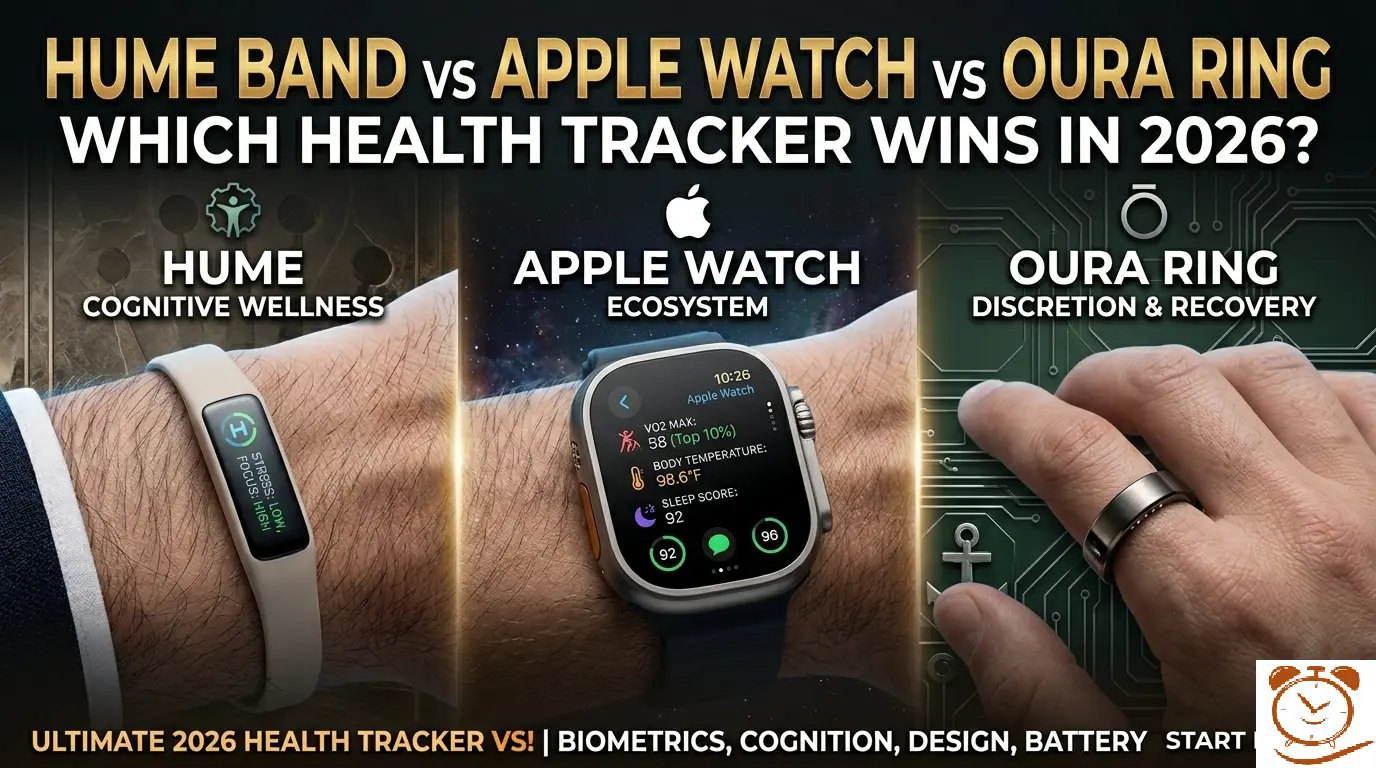
If you’re trying to pick the best health tracker in 2026, you’re not alone. The market is full of options, but three stand out: the Hume Band, Apple Watch, and Oura Ring. Each promises better sleep, deeper health insights, and a path to a longer, healthier life. But which one actually delivers?
In this post, we’ll break down the Hume Band vs Apple Watch vs Oura Ring in a simple, honest way. No tech jargon. No hype. Just real facts about price, features, battery life, and what each device does best—so you can pick the one that fits your life.
Let’s dive in.
Who Are These Devices For?
The Hume Band vs Apple Watch vs Oura Ring debate starts with knowing who each device is made for. They’re all health wearables, but they do very different things well.
Hume Band: Built for people who care about long-term health, aging, and preventing illness before it starts. It focuses on metabolic health and longevity.
Apple Watch: Best for active users who want a smartwatch with health features—like GPS, ECG, and notifications—plus fitness and daily convenience.
Oura Ring: Designed for sleep lovers and recovery-focused users. It’s small, worn at night, and gives deep insights into sleep quality and readiness.
Knowing your goal helps you pick the right tool. Want to live longer? Hume. Want better sleep? Oura. Want a smartwatch that tracks health? Apple Watch.
Price: What Will It Cost You?
When comparing the Hume Band vs Apple Watch vs Oura Ring, price isn’t just about the upfront cost. It’s about total value over time—especially with subscriptions.
Hume Band: One-Time Purchase, No Required Subscription
One of the biggest wins for the Hume Band is its pricing model. You pay once and get access to core health data without a monthly fee.
Starting price: $299 (one-time purchase)
Discounts: Promo codes like NY50 or HEALTH20 can drop the price to $199
Optional premium: $8.99/month ($107.88/year) for AI coaching and deeper insights
No subscription needed for basic data like HRV, heart rate, sleep stages, and recovery
30-day return policy – longer than most competitors
HSA/FSA eligible – you may use pre-tax dollars
This makes Hume a great choice if you hate recurring fees. You own your data, and you can export it anytime.
Oura Ring: High Upfront Cost + Mandatory Subscription
The Oura Ring 4 starts at $349 for basic finishes (Silver, Black). Premium colors like Gold or Rose Gold go up to $499.
But here’s the catch: you must pay $69.99/year ($5.99/month) to unlock full features.
Without the subscription, you only get:
Basic activity tracking
Steps
Simplified heart rate
Temperature trends
You lose:
Full sleep staging
HRV analysis
Stress tracking
Recovery guidance
Period prediction
So the real cost adds up:
Year
Total Cost (Base Model + Annual Plan)
1
$419
2
$489
3
$559
Oura says the subscription funds ongoing research and AI improvements. But for many, it’s a long-term cost that never ends.
They offer a 14-day return policy, which is shorter than Hume’s 30 days.
Apple Watch: No Subscription, But Higher Upfront Cost
Apple Watch prices vary by model:
Apple Watch SE 3: $249 – basic health tracking, no blood oxygen
Apple Watch Series 11: $399 – includes ECG, blood oxygen, hypertension alerts, skin temp
Apple Watch Ultra 3: $799 – built for athletes, 42-hour battery, dual-frequency GPS
No subscription is needed. You pay once and get full access to all health tools.
This makes Apple Watch more predictable than Oura, but pricier than Hume unless you go for the SE model.
Battery Life: Who Lasts the Longest?
Battery life is a big deal if you hate charging every day.
Let’s compare:
Device
Battery Life
Charging Frequency
Hume Band
4–5 days
Every 4–5 days
Oura Ring 4
5–8 days
Once a week or less
Apple Watch SE 3
18 hours
Daily
Apple Watch Series 11
24 hours
Daily
Apple Watch Ultra 3
42 hours
Every 1.5–2 days
If you want to wear your tracker 24/7 without daily charging, Oura and Hume win easily.
The Oura Ring lasts the longest—up to 8 days—making it perfect for sleep tracking.
The Hume Band gives solid 4–5 day performance, which is good for continuous health monitoring.
The Apple Watch needs daily charging for Series and SE models. Only the Ultra 3 lasts 42 hours, which is still far behind the rings.
Health Features: What Do They Actually Track?
Now let’s get into what matters most: health tracking.
Sleep Tracking: Who’s the Best?
When it comes to sleep, Oura Ring is the gold standard.
Sleep staging accuracy: 76–79.5% vs Apple Watch’s 50.5–86.1%
Uses multi-wavelength sensors and clinical-grade algorithms
Tracks deep sleep, REM, light sleep, and gives a Sleep Score
Can detect illness up to 2 days before symptoms using skin temperature
Apple Watch tracks sleep too, but it’s less accurate. One study found it was only 62% accurate at detecting deep sleep compared to professional tests.
Hume Band tracks sleep stages and recovery, but doesn’t claim clinical-grade sleep staging. It focuses more on how sleep affects long-term health and metabolic function.
So for pure sleep lovers, Oura is the top pick.
Heart Rate & HRV: Accuracy Matters
All three track heart rate and HRV (Heart Rate Variability), which shows how well your body handles stress.
Apple Watch: 95% heart rate accuracy, good but not quite as precise
Hume Band: Clinical-grade sensors with ±3 bpm accuracy vs ECG, tracks HRV, SpO2, skin temp
Oura leads in HRV and resting heart rate accuracy, making it ideal for recovery tracking.
Unique Health Tools
This is where each device stands out.
Hume Band: Metabolic Health & Longevity
Hume’s big focus is longevity—helping you live longer and healthier. It tracks:
Metabolic Capacity: A score (0–100) of how well your body makes energy
Metabolic Momentum: Shows how daily habits affect aging
Biological Age: Estimates your body’s true age based on health data
Chronic illness detection: Claims to spot early signs of inflammation using biometrics
These features are unique. But keep in mind: Hume is not a medical device and can’t diagnose disease. Clinical validation for illness detection is still ongoing.
Still, early users report positive results—like a 1-year drop in biological age and 12% higher HRV after 6 months.
Apple Watch: Medical-Grade Alerts
Apple Watch has FDA-cleared tools:
ECG to detect atrial fibrillation
Blood oxygen sensing (95% accurate)
Sleep apnea notifications with 100% participant accuracy in a clinical study
Hypertension alerts (FDA-cleared in 2025)
These are serious health tools. But remember: they’re for notification, not diagnosis. They help you know when to see a doctor.
Apple Watch also allows you to export a 3-month sleep apnea report as a PDF, which you can share with your doctor.
Oura Ring: Recovery & Readiness
Oura’s strength is the Readiness Score, which tells you how recovered your body is each morning. It uses sleep, HRV, and temperature to guide your day.
It also:
Predicts women’s ovulation with 93% accuracy
Tracks period cycles using body temp
Offers temperature deviation alerts for illness
For people who want to optimize daily performance, Oura is hard to beat.
Design & Comfort: Can You Wear It All Day?
Comfort matters—especially if you wear it while sleeping.
Feature
Hume Band
Oura Ring
Apple Watch
Weight
8.6g
3.3–5.2g
47.3g (Series 11)
Water Resistance
IP68 (1 meter)
IPX8 (100m)
100m (all models)
Form Factor
Wristband
Ring
Smartwatch
All-Day Wear
Comfortable, lightweight
Tiny, can be lost
Bulky, noticeable
Hume Band is lightweight and comfortable for 24/7 wear.
Oura Ring is the smallest and lightest, great for sleep—but some find it loose or uncomfortable.
Apple Watch is the bulkiest, especially during sleep.
For sleep and subtle wear, Oura and Hume win. Apple Watch is more of a daily driver.
Smart Features: More Than Just Health
If you want texts, calls, apps, and GPS, Apple Watch is the only real choice.
It has:
Notifications
GPS for outdoor workouts
Music storage
App store
Emergency SOS
Skin temperature sensing
Environmental noise monitoring
Hume and Oura are health-only devices. They don’t have screens or smart features. You use your phone app to see data.
So if you want one device for everything, Apple Watch wins.
But if you just want health insights without distractions, Hume or Oura are better.
Which One Should You Buy?
Let’s break it down by who you are.
Choose Hume Band If:
You care about long-term health and aging
You want a one-time purchase with no required subscription
You like AI coaching to understand your data
You want 30-day returns and HSA/FSA use
Just know: its illness detection claims aren’t clinically proven yet, and battery life is average (4–5 days).
Choose Oura Ring If:
Sleep and recovery are your top goals
You don’t mind paying $70/year forever for full features
You want clinical-grade sleep and HRV data
You like a tiny, lightweight ring you can wear 24/7
But the subscription is mandatory, and the return window is short (14 days).
Choose Apple Watch If:
You want a full smartwatch with health tools
You need GPS, ECG, or sleep apnea alerts
You’re okay with daily charging
You don’t want a subscription
It’s the most versatile, but not the best for deep health insights like HRV or longevity.
Hume Band vs Apple Watch vs Oura Ring
After comparing all three, here’s the truth:
Best for Longevity & Metabolic Health: Hume Band. Its focus on aging, one-time price, and AI coaching make it unique.
Best for Sleep & Recovery: Oura Ring. Still the king of sleep tracking.
Best for Smart Features & Medical Alerts: Apple Watch. The only one with FDA-cleared tools and full smartwatch power.
So who wins?
If you want deep, long-term health insights without a subscription, the Hume Band is the most exciting new option in 2026.
But if you’re all about sleep and daily readiness, stick with Oura Ring.
And if you want a watch that does it all, Apple Watch is still unmatched.
In the Hume Band vs Apple Watch vs Oura Ring battle, there’s no single winner. It depends on what you value most.
Pick the one that matches your goals—and your lifestyle.
The Best Smartwatches with Health Monitoring Features in 2026 aren’t just tracking your steps—they’re predicting illness, detecting hypertension, and even analyzing your sleep with clinical precision. With FDA-cleared diagnostics, AI-powered insights, and 0.2°C temperature accuracy, your wrist is now a frontline health guardian.
But here’s the real question: What if your smartwatch could alert you to a heart issue before symptoms appear? Or tell you you’re getting sick 2.75 days before you feel it?
That’s not science fiction—it’s reality in 2026. And if you care about long-term health, early detection, and taking control of your wellness journey, you need to see which devices made the list—and why one of them might just save your life.
The focus has shifted from simply collecting data to delivering actionable, personalized health intelligence. Whether you’re an iPhone user, Android loyalist, or someone who values clinical validation over flashy features, the Best Smartwatches with Health Monitoring Features in 2026 offer something transformative.
Apple Watch Series 11: The Most Advanced Health Hub for iPhone Users
Apple Watch Series 11 sets the gold standard for integrated health monitoring in 2026, especially for iPhone users. Its standout feature? FDA-cleared hypertension screening, a first for mainstream wearables. This isn’t a vague alert—it’s a clinically validated system that analyzes heart rate, activity, and sleep trends to identify potential high blood pressure risks early.
The Series 11 retains all the essentials:
ECG with 98% sensitivity for AFib detection
SpO2 monitoring
Skin temperature sensing (0.2°C precision)
Sleep apnea notifications
Dual-frequency GPS and a titanium case
Battery life is 36 hours, which means daily charging, but the depth of health integration justifies it. For extreme adventurers, the Apple Watch Ultra 3 offers 42-hour battery life, satellite SOS, and 100m water resistance, making it ideal for outdoor athletes who still demand top-tier health tracking.
Feature
Apple Watch Series 11
Apple Watch Ultra 3
Battery Life
36 hours
42 hours
Health Highlights
Hypertension screening, ECG, SpO2, sleep apnea
Satellite SOS, dual-frequency GPS, ECG
Price (USD)
$399
$799
Display Brightness
2,000–3,000 nits
3,000 nits
Samsung Galaxy Watch 8: The Android King of Health & AI
For Android users, the Samsung Galaxy Watch 8 is the definitive choice among the Best Smartwatches with Health Monitoring Features. It combines FDA-cleared sleep apnea detection, ECG, and body composition analysis using bioelectrical impedance to measure body fat, muscle mass, and hydration levels.
What truly differentiates it is Galaxy AI integration. Features like Bedtime Guidance, Antioxidant Index, and Vascular Load tracking provide personalized insights that go beyond raw data. The 40-hour battery, 3nm Exynos W1000 processor, and 3,000-nit AMOLED display ensure smooth performance and excellent outdoor visibility.
Priced between $349.99 and $379.99, it’s a premium device that rivals Apple in health functionality while offering deeper AI-powered coaching.
Feature
Samsung Galaxy Watch 8
Battery Life
40 hours
Key Sensors
ECG, SpO₂, infrared temp, bioimpedance
AI Features
Galaxy AI, Antioxidant Index, Vascular Load
Price (USD)
$349.99–$379.99
Withings ScanWatch 2: Medical-Grade Accuracy for the Health-Conscious
If you prioritize clinical accuracy over smart features, the Withings ScanWatch 2 is unmatched. It’s one of the few wearables with FDA-cleared ECG, sleep apnea detection, and continuous SpO2 monitoring during sleep—all on a hybrid analog-digital design that lasts up to 35 days on a single charge.
Its 16-channel PPG sensor array delivers hospital-grade trend data, making it ideal for users managing chronic conditions or seeking long-term health insights. At $349.95, it’s a premium investment for those who value reliability and battery life over notifications and apps.
Feature
Withings ScanWatch 2
Battery Life
35 days
FDA-Cleared Features
ECG, sleep apnea, SpO2
Design
Hybrid analog-digital
Price (USD)
$349.95
Garmin Venu 3: Fitness Meets Medical Precision
The Garmin Venu 3 bridges the gap between athletic performance and holistic health. With 14-day battery life, medical-grade accuracy, and advanced metrics like HRV monitoring, VO2 Max tracking, and Body Battery energy scoring, it’s built for serious users.
It includes ECG, SpO2, and stress tracking, making it ideal for managing recovery and preventing overtraining. While it lacks the AI smarts of Apple or Samsung, its reliability, battery efficiency, and fitness-first design make it a top pick for athletes.
Feature
Garmin Venu 3
Battery Life
14 days
Key Metrics
HRV, VO2 Max, Body Battery, ECG
Sports Modes
30+
Price (USD)
$449.99
Google Pixel Watch 4: AI-Powered Health for Android
The Google Pixel Watch 4 brings Gemini AI to health coaching, offering personalized summaries, Emergency Satellite SOS, and the Actua 360 Display for better readability. With 36–40 hour battery life and the full Fitbit sensor suite, it delivers accurate heart rate, sleep, and temperature tracking.
Its sleep tracking accuracy reaches 85% in polysomnography studies, making it one of the most reliable sleep monitors among Android watches. At $349–$350, it’s a compelling option for Pixel users who want AI-driven health insights without sacrificing accuracy.
Feature
Google Pixel Watch 4
Battery Life
36–40 hours
AI Features
Gemini AI, health summaries
Sleep Accuracy
85% (vs. clinical studies)
Price (USD)
$349–$350
Amazfit Active Max: Long Battery, Big Value
For budget-conscious buyers, the Amazfit Active Max offers 25 days of battery life, 178 sports modes, GPS, and 24/7 health monitoring via the HX3691 sensor for heart rate, SpO2, stress, and mood.
At $169.99, it’s one of the most affordable long-lasting health trackers. While it lacks FDA clearances, its value proposition is undeniable for casual users who want reliable tracking without daily charging.
Feature
Amazfit Active Max
Battery Life
25 days
Health Sensors
HX3691 (HR, SpO2, stress)
Sports Modes
178+
Price (USD)
$169.99
Oura Ring 4: The Sleep & Recovery Specialist
Though not a watch, the Oura Ring 4 is a top-tier health wearable. With 7–8 days battery life, 79% four-stage sleep classification accuracy, and 94.4–94.5% overall sleep accuracy, it outperforms most wrist devices in sleep tracking.
It offers 0.1°C temperature precision, HRV monitoring, and can detect infections up to 2.75 days before symptoms appear. At $349–$499, it’s ideal for users focused on recovery, sleep optimization, and early illness detection.
Feature
Oura Ring 4
Battery Life
7–8 days
Sleep Accuracy
94.4–94.5% overall
Temperature Precision
0.1°C
Price (USD)
$349–$499
How Smartwatches Compare in Sleep Tracking
Sleep tracking accuracy varies significantly across devices. Clinical studies show:
Device
Sleep Stage Accuracy
Overall Sleep Accuracy
Notes
Oura Ring 4
79%
94.4–94.5%
Highest reliability
Apple Watch Series 10
50.5–86.1%
—
Overestimates sleep by 30–45 mins
Google Pixel Watch 4
85%
—
Fitbit-powered algorithms
Samsung Galaxy Watch 8
Not published
—
Uses AI-based analysis
Oura leads in consistency and precision, while Apple and Pixel show variability depending on user physiology.
Battery Life vs. Health Monitoring Intensity
Battery life is a trade-off with continuous health monitoring:
Withings ScanWatch 2: FDA-cleared ECG and sleep apnea
Google Pixel Watch 3/4: FDA-cleared ECG and SpO2
These clearances mean the devices meet clinical standards for trend detection, though they’re not replacements for diagnostic tools.
What This Means for Your Health Journey
The Best Smartwatches with Health Monitoring Features in 2026 are no longer just gadgets—they’re personal health partners. Whether you need early hypertension alerts, sleep apnea detection, or AI-powered recovery insights, there’s a device tailored to your needs.
Your choice depends on:
Ecosystem (iOS vs. Android)
Health priorities (sleep, heart, fitness)
Battery preferences
Budget
But one thing is clear: your wrist now holds the power to prevent, detect, and manage health issues like never before.
Limitations & Unknowns
While 2026 brings incredible advancements, key blindspots remain:
No official launch dates for rumored devices like Apple Watch Ultra 4 or Samsung Galaxy Ring 2
Regional price variations not fully documented
Long-term accuracy studies for new features like glucose trend estimation are pending
Meta’s smartwatch (Malibu 2) has no official release date
FDA approvals are for trends, not absolute diagnoses
Always consult a healthcare provider for medical concerns—wearables are tools, not replacements.
When it comes to choosing a premium smartwatch, the debate between the Apple Watch Series 11 and the Galaxy Watch 8 is at the forefront for tech enthusiasts and fitness lovers alike. Both these smartwatches bring cutting-edge features, sleek designs, and reliable performance. But how do they compare? In this blog, we will explore the differences and similarities between the Apple Watch Series 11 and Galaxy Watch 8 to help you make an informed decision.
Design and Display
The Apple Watch Series 11 features a durable, lightweight aluminum or stainless steel case combined with a stunning Retina display that adapts seamlessly to your lighting conditions. Its always-on display option is a major plus, providing quick access to notifications and fitness stats.
The Galaxy Watch 8 retains its signature circular design, giving it a traditional watch look with a modern twist. It boasts a bright, vivid Super AMOLED display that offers excellent visibility even in direct sunlight. Both watches are water-resistant, making them suitable for swimming and outdoor activities.
Features and Performance
The Apple Watch Series 11 excels in health and fitness tracking, supporting ECG, blood oxygen monitoring, and advanced sleep analysis. Its seamless integration with iOS devices enhances user experience with features like call, message, and app notifications directly on the watch.
On the other hand, the Galaxy Watch 8 offers a thorough health suite, including stress tracking, body composition analysis, and a wider variety of workout modes. Powered by Tizen OS, it provides a smooth interface with customizable watch faces and third-party app support.
Battery Life and Compatibility
The Apple Watch Series 11 generally lasts around 18 hours on a full charge, optimized for overnight wear and daily use. Its compatibility is limited to iPhones, which may restrict some users. Conversely, the Galaxy Watch 8 provides slightly longer battery life, approximately 24 hours, and supports both Android and iOS devices, offering greater flexibility.
Feature
Apple Watch Series 11
Galaxy Watch 8
Display Size
42/46 mm, 1.65/1.81 inch LTPO OLED
40/44 mm, 1.34/1.47 inch Super AMOLED
Resolution
374×446 / 416×496 pixels
438×438 / 480×480 pixels
Brightness
2,000 nits
3,000 nits
Processor
S11 Dual-Core 64-bit
Exynos W1000 3nm
RAM & Storage
64 GB storage (RAM not specified)
2 GB RAM, 32 GB storage
Operating System
watchOS 26
Wear OS 6 + One UI 8
Connectivity
5G, Ultra-Wideband, Bluetooth 5.3, Wi-Fi
LTE 4G, Bluetooth 5.3, Dual-band Wi-Fi
Health Features
ECG, Blood Oxygen, Hypertension alert
Body composition, Antioxidant index, ECG
Battery Capacity
~ (24h usage), Fast charging (15 mins = 8h)
325mAh / 445mAh, Fast wireless charging
Water/Dust Resistance
IP6X, WR50
5ATM + IP68, MIL-STD-810H
Compatibility
iPhone only
Android & iPhone
Weight
30.3g – 43.1g
30g – 34g
Model
Price in India (INR)
Price in USA (USD)
Apple Watch Series 11 42mm
₹46,900
$399
Apple Watch Series 11 46mm
₹49,900
Approx. $429
Galaxy Watch 8 40mm
₹32,999
$349.99 (discounted to $319.99)
Galaxy Watch 8 44mm
₹35,999
$379
Galaxy Watch 8 Classic LTE
₹50,999
$499
Watch Model
Price in India (INR)
Price in USA (USD)
Price in UK (GBP)
Price in Australia (AUD)
Price in Canada (CAD)
Apple Watch Series 11 42mm
₹46,900
$399
£349
AUD 579
CAD 529
Apple Watch Series 11 46mm
₹49,900
Approx. $429
£379
AUD 609
CAD 569
Galaxy Watch 8 40mm
₹32,999
$349.99 (discounted to $319.99)
£299
AUD 459
CAD 459
Galaxy Watch 8 44mm
₹35,999
$379
£329
AUD 499
CAD 499
Galaxy Watch 8 Classic LTE
₹50,999
$499
£449
AUD 729
CAD 699
Conclusion
Both the Apple Watch Series 11 and Galaxy Watch 8 are excellent choices, each catering to different user needs. If you’re deeply integrated into the Apple ecosystem and prioritize health features, the Apple Watch Series 11 is the ideal pick. However, for those seeking a versatile and longer-lasting smartwatch compatible with both Android and iOS, the Galaxy Watch 8 stands out. Your choice ultimately depends on your smartphone and personal preferences.
Apple Watch Series 11 vs Apple Watch SE 3: Which One Should You Choose?
Choosing the right Apple smartwatch in 2025 boils down to your needs and budget, with the Apple Watch Series 11 and Apple Watch SE 3 being top contenders. Both watches run on Apple’s latest tech but cater to different users — the Series 11 focuses on premium health features and design, whereas the SE 3 offers essential functionality at a lower price.
Design and Display
The Apple Watch Series 11 comes in 42mm and 46mm sizes with aluminum and titanium cases. It has a bright always-on Retina LTPO3 OLED display, capable of up to 2,000 nits brightness, providing vibrant colors and sharp visuals for all conditions.
The Apple Watch SE 3 is available in 40mm and 44mm aluminum cases and features an always-on Retina OLED display too, but with half the brightness at 1,000 nits. It lacks the premium materials and thinner bezels of the Series 11, giving it a slightly bulkier look.
Performance and Features
Powered by the S11 chip, the Series 11 supports advanced health sensors like ECG, blood oxygen monitoring, hypertension notifications, and temperature sensing. It also offers 5G connectivity and a longer battery life of up to 24 hours.
Meanwhile, the SE 3 uses the slightly older S10 chip and includes core health tracking features like heart rate monitoring, fall detection, and emergency SOS, but misses ECG, blood oxygen, and temperature sensors. It supports GPS and cellular with 5G capabilities but has a shorter typical battery life of 18 hours.
The Series 11 charges to 80% in about 30 minutes and lasts up to 24 hours in regular use. It is water-resistant up to 50m and supports IP6X dust resistance.
The SE 3 offers up to 18 hours of battery life and fast charging to 80% in 45 minutes. It is also water-resistant up to 50m but lacks the dust resistance feature.
Both watches require an iPhone 11 or later running iOS 26 or above.
Feature
Apple Watch Series 11
Apple Watch SE 3
Case Sizes
42mm, 46mm
40mm, 44mm
Case Materials
Aluminum, Titanium
Aluminum
Display Type
Always-On Retina LTPO3 OLED, 2000 nits
Always-On Retina OLED, 1000 nits
Processor
S11 Chip
S10 Chip
Health Sensors
ECG, Blood Oxygen, Temperature, Hypertension
Heart Rate, Fall Detection
Connectivity
GPS / Cellular (5G capable)
GPS / Cellular (5G capable)
Battery Life
Up to 24 hours
Up to 18 hours
Fast Charging
0–80% in ~30 minutes
0–80% in ~45 minutes
Water Resistance
50m + IP6X dust resistant
50m
Compatibility
iPhone 11 or later, iOS 26+
iPhone 11 or later, iOS 26+
The Apple Watch Series 11 shines with cutting-edge health sensors, a brighter and larger display, premium build materials, and longer battery life, making it ideal for the health-conscious and tech-savvy user. The Apple Watch SE 3 provides a strong value proposition with essential features, fast performance, and a lower price suitable for budget-conscious buyers or first-time smartwatch users. Both uphold Apple’s ecosystem excellence, ensuring seamless integration with your iPhone.
Apple Watch Series 11 vs Series 8: Which One is Right for You?
Choosing between the Apple Watch Series 11 and Apple Watch Series 8 can be challenging as both models offer advanced features and sleek designs. The Apple Watch Series 11 introduces cutting-edge health innovations and connectivity upgrades, while the Apple Watch Series 8 remains a reliable performer with essential features at a potentially lower price point. This comparison will help you understand the key differences and make an informed choice.
Design and Display: Premium Upgrades vs Proven Style
The Apple Watch Series 11 features a more durable and scratch-resistant display with Ion-X glass and is available in titanium alongside aluminum. It supports a brighter Always-On Retina LTPO OLED display with up to 2000 nits brightness, ideal for outdoor visibility.
The Apple Watch Series 8 offers a Retina LTPO OLED display with 1000 nits brightness, housed in aluminum or stainless steel cases. Both models come in 41mm and 45mm sizes and provide waterproofing up to 50 meters, but the Series 11 is slightly thinner and lighter.
Performance and Health Tracking
Powered by the latest S10 chip, the Apple Watch Series 11 boasts faster processing speeds and more advanced sensors. It introduces hypertension notifications, enhanced sleep scoring, and temperature sensing, alongside classic ECG and blood oxygen monitoring.
The Apple Watch Series 8, running on the S8 chip, supports ECG, blood oxygen, and temperature sensing but lacks hypertension alerts. It offers precise workout tracking, crash detection, and improved safety features, making it a strong contender for daily use.
Connectivity and Battery Life
The Apple Watch Series 11 supports 5G connectivity, Bluetooth 5.3, and Wi-Fi 6, ensuring faster data transfer and smoother streaming. Battery life lasts up to 24 hours with fast charging that can provide 8 hours of use in 15 minutes.
The Apple Watch Series 8 provides LTE 4G, Bluetooth 5.0, and Wi-Fi 6, with up to 18 hours of battery life. Fast charging is supported but takes longer compared to the Series 11.
Feature Comparison
Feature
Apple Watch Series 11
Apple Watch Series 8
Release Year
2025
2022
Case Materials
Aluminum, Titanium
Aluminum, Stainless Steel
Display Size
41mm, 45mm
41mm, 45mm
Display Brightness
Up to 2000 nits
Up to 1000 nits
Processor
S10 Chip
S8 Chip
Connectivity
5G, Bluetooth 5.3, Wi-Fi 6
LTE 4G, Bluetooth 5.0, Wi-Fi 6
ECG Sensor
Yes
Yes
Blood Oxygen Sensor
Yes
Yes
Hypertension Notifications
Yes
No
Temperature Sensor
Yes
Yes
Battery Life
Up to 24 hours
Up to 18 hours
Fast Charging
8 hours use in 15 minutes
Slower fast charging
Water Resistance
50m + IP6X Dust Resistant
50m + IP6X Dust Resistant
Weight
Lighter, thinner design
Slightly heavier
This table highlights that the Series 11 offers upgraded display brightness, processing power, 5G connectivity, and new health features like hypertension notifications. The Series 8 continues to provide excellent health tracking and safety features suitable for everyday users.
Practical Tips for Choosing
If you want the latest health innovations and faster connectivity, prioritize the Apple Watch Series 11.
For reliable performance with comprehensive health tools at a better price, consider the Apple Watch Series 8.
Both models integrate smoothly with the iPhone and support a wide range of apps and customizations.
My Team Point of View
The Apple Watch Series 11 and Apple Watch Series 8 each cater to different user priorities. The Series 11 excels in breakthrough health monitoring and connectivity, while the Series 8 offers proven features at a competitive value. Assess your needs and budget to select the Apple Watch that best fits your lifestyle.
Apple Watch Series 11 vs Apple Watch Series Ultra 2: The Ultimate 2025 Comparison
Choosing the right Apple Watch in 2025 means deciding between the Apple Watch Series 11 and the Apple Watch Series Ultra 2. Both models serve different users, with the Series 11 focused on everyday health and connectivity, and the Ultra 2 built for extreme environments and outdoor enthusiasts. This guide will help you understand the key features and differences for a smarter purchase.
Design and Display: Sleek Everyday Wear vs Rugged Adventure Gear
The Apple Watch Series 11 comes in 41mm and 45mm sizes with aluminum and titanium cases. Its Retina LTPO OLED display offers up to 2000 nits of brightness, making it bright and vibrant for daily use indoors and outdoors. The watch is slim, lightweight, and features durable Ion-X glass for scratch resistance.
In contrast, the Apple Watch Series Ultra 2 features a larger 49mm titanium case built for durability. It boasts an ultra-bright Always-On Retina LTPO OLED display with up to 3000 nits brightness, ideal for sunlight-heavy conditions. The sapphire crystal front cover and reinforced frame ensure toughness for hiking, diving, and extreme sports.
Performance and Health Tracking
Both watches run on Apple’s efficient S10 chip, powering fast app launches and smooth operation. The Series 11 focuses on comprehensive health insights, including ECG, blood oxygen, body temperature sensing, and new hypertension notifications.
The Ultra 2 adds specialized fitness features like dual-frequency GPS for precise location tracking, a depth gauge for diving, and advanced motion sensors tailored for outdoor activities. Both support all-day health monitoring but cater to different lifestyles.
Battery and Connectivity
Battery life is a decisive factor. The Apple Watch Series 11 lasts about 24 hours, enough for daily work and workouts, and supports fast charging—15 minutes can give 8 hours of use.
The Ultra 2 doubles the endurance with up to 48 hours of normal use and 60 hours in the Low Power Mode, perfect for long excursions without frequent charging. Both offer 5G, Wi-Fi 6, and Bluetooth 5.3 for reliable, fast connections.
This detailed table highlights that the Ultra 2 is designed for adventurers needing durability and extended battery life, while the Series 11 fits users wanting advanced health features in a stylish, daily wearable.
Tips for Choosing Your Apple Watch
Choose the Series 11 if you want a lightweight, stylish smartwatch packed with health features for daily routines.
Pick the Ultra 2 if you need a tough watch for outdoor activities, long battery life, and extreme sports.
Both watches seamlessly integrate within the Apple ecosystem, delivering smooth app support and connectivity.
Conclusion
The Apple Watch Series 11 and Apple Watch Series Ultra 2 cater to distinct lifestyles. The Series 11 is perfect for everyday health and smart convenience, while the Ultra 2 targets outdoors enthusiasts with rugged durability and professional-grade features. Understanding these differences will help you select the Apple Watch that truly fits your life.
Apple Watch Series 11 vs Ultra 3: Which One Should You Choose in 2025?
The Apple Watch Series 11 and Apple Watch Series Ultra 3 are flagship models launched in 2025, catering to different user needs. The Series 11 combines high-end design with advanced health features, perfect for everyday users. The Ultra 3, on the other hand, pushes the boundaries with rugged durability, extended battery life, and professional-grade features suited for outdoor enthusiasts and athletes. This comparison will help you decide which Apple Watch fits your lifestyle best.
Design, Display, and Durability
The Apple Watch Series 11 features a sleek, lightweight aluminum and titanium case available in 41mm and 45mm sizes. Its bright Retina LTPO OLED display reaches up to 2000 nits, offering vibrant visuals during daily use. The case is resistant to scratches and dust, making it ideal for regular wear.
The Ultra 3 is a titan-built powerhouse, with a larger 49mm case optimized for extreme durability. It boasts a blisteringly bright 3000 nits Always-On Retina LTPO display, making it perfect for outdoor activities under direct sunlight. The Ultra 3 is also equipped with a reinforced front and robust water resistance up to 100 meters, certified for outdoor and underwater adventures.
Performance and Specialized Features
Both watches are powered by the powerful S10 chip, ensuring fast responsiveness. The Series 11 emphasizes health and everyday productivity, supporting features like ECG, blood oxygen monitoring, sleep tracking, and hypertension alerts.
The Ultra 3 introduces enhanced sensors and tools geared for extreme conditions, including advanced GPS with dual-frequency accuracy, a dive computer function certified to 150 meters, and a built-in siren for safety during wilderness activities. It also offers longer battery endurance, capable of lasting up to 60 hours in low power mode.
Battery Life, Connectivity, and Practical Use
The Series 11 offers a battery life of about 24 hours, suitable for a typical day, with fast charging that provides 8 hours of use in just 15 minutes. It supports 5G, Wi-Fi 6, and Bluetooth 5.3 for seamless connectivity.
The Ultra 3 doubles that with up to 60 hours on a single charge, optimal for multi-day expeditions. It supports all modern connectivity options, including 5G, Wi-Fi 6E, and Bluetooth 5.3, designed to keep outdoor adventurers connected regardless of location.
Comparison Table: Apple Watch Series 11 vs Ultra 3
Main Takeaway: The Ultra 3 offers rugged durability, extended battery life, and advanced outdoor features, making it ideal for extreme environments. The Series 11 shines with its sleek design, health sensors, and everyday connectivity.
Action Tips for Buyers
Opt for the Series 11 if you prioritize style, health sensors, and daily convenience.
Choose the Ultra 3 for outdoor activities, diving, and multi-day excursions.
Both watches seamlessly integrate into the Apple ecosystem for calls, notifications, and fitness tracking.
Final summary:
The Apple Watch Series 11 and Ultra 3 serve different lifestyles. The Series 11 is perfect for stylish daily use with advanced health features, while the Ultra 3 is built for rugged outdoor adventures with longer battery life and specialized tools. Select based on your activity level and environment.
Apple Watch Series 11 vs Series 10: Which New Apple Watch Is Right for You?
Deciding between the apple watch series 11 and series 10 in 2025 involves understanding their differences and improvements. The series 11 introduces notable upgrades in health sensors, display technology, and connectivity, making it a compelling choice for tech enthusiasts and health-conscious users. Meanwhile, the series 10 remains a reliable, feature-rich smartwatch that continues to serve daily needs efficiently.
Design and Display: Subtle Changes and Improvements
The apple watch series 11 features a refined design, available in 41mm and 45mm sizes. It boasts a brighter and more durable Retina LTPO OLED display, with up to 2000 nits brightness, making it easier to read in bright sunlight. The case materials include aluminum and titanium, giving it a sleek look with added sturdiness.
The series 10 remains similar in size and shape but offers a slightly less bright display with up to 1500 nits brightness. It is available in aluminum and stainless steel, emphasizing style and lightweight comfort for everyday wear.
Performance and Core Features
Both models run on Apple’s latest S10 chip, ensuring smooth operation and efficient power management. The series 11 upgrades include advanced health sensors such as blood pressure monitoring and improved sleep tracking. It also offers a new wrist gesture for easier interaction.
The series 10 carries forward core health features like ECG, blood oxygen, and heart rate monitoring. It is well-suited for users who want reliable health tracking without the latest sensor integrations.
Battery Life and Connectivity
The apple watch series 11 offers around 24 hours of battery life, with faster charging capabilities—just 15 minutes can curb a full day’s worth of usage. It supports 5G connectivity, ensuring faster data transfer and streaming.
The series 10 provides approximately 18 hours of battery life, with standard charging. It supports LTE and Wi-Fi but does not include the newer 5G capabilities, making it suitable for everyday bandwidth needs.
Comparison Table: Apple Watch Series 11 vs Series 10
Feature
Apple Watch Series 11
Apple Watch Series 10
Release Year
2025
2024
Display Brightness
Up to 2000 nits
Up to 1500 nits
Case Sizes
41mm, 45mm
40mm, 44mm
Case Material
Aluminum, Titanium
Aluminum, Stainless Steel
Processor
S10 Chip
S10 Chip
Health Sensors
Blood Pressure, ECG, SpO2, Temp, Hypertension
ECG, Blood Oxygen, Heart Rate
Battery Life
Up to 24 hours
About 18 hours
Charging Speed
Full day in 15 minutes
Standard charge
Connectivity
5G, Wi-Fi 6, Bluetooth 5.3
LTE, Wi-Fi 6
Water Resistance
50 meters
50 meters
Durability
Scratch-resistant, reinforced case
Standard durability
Weight
Lighter, refined design
Slightly heavier
Main takeaway: The apple watch series 11 delivers improved display brightness, faster charging, and advanced health sensors, making it a more futuristic upgrade over the series 10.
Tips for Buyers
Choose series 11 if you want cutting-edge health sensors and faster connectivity.
Opt for series 10 for reliable features in a slightly more affordable package.
Both watches work seamlessly with iPhones, ensuring smooth integration across your Apple devices.
Summary
The apple watch series 11 offers meaningful upgrades in display, sensors, and connectivity, making it ideal for users who want the latest advancements. Meanwhile, the series 10 remains a dependable choice that combines core features with proven performance. Your decision should be based on whether cutting-edge tech or cost-efficiency fits your lifestyle best.
Apple Watch Series 11 vs Series 7: What’s New in 2025?
Choosing between the Apple Watch Series 11 and the Apple Watch Series 7 means weighing the latest innovations against a still-capable older model. Released in 2025, the Series 11 brings advancements in health tracking, display technology, and connectivity, while the Series 7 remains a solid choice with reliable features for everyday smartwatch users. This comparison helps highlight the significant differences to guide your buying decision.
Design and Display: Brightness and Durability Boost
The Apple Watch Series 11 features subtle design enhancements with aluminum and titanium case options in 41mm and 45mm sizes. Its Retina LTPO OLED display can reach up to 2000 nits brightness, making it remarkably visible even in direct sunlight and enhancing outdoor usability.
The Series 7, launched in 2021, offers a slightly smaller range with 41mm and 45mm sizes and an aluminum or stainless steel case. Its Always-On Retina display gives up to 1000 nits brightness, which is sufficient for indoor and some outdoor use but less vivid in bright sunlight compared to the Series 11.
Performance and Advanced Health Features
Equipped with Apple’s latest S10 chip, the Series 11 delivers faster performance and better power efficiency. It introduces new health monitoring features such as hypertension notifications, more detailed sleep analysis, and continuous temperature sensing, building on the foundation of ECG, blood oxygen, and heart rate tracking.
The Series 7, powered by the S7 chip, supports ECG, blood oxygen monitoring, and heart rate tracking but lacks some of the advanced sensors and health alerts present in the Series 11.
Battery Life and Connectivity
Both watches offer about 18 to 24 hours of battery life, depending on usage. The Series 11 supports faster charging, reaching 80% in about 30 minutes and supports 5G connectivity for quicker wireless data transfer.
The Series 7 provides solid all-day battery life with standard charging speeds and is limited to LTE (4G) network connectivity.
Apple Watch Series 11 vs Series 7: Key Differences Table
Feature
Apple Watch Series 11
Apple Watch Series 7
Release Year
2025
2021
Case Sizes
41mm, 45mm
41mm, 45mm
Case Materials
Aluminum, Titanium
Aluminum, Stainless Steel
Display Brightness
Up to 2000 nits
Up to 1000 nits
Processor
S10 Chip
S7 Chip
ECG Sensor
Yes
Yes
Blood Oxygen Sensor
Yes
Yes
New Health Features
Hypertension notifications, Temp sensor
N/A
Battery Life
Up to 24 hours
Up to 18 hours
Charging Speed
Fast charging, 80% in 30 mins
Standard charging
Connectivity
5G, Wi-Fi 6, Bluetooth 5.3
LTE (4G), Wi-Fi 6, Bluetooth 5.0
Water Resistance
50m
50m
Durability
IP6X dust resistant
IP6X dust resistant
Weight
Lighter with titanium option
Slightly heavier
The table confirms that the Apple Watch Series 11 offers a brighter screen, enhanced health sensors, and faster connectivity, making it the better choice for future-proofing.
Practical Buying Tips
Opt for the Series 11 if you want the latest health tech and faster wireless speeds.
Consider the Series 7 if you seek a dependable watch with core features at a reduced price.
Both models fit perfectly in the Apple ecosystem, providing seamless integration with iPhones.
Conclusion
The Apple Watch Series 11 is a significant upgrade from the Apple Watch Series 7, especially in display brightness, health monitoring, and connectivity. For users wanting the newest tech and health insights, the Series 11 is ideal. The Series 7 still holds strong value for those on a budget who want a reliable and feature-rich smartwatch.
Apple Watch Series 11 vs Series 9: What’s Different in 2025?
When comparing the Apple Watch Series 11 and Apple Watch Series 9 in 2025, both models stand out as premium smartwatches packed with innovative features. The Series 11 builds on the strengths of the Series 9 by introducing enhanced health sensors, improved display brightness, and upgraded connectivity. This article highlights the key differences to help you choose the Apple Watch that best suits your lifestyle.
Design and Display Enhancements
The Apple Watch Series 11 maintains classic Apple aesthetics with 41mm and 45mm case options in aluminum and titanium. Its Retina LTPO OLED display now delivers up to 2000 nits of brightness, nearly doubling the Series 9’s peak brightness of 1000 nits for better visibility in outdoor light.
The Series 9 offers a similar design and size but with slightly lower brightness and a refined display experience. Both watches feature always-on Retina displays and are water-resistant up to 50 meters.
Performance and Health Monitoring
Powered by the new S10 chip, the Series 11 provides faster performance and more efficient battery usage compared to the Series 9’s S9 chip. Importantly, the Series 11 introduces hypertension notifications and enhanced temperature sensing, expanding the health monitoring capabilities already strong in Series 9 (ECG, blood oxygen, sleep tracking).
Both are excellent for fitness tracking, fall detection, and emergency SOS, but Series 11’s health suite edges ahead with richer insights.
Battery Life and Connectivity
Battery life on both watches averages around 18 to 24 hours, depending on usage. The Series 11 supports 5G connectivity and Wi-Fi 6E, enabling faster data and seamless streaming, while the Series 9 supports LTE (4G) and Wi-Fi 6.
Fast charging is improved in Series 11, reaching 80% in around 30 minutes compared to slightly slower charge times on Series 9.
Apple Watch Series 11 vs Series 9 Feature Comparison Table
Feature
Apple Watch Series 11
Apple Watch Series 9
Release Year
2025
2023
Case Sizes
41mm, 45mm
41mm, 45mm
Case Materials
Aluminum, Titanium
Aluminum, Stainless Steel
Display Brightness
Up to 2000 nits
Up to 1000 nits
Processor
S10 Chip
S9 Chip
Health Sensors
ECG, Blood Oxygen, Temp, Hypertension Alerts
ECG, Blood Oxygen, Temp Sensor
Battery Life
18-24 hours
18-24 hours
Charging Speed
Fast charging (80% in ~30 mins)
Standard fast charging
Connectivity
5G, Wi-Fi 6E, Bluetooth 5.3
LTE (4G), Wi-Fi 6, Bluetooth 5.0
Water Resistance
50 meters
50 meters
Durability
IP6X Dust Resistant
IP6X Dust Resistant
Weight
Slightly lighter
Slightly heavier
The table shows that while the designs are similar, the Series 11 excels in display brightness, processor speed, and offers 5G connectivity, providing a future-proof experience.
Practical Tips for Choosing
Opt for Series 11 if you want the latest health notifications, superior display visibility, and faster connectivity.
Consider the Series 9 if you want a premium Apple Watch experience at potentially better pricing as the newer model rolls out.
Both perfectly complement the Apple ecosystem for iPhone users prioritizing fitness and connectivity.
Conclusion
The Apple Watch Series 11 builds on the solid foundation of the Series 9 by adding improved display brightness, advanced health tracking, and faster 5G connectivity. If you seek cutting-edge features and enhanced usability, Series 11 is the ideal pick. However, Series 9 remains a strong competitor with excellent capabilities for daily smartwatch users.
Apple Watch Series 11 vs Series 12 Pro: Which One Should You Choose in 2025?
In 2025, Apple continues to elevate its smartwatch game with the release of the Apple Watch Series 12 Pro, but many users still wonder how it compares to the predecessor, Series 11. Both models boast cutting-edge features, but the Series 12 Pro takes things further with enhanced durability, advanced sensors, and a more powerful processor. This guide will help you understand the key differences, so you can choose the perfect Apple Watch for your needs.
Design, Display, and Build
The Apple Watch Series 11 features a sleek, lightweight aluminum and titanium case in 41mm and 45mm sizes. Its Retina LTPO OLED display offers up to 2000 nits of brightness, ensuring clear visuals even in sunlight. Its durable build makes it ideal for daily wear.
The Series 12 Pro, launched in 2025, features an even more rugged titanium or stainless steel case with smaller bezels and a larger, always-on Retina display with brightness reaching 2500 nits. The watch is designed for extreme environments, with enhanced shock and scratch resistance suitable for outdoor adventurers.
Performance and Health Capabilities
Both watches are powered by Apple’s latest S12 chip, providing faster performance and improved battery efficiency. The Series 12 Pro introduces new health sensors, including a dedicated hydration monitor, advanced GPS with dual-frequency accuracy, and a dive computer mode, making it perfect for athletes and explorers.
The Series 11 already supports ECG, blood oxygen, and temperature sensing, but the Series 12 Pro offers more detailed metrics, especially useful for rigorous outdoor activities and professional sports.
Battery and Connectivity
The Series 11 offers a solid 24 hours of battery life with fast charging. The Series 12 Pro extends battery life to up to 60 hours in low power mode, ideal for multi-day outdoor trips. Both models support 5G, Wi-Fi 6E, and Bluetooth 5.3 for seamless connectivity.
Features Comparison: Apple Watch Series 11 vs Series 12 Pro
Feature
Apple Watch Series 11
Apple Watch Series 12 Pro
Release Year
2025
2025
Case Sizes
41mm, 45mm
45mm (larger), 49mm (rugged design)
Case Materials
Aluminum, Titanium
Titanium, Stainless Steel
Display Brightness
2000 nits
2500 nits
Display Type
Retina LTPO OLED
Always-On Retina LTPO OLED
Processor
S12 Chip
S12 Chip
Water Resistance
50 meters
100 meters, dive certified
Durability
Dust and scratch resistant
Military-grade shock and scratch resistance
Sensors
ECG, Blood Oxygen, Temp, Hypertension
ECG, Blood Oxygen, Temp, Hydration, GPS
Battery Life
24 hours
60 hours in low power mode
Connectivity
5G, Wi-Fi 6E, Bluetooth 5.3
5G, Wi-Fi 6E, Bluetooth 5.3
Fitness & Outdoor Features
Heart rate, sleep tracking
Dive mode, advanced GPS, hydration alert
Weight
Lighter, sleek design
Heavier, rugged build
Main takeaway: The Series 12 Pro offers a bigger, brighter display, longer endurance, and advanced sensors, perfect for outdoor and professional athletes. The Series 11 remains a powerful daily smartwatch with core health features.
Practical Tips for Buyers
Opt for the Series 12 Pro if you need durability, extended battery, and high-precision GPS for outdoor adventures.
Choose the Series 11 for daily fitness tracking, style, and seamless integration.
Both watches work flawlessly with iPhones and offer excellent workout and health tracking.
The Apple Watch Series 11 and Series 12 Pro cater to different priorities. Series 11 is ideal for everyday users seeking sleek design and core health features, while Series 12 Pro targets outdoor enthusiasts and athletes with durability, advanced sensors, and long battery life. Pick the one that aligns with your lifestyle.
Apple Watch Series 11 vs 10 Battery Life, You Need to Know
When comparing the apple watch series 11 vs 10 battery life, understanding how each performs in real-world use is crucial for making the right choice. Both models come equipped with Apple’s efficient chips and optimized software, but there are subtle improvements in battery endurance and charging speeds with Series 11. This blog examines the battery life differences between these two popular smartwatches, providing insights on what to expect day-to-day.
Battery Performance Overview
The Apple Watch Series 11 is expected to deliver up to 24 hours of battery life under typical usage. This encompasses a blend of fitness tracking, notifications, music playback, and GPS use. Fast charging support allows it to reach approximately 80% charge within 30 minutes, making it easy to top up quickly during busy days.
The Apple Watch Series 10, while slightly older, still holds strong with up to 18 hours of typical battery life. Charging speeds are standard for Apple watches, and while it lacks the latest fast-charge improvements, it offers reliable performance for daily activities without major compromises.
Real-World Use Cases
In practice, Series 11 users benefit from minor efficiency gains — longer active GPS tracking for workouts, better sleep monitoring without frequent recharging, and smoother operation during always-on display heavy use. The Series 10 remains solid for casual users but may require more frequent charging during intensive fitness sessions or extended outdoor use.
Battery Life and Charging Comparison Table
Feature
Apple Watch Series 11
Apple Watch Series 10
Typical Battery Life
Up to 24 hours
Up to 18 hours
GPS Tracking Battery Life
Approximately 6-7 hours
Approximately 5-6 hours
Fast Charging Support
80% charge in ~30 minutes
Standard charging
Charging Time (0-100%)
About 70 minutes
About 90 minutes
Battery Capacity
Expected ~300 mAh
Expected ~265 mAh
Power Efficiency
Enhanced with S10 chip
S9 chip
The table shows the Series 11 offers modest but meaningful improvements in battery capacity, GPS usage time, and faster charging compared to the Series 10.
Actionable Tips for Extending Apple Watch Battery Life
Use Power Saving Mode during long workouts or travel.
Reduce Always-On Display brightness or disable it when not needed.
Limit background app refresh for non-essential apps.
Charge your watch for short bursts during the day if full overnight charging isn’t feasible.
The apple watch series 11 vs 10 battery life comparison reveals that the Series 11 provides enhanced endurance with faster charging, making it better suited for active users and those needing more consistent usage during the day. The Series 10 still offers respectable battery performance, perfect for those new to smartwatches or with lighter usage demands.
Mainly all information is collected from official website of Apple. and other genuine Website.
Have you felt that jolt of excitement when Apple drops a new product? With the Apple Watch Series 11, the buzz is even more real! Maybe you’re a fitness lover, a tech enthusiast, or just someone who likes staying connected. If you’re asking “Should I get the Apple Watch Series 11?” — let’s walk through every major update, cool feature, and even the honest pros and cons so you can decide for yourself.
What’s New in Apple Watch Series 11?
GPS + Cellular freedom lets you leave your phone at home and still take calls, reply to messages, and stream music with stable 5G RedCap technology.
Blood Pressure Alert: Not a medical device, but it nudges you about your hypertension trends—helpful for those caring about health.
Expected Features: From upgraded S10 chip to a tougher, brighter Ion-X display, Apple really turned it up a notch this year.
Latest Health Tools: ECG, SpO₂, advanced sleep tracking, and more personalized data.
Amazing Battery: Up to 24 hours! And with quick charge, a short break gives you the whole day.
Deep Dive: Apple Watch Series 11 Features Compared to Series 10
Here’s a simple look at how the new Series 11 stacks up against the still-popular Series 10… all in one friendly table:
Feature
Apple Watch Series 11
Apple Watch Series 10
Global Rating (as of October 21, 2025)
Design
Lighter, more color options
Classic look, fewer colors
4.8★
Display
Bright OLED, Ion-X (scratch-resistant)
OLED, standard glass
4.7★
Battery
24 hours, Quick Charge
18 hours, normal charge
4.6★
Health Tracking
Blood pressure, ECG, SpO₂, sleep score
SpO₂, ECG, sleep tracking
4.7★
Price in India (Starting)
₹43,900
₹41,900
4.7★
Apple Watch Series 11 Price, Launch Date & Ultra 3
Release Date: September 19, 2025
India Price: Starts at ₹43,900 (basic GPS), ₹54,900 (GPS + Cellular)
USA Price: Starts at $399 (GPS), $499 (GPS + Cellular)
Ultra 3: For adventure lovers or athletes, you get a bigger, tougher watch with extra features for extreme use.
Apple Watch Series 11 Health Features
I remember my uncle—he’s not a tech guy, but he started walking after lunch. With Series 11, he noticed blood pressure warnings (just trends, but still!). He now checks his habits more closely. The watch tracks sleep, heart rate, and movement better than any previous model.
ECG Monitoring for heart health
SpO₂ Sensor for oxygen
Motion sensors for every type of workout
Apple Watch Series 11 Leaks & Rumors
Reddit and tech blogs were wild with rumors before launch—some guessed blood pressure would be clinical-grade soon (not quite yet). Still, the S10 chip, color options, and improved UI delivered real excitement based on official sources.
The Full Features List
Stunning color choices (Space Gray, Jet Black, Rose Gold, Silver)
Water resistance for daily wear & sport
Brighter display, tougher glass
Up-to-date sensors for health, movement & sleep
Faster processor and seamless new UI
Convenient quick charge
FAQs About Apple Watch Series 11
Q: Does Apple Watch Series 11 really track blood pressure? A: Yes, but remember—it tracks hypertension trends, not full medical readings.
Q: How long does the Series 11 battery last? A: Up to 24 hours with fast charge to keep you moving all day.
Q: Is the Series 11 thinner than Series 10? A: Yes, it’s a little lighter and sleeker, with more color options.
Q: Is Apple Watch Series 11 worth it? A: If you want the best health tools, battery, and independence from your phone, Series 11 is the upgrade to consider.
Conclusion
The Apple Watch Series 11 makes health tracking simple, reliable, and a little bit fun. It’s for anyone who wants better wellness, less screen time, and real-life nudges—all on your wrist. If you’re excited by true innovation, this might just be your next favourite gadget.
Author Bio: Written by the Axor Editorial Team – experts in precision, technology, and timeless design. Research: Mona Kumar | Writing: Satish | Fact-Check: Anjali | Expert Review: Kishan Giri | Approval: Deepak Chauhan