

If you are trying to decide between the latest wearable tech, the Oura Ring 5 vs 4 debate is the most important conversation in the fitness world right now. Released in late May 2026, the Oura Ring 5 promises to be the world’s smallest smart ring, offering a slimmer design, better battery life, and new health tracking features like blood pressure signals and GLP-1 medication tracking. However, the Oura Ring 4 remains a powerful device with proven accuracy and a lower total cost of ownership.
The choice ultimately depends on what you value most: the absolute smallest form factor and newest sensors of the Ring 5, or the value and established reliability of the Ring 4. The Ring 5 is 40% smaller than its predecessor, making it much easier to wear with other jewelry, but it comes with a higher upfront price and a required subscription for advanced features. Both rings require a $5.99 monthly subscription to unlock their full potential, which is a key factor in your long-term budget.
In this guide, we will break down every difference between the two generations. We will look at the design changes, the new health sensors, the battery improvements, and the real-world costs. By the end, you will know exactly which ring fits your lifestyle and health goals in 2026.
Design and Comfort: A Massive Shift in Size
The most obvious difference when comparing Oura Ring 5 vs 4 is the physical size, with the newer model achieving a significant reduction in bulk. Oura has made a huge leap in miniaturization, changing how the device feels on your finger.
Dimensions and Weight
The Ring 5 measures just 6.09mm in width and 2.28mm in thickness, making it noticeably slimmer than the Ring 4. The weight has also been reduced significantly, with the Ring 5 weighing between 2g and 2.69g depending on the size, whereas the Ring 4 weighed around 3.3g. This reduction makes the Ring 5 feel almost invisible on your hand, which is great for people who are not used to wearing jewelry or who find smart rings distracting during sleep.
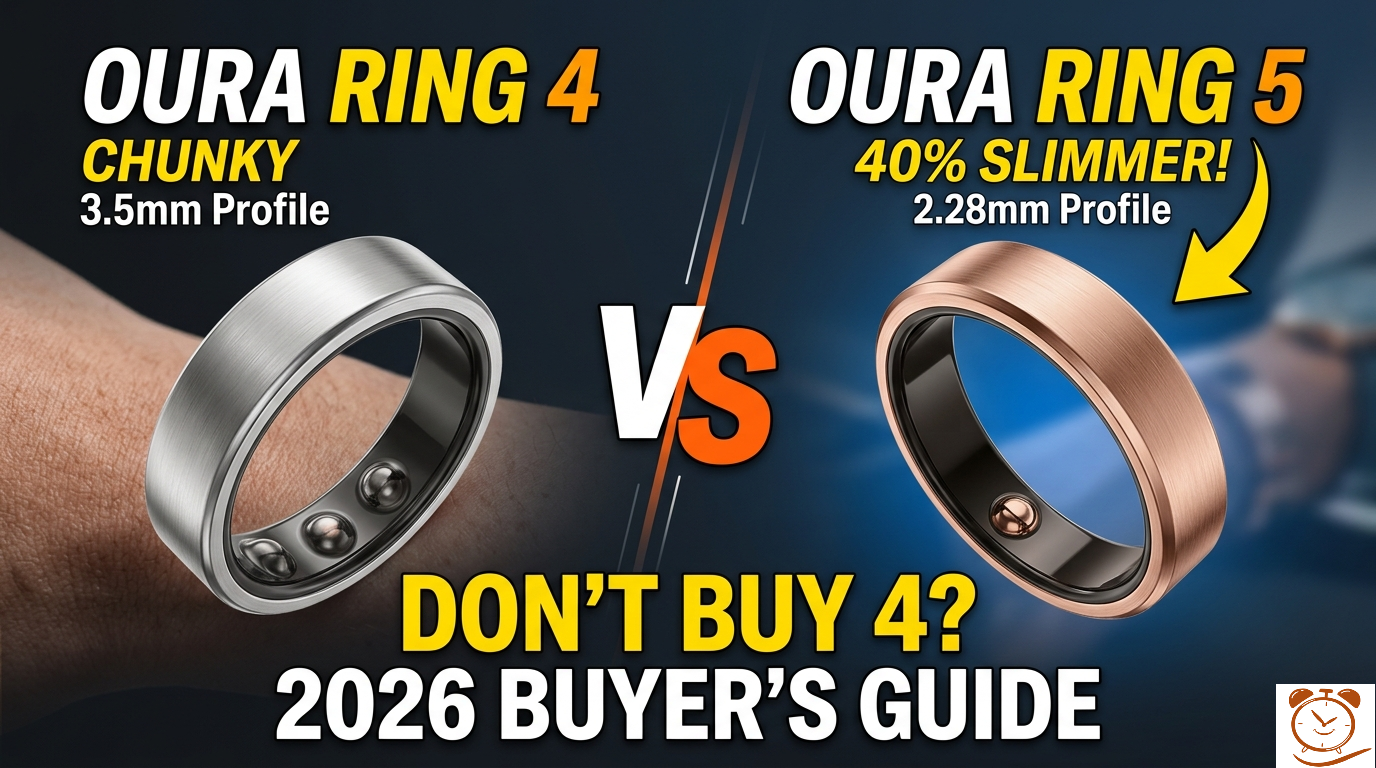
The Ring 5 also features a smoother curvature and a re-engineered interior. Unlike the Ring 4, which had a completely flat interior, the Ring 5 reintroduces precision-engineered, low-profile sensor domes to ensure better skin contact without adding bulk. This design change helps the sensors read your heart rate and temperature more accurately, even when you are moving.
Oura Ring 5 vs 4: Quick Comparison Table
| Feature | Oura Ring 5 (New 2026) | Oura Ring 4 (Previous Gen) | Why It Matters |
|---|---|---|---|
| Physical Size | 40% Smaller (6.09mm wide) | Standard (7.90mm wide) | Ring 5 is significantly slimmer and less noticeable on the finger. |
| Thickness | 2.28 mm | 2.88 mm | The thinner profile makes it more comfortable for sleeping and wearing with other jewelry. |
| Weight | 2g – 2.69g | 3.3g – 5.2g | Ring 5 is incredibly light, feeling almost like a normal band. |
| Battery Life | 6 – 9 Days | 5 – 8 Days | Ring 5 offers slightly better endurance despite being smaller. |
| Sizing Range | Sizes 6 – 13 | Sizes 4 – 15 | Ring 4 is better for very small or very large fingers; Ring 5 has a limited range. |
| Sensors | 12 Pathways (4x stronger LEDs) | 18 Pathways (Smart Sensing) | Ring 5 uses fewer but stronger sensors for better accuracy during movement. |
| Key Features | Live Activity Tracking, Blood Pressure Signals, GLP-1 Tracking | Sleep & Activity Tracking (Software updates add some new features) | Ring 5 hardware enables real-time workout stats and advanced health signals. |
| Durability | PVD Scratch-Resistant Coating | Standard Titanium Coating | Ring 5 is tougher and more resistant to daily scratches. |
| Starting Price | $399 (Silver/Black) | ~$349 (Often discounted) | Ring 5 costs $50 more upfront for the new design and sensors. |
| Subscription | $5.99 / month (Required) | $5.99 / month (Required) | Both rings require a membership to unlock full data and insights. |
| Charging Case | Available ($99) | Not Compatible | Only Ring 5 has a dedicated portable charging case for travel. |
Key Takeaway for Buyers
- Choose Oura Ring 5 if: You want the smallest, most comfortable design, need live workout stats, or have fingers between sizes 6–13. It is the best choice for new buyers who want the latest technology.
- Choose Oura Ring 4 if: You need sizes 4, 5, 14, or 15, are on a tighter budget, or already own a Ring 4 (since most new software features like Health Radar are coming to Ring 4 via updates).
Durability and Materials
Both rings are built from titanium, known for being strong yet lightweight, ensuring they can withstand daily wear. However, the Ring 5 introduces a new scratch-resistant coating using PVD (Physical Vapor Deposition) technology. This is a welcome upgrade, as scratches on smart rings can be unsightly and potentially affect sensor performance over time.
Both devices carry an IP68 rating, meaning they are fully resistant to dust and can be submerged in water. You can wear either ring in the shower, pool, or ocean without worry. The Ring 5’s smaller profile might make it slightly less prone to knocking against doorframes or gym equipment, simply because there is less of it sticking out.
Sizing Options
One area where the Ring 4 actually offers more flexibility is in sizing, which is a crucial detail for many buyers. The Ring 4 was available in sizes 4 through 15, covering a very wide range of finger sizes. The new Ring 5 has a more limited range, available only in sizes 6 through 13.
If you have very small or very large fingers, the Ring 4 might be your only option. This is a crucial detail to check before ordering, as a poor fit can ruin the accuracy of any smart ring.
Health Tracking Features: What’s New in 2026?
When looking at Oura Ring 5 vs 4, the feature set is where the newer model tries to justify its higher price tag with advanced health monitoring capabilities. While both rings track sleep, activity, and readiness, the Ring 5 introduces several groundbreaking features that were not available on the previous generation.
Health Radar and Blood Pressure Signals
The headline feature for the Ring 5 is “Health Radar,” a proactive health monitoring system that looks for early signs of cardiovascular and respiratory issues. Specifically, the Ring 5 can track blood pressure signals and nighttime breathing trends.
It is important to note that the Ring 5 seeks FDA clearance for blood pressure monitoring, meaning it currently provides “signals” and trends rather than a clinical diagnosis. However, having this data overnight is a major step forward for preventive health. The Ring 4 does not have this capability. Interestingly, some sources indicate that certain Health Radar features, like nighttime breathing, may be rolled out to Ring 4 owners via software updates, but the dedicated blood pressure signal tracking appears to be a hardware-specific advantage of the Ring 5 due to its new sensor array.
GLP-1 Medication Tracking
In a move that reflects current health trends, the Ring 5 includes specific tracking for GLP-1 medications like Ozempic, Wegovy, and Mounjaro. This feature helps users understand how these medications affect their sleep, heart rate, and overall recovery. The ring partners with Counsel Health to offer telehealth visits for users interested in these medications. The Ring 4 does not have this dedicated insight category.
Live Activity Tracking
For fitness enthusiasts, the Ring 5 adds “Live Activity Tracking,” allowing you to start a workout in the app and see real-time metrics. You can now see pace, distance, and heart rate on your connected phone while you exercise. Previously, Oura rings were strictly for post-workout analysis. Now, you can use them somewhat like a sports watch during a run or gym session.
The Ring 5 yields a 24% improvement in signal quality during movement compared to previous generations, making this real-time data much more reliable. The Ring 4 lacks this live tracking capability.
Sensor Accuracy and Signal Pathways
You might assume that more sensors mean better accuracy, but Oura has taken a different approach with the Ring 5. The Ring 4 used 18 signal pathways to read your biometrics, while the Ring 5 has reduced this to 12 pathways. However, these 12 pathways are optimized with 4x stronger LEDs and shorter light paths.
Oura claims this results in 12% better overnight HRV accuracy and 19% better workout heart rate accuracy. Independent claims state the Ring 5 achieves 99% heart rate accuracy compared to an ECG and 95% sleep staging accuracy compared to a clinical lab. While the Ring 4 was already highly accurate—with peer-reviewed data showing it hit a concordance correlation coefficient (CCC) of 0.99 for HRV—the Ring 5 aims to perfect this further, especially during high-intensity movement.
A study by the University of Tokyo validated the Ring 5’s accuracy, showing sleep staging accuracy between 75.5% for light sleep and 90.6% for REM sleep. The inter-device reliability was found to be 94.8%. While the Ring 4 also boasts strong validation, the Ring 5’s new sensor layout and stronger LEDs are designed to maintain this accuracy even with the smaller form factor.
Battery Life and Charging
Battery life is often a dealbreaker for wearable devices, and the newer model offers a clear advantage in endurance. In the Oura Ring 5 vs 4 comparison, the Ring 5 wins again with longer usage between charges.
Improved Endurance
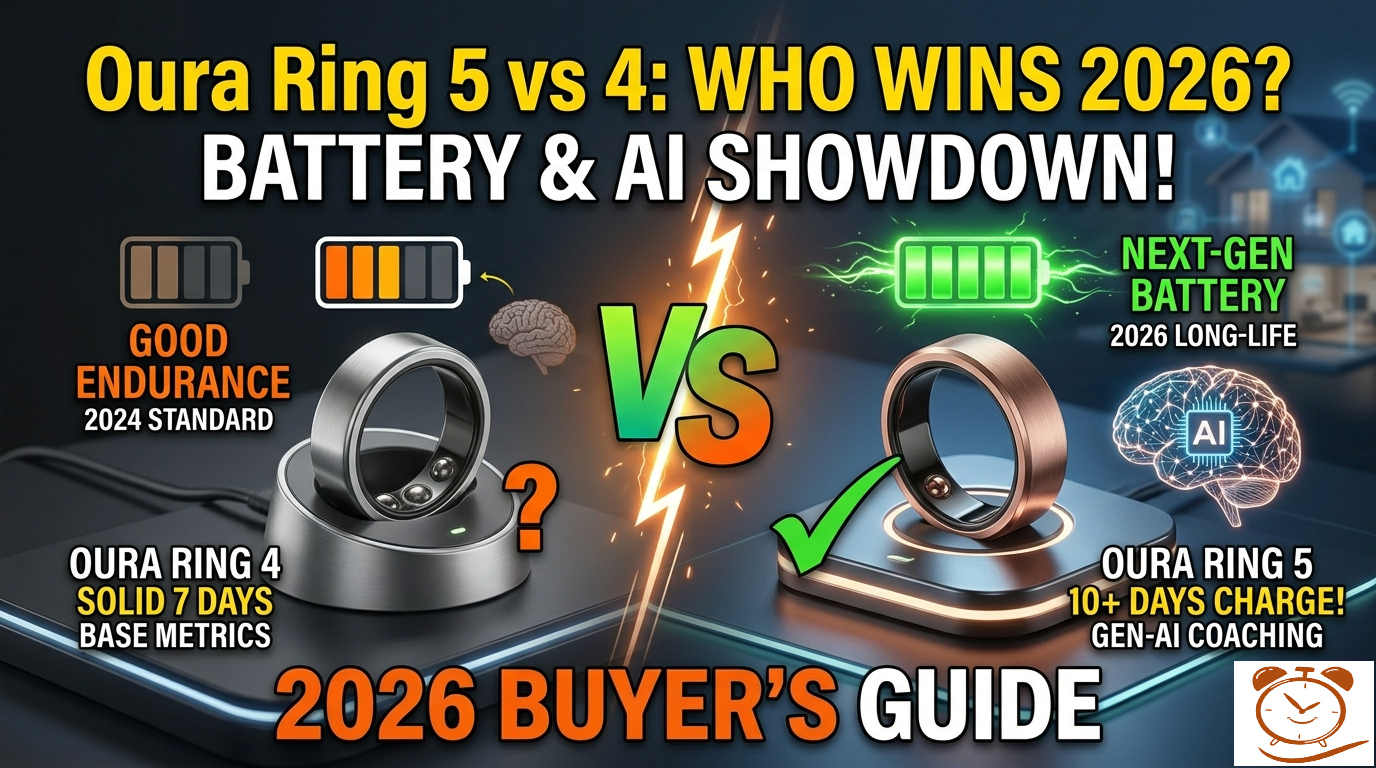
The Ring 4 offered a battery life of 5 to 8 days on a single charge. The Ring 5 has improved this to 6 to 9 days. While an extra day might not sound revolutionary, it means you can potentially go over a week without charging, which is ideal for travel or busy weeks where you might forget your charger.
This improvement comes from a re-engineered battery and sensor system that is more energy-efficient. Despite being smaller and lighter, the Ring 5 manages to last longer, which is a significant engineering achievement.
Charging Options
Both rings use a proprietary USB-C charger, making them easy to plug into standard adapters. However, the Ring 5 introduces an optional portable charging case available for $99. This case acts like a power bank for your ring, extending its battery life significantly when you are on the go. The Ring 4 does not have a dedicated charging case accessory, though you can use any standard USB-C power bank with its cable.
Price and Subscription Costs
Cost is a major factor in deciding between Oura Ring 5 vs 4, as the pricing structure has shifted and requires careful calculation of long-term expenses. The upfront hardware cost is just one part of the equation.
Upfront Hardware Costs
The Oura Ring 5 starts at $399 (or £399) for the standard Silver and Black finishes. Premium finishes, such as gold or special coatings, cost $499 (or £499). In the UAE, pricing starts at Dh1,599 for base finishes and Dh1,999 for premium ones.
The Ring 4 is generally cheaper, offering a more budget-friendly entry point. While prices can vary by retailer, the total 3-year cost analysis shows a clear difference. Over three years, the total cost for a Ring 4 setup is approximately $559, while the Ring 5 setup totals $609. This calculation includes the hardware and the mandatory subscription.
The Mandatory Subscription
This is the most critical financial detail: You must pay a subscription to use the advanced features of either ring. Both the Ring 4 and Ring 5 require a subscription of $5.99 per month (or £5.99) to access detailed health insights, trends, and the new Health Radar features. Without the subscription, the rings provide very limited data, essentially rendering them useless for serious health tracking.
Some users find this recurring cost frustrating, especially after paying nearly $400 for the hardware. However, Oura argues that the subscription funds continuous software updates, new features like the AI Advisor, and server maintenance. The subscription is priced at Dh29.99/month or Dh269/year in the UAE.
Value Proposition
Is the extra cost of the Ring 5 worth it for your specific needs? If you want the smallest possible design, live workout tracking, and blood pressure signals, then yes. The $50 difference in total 3-year cost is relatively small for these added capabilities. However, if you are on a budget and primarily care about sleep and basic activity tracking, the Ring 4 remains an incredible value. It offers 95% of the core experience for less money.
Software and AI Features
Software is the brain of the operation, and the Oura Ring 5 vs 4 comparison isn’t just about hardware; it’s about the intelligence behind the data. The newer ring launches with enhanced digital tools.
Oura Advisor and AI Insights
The Ring 5 launches with an enhanced “Oura Advisor,” an AI-powered tool that provides personalized health insights. It combines your historical data with real-time inputs to give you actionable advice. For example, it might suggest when to rest based on your cardiovascular strain or how your recent workout affected your sleep. While the Ring 4 will likely receive some of these software updates, the Ring 5’s faster processor and new sensors allow it to leverage these AI features more effectively.
Multi-Ring Support
A new feature for families or couples is “Multi-Ring Support,” allowing you to manage multiple rings under one account. You can now add additional rings for an extra fee of $99. This makes it easier to track the health of a partner or family member without needing separate subscriptions for everything. This feature is available for the Ring 5 ecosystem.
- Top casino online în România – Clasamente actualizate pentru sloturi și jackpoturi
- Best Non-GamStop Casinos in the UK
- Thor Fortune casino ES – slots y otros juegos de casino
- Pin Up Casino – Azərbaycanda Onlayn Kazino – Giriş və Qeydiyyat
- Best Non-GamStop Casinos in the UK
Health Records Integration
The Ring 5 supports “Health Records,” allowing you to connect clinical data from your doctors directly into the Oura app. This creates a more complete picture of your health, combining daily wearable data with official medical records. This is a significant step toward integrating consumer wearables into mainstream healthcare.
Who Should Buy Which Ring?
Deciding between Oura Ring 5 vs 4 comes down to your specific needs, finger size, and budget constraints. Here is a breakdown to help you choose.
Buy the Oura Ring 5 If:
- You want the smallest design: The 40% size reduction makes it the best choice for those with smaller fingers or those who hate the feeling of bulky jewelry.
- You need live workout data: If you want to see your heart rate and pace in real-time while running or lifting, the Ring 5 is the only option.
- You are interested in preventive health: The new blood pressure signals and nighttime breathing trends in Health Radar offer a deeper look into your long-term cardiovascular health.
- You take GLP-1 medications: The dedicated tracking for Ozempic and similar drugs is a unique and valuable tool for users on these medications.
- Budget is not a primary concern: The slightly higher cost is justified by the newer technology and longer battery life.
Buy the Oura Ring 4 If:
- You want the best value: The Ring 4 is cheaper upfront and has a lower total cost of ownership over three years.
- You need extreme sizes: If you need a size 4, 5, 14, or 15, the Ring 4 is your only choice since the Ring 5 stops at 6 and 13.
- Sleep tracking is your main goal: The Ring 4’s sleep tracking is already validated and highly accurate. Unless you specifically need the new breathing trends, the Ring 4 performs exceptionally well here.
- You don’t care about live stats: If you are happy reviewing your workout data after the fact, you don’t need the Ring 5’s live tracking features.
My Final Thought
The Oura Ring 5 vs 4 decision is not about one ring being “bad” and the other “good,” as both are excellent devices that lead the smart ring market in 2026. The Ring 4 is a mature, proven device that offers fantastic sleep and activity tracking at a great price. It is the sensible choice for most people.
However, the Ring 5 is a technological marvel. By shrinking the device by 40% while adding stronger sensors, better battery life, and advanced health features like blood pressure monitoring and live workout tracking, Oura has set a new standard. If you can afford the extra cost and the mandatory subscription, the Ring 5 is the superior device. It future-proofs your purchase with features that will likely become essential in the coming years.
For those prioritizing comfort and the latest health insights, the Ring 5 is the clear winner. For those who want reliable tracking without breaking the bank, the Ring 4 remains a top-tier recommendation. Whichever you choose, you are getting one of the most accurate and unobtrusive health trackers available today.
Remember, the subscription is required for both, so factor that $5.99 monthly cost into your decision. With the Ring 5, you are paying a premium for innovation and miniaturization. With the Ring 4, you are paying for proven performance. In the fast-moving world of wearable tech, both rings prove that the future of health monitoring is right on your finger.
Limitations & Unknowns
While the Ring 5 boasts impressive specs, it is important to note that peer-reviewed validation studies specifically for the Ring 5 are still emerging. Most accuracy claims currently rely on internal data or early studies like the one from the University of Tokyo. Additionally, the blood pressure monitoring feature is not yet FDA-cleared for diagnostic use, meaning it provides trends rather than medical-grade readings. Finally, the **limited size range **(6-13) of the Ring 4.