

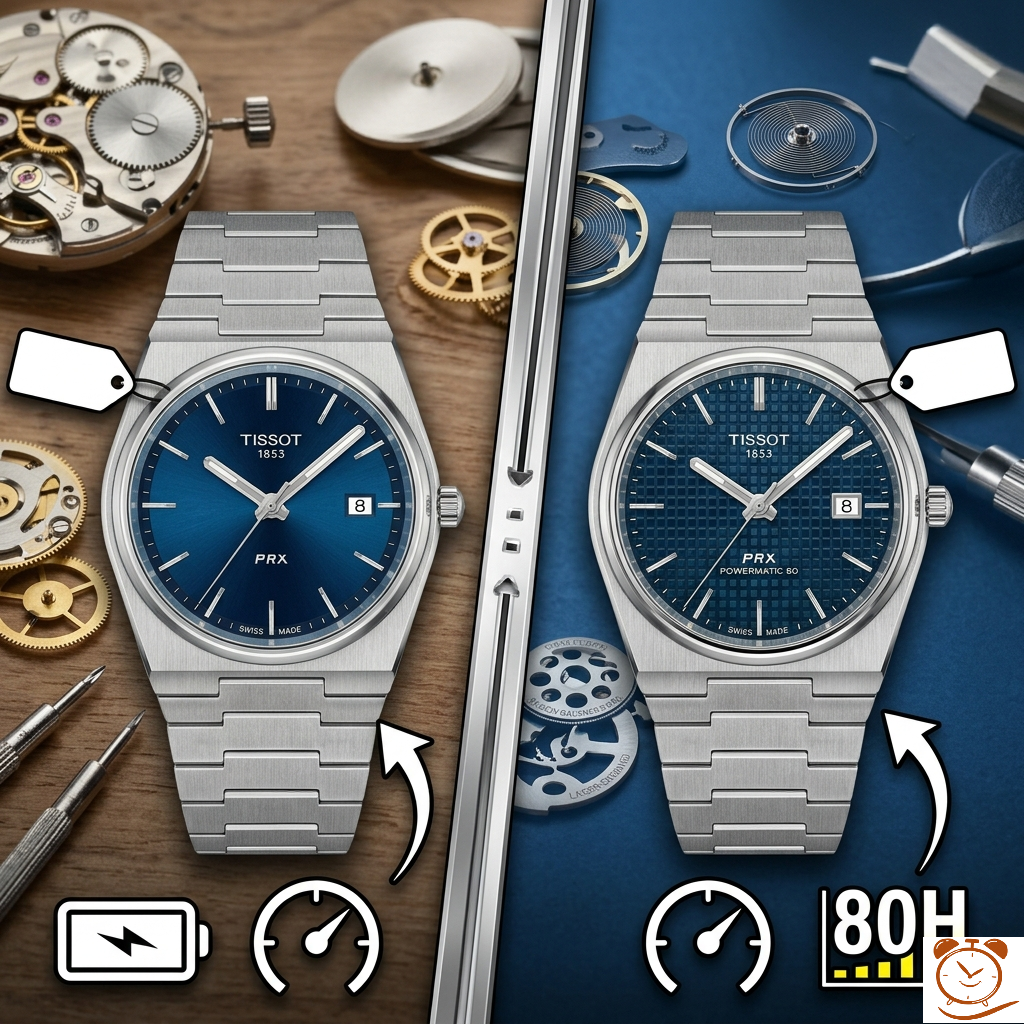
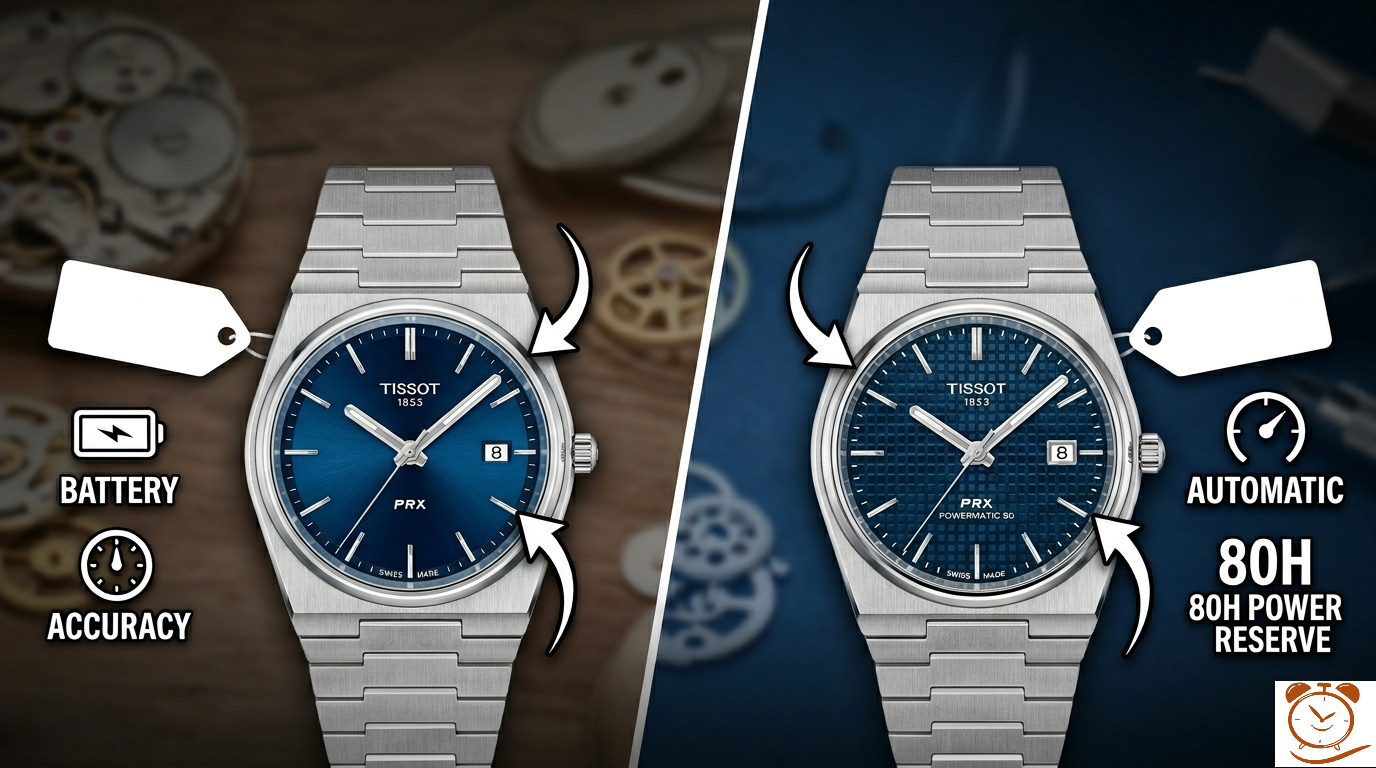
Choosing between the Tissot PRX Quartz and the Tissot PRX Powermatic 80 often comes down to a simple choice: do you want a precise, low-maintenance tool, or a traditional mechanical machine with a sweeping second hand? The Tissot PRX Quartz vs Tissot PRX Powermatic 80 debate highlights a $300 price difference that buys you an automatic movement, an exhibition case back, and a textured “waffle” dial, while the quartz version offers superior accuracy (±10 seconds/month) and a slimmer profile (9.6mm–10.4mm). Both watches share the same iconic 1970s design, 100m water resistance, and sapphire crystal, making them top contenders in the affordable luxury segment.
The Tissot PRX Quartz vs Tissot PRX Powermatic 80 comparison reveals two distinct watches hidden inside the same stunning case. The Quartz model is the champion of accuracy and convenience, costing roughly $395–$450 USD (₹35,500–₹45,000 INR) and requiring almost no maintenance beyond a battery change every 2–3 years. In contrast, the Powermatic 80 automatic costs $650–$750 USD (₹48,000–₹70,000 INR) and offers the emotional appeal of a mechanical movement with an 80-hour power reserve, a visible exhibition case back, and a unique waffle-patterned dial. While the automatic version is slightly thicker (10.9mm vs 10.4mm) and less accurate (±15 seconds/day), it provides a traditional watchmaking experience that many collectors prefer.
Understanding the Core Difference: Movement
The heart of the Tissot PRX Quartz vs Tissot PRX Powermatic 80 discussion is the movement, or the engine, that drives the watch. This single component dictates the price, the feel, and the daily experience of owning the timepiece.
The Tissot PRX Quartz model is powered by the Swiss-made ETA F06.115 movement. This is a battery-operated mechanism that uses a quartz crystal to keep time. It is incredibly reliable and accurate, ticking once per second. You simply put it on, and it works perfectly without any need for winding. The battery typically lasts between 2 to 3 years before needing a simple replacement.
On the other side, the Powermatic 80 model features the Calibre Powermatic 80.111 automatic movement. This is a mechanical engine that runs without a battery. It harnesses the natural motion of your wrist to wind a mainspring, which stores energy to power the watch. This results in a smooth, sweeping motion of the second hand, a hallmark of mechanical watches. It also includes a Nivachron hairspring, a special component that resists magnetism from everyday electronics like phones and laptops, ensuring better timekeeping stability.
Price Comparison: Global and India Markets
Price is often the deciding factor when choosing between these two models. The Tissot PRX Quartz vs Tissot PRX Powermatic 80 price gap reflects the complexity of the automatic movement versus the simplicity of the quartz one.
Global Pricing (USD)
In the United States and global markets, the Quartz version serves as the entry point into the PRX collection.
- Tissot PRX Quartz: Prices typically range from $395 to $450.
- Tissot PRX Powermatic 80: Prices are higher, generally sitting between $650 and $750. Special editions or specific finishes can reach up to $850.
Pricing in India (INR)
For buyers in India, the price difference remains consistent, offering a clear value proposition for each tier.
- Tissot PRX Quartz: Available for approximately ₹35,500 to ₹45,000.
- Tissot PRX Powermatic 80: Ranges from ₹48,000 to ₹70,000. The popular 35mm automatic models with colored dials (blue, green, black) are often listed around ₹61,000 to ₹65,000 on official channels.
| Feature | Tissot PRX Quartz | Tissot PRX Powermatic 80 |
|---|---|---|
| US Price Range | $395 – $450 | $650 – $750 |
| India Price Range | ₹35,500 – ₹45,000 | ₹48,000 – ₹70,000 |
| Movement Type | Battery (Quartz) | Automatic (Mechanical) |
| Case Back | Solid | Exhibition (See-through) |
Design and Dimensions: Thickness and Wearability
While they look identical from a distance, the internal mechanics create subtle but noticeable differences in how the watches wear on your wrist.
Case Thickness
The Quartz model is the clear winner for those who prefer a slim, understated profile.
- 40mm Quartz: Measures 10.4 mm thick.
- 35mm Quartz: Even slimmer at just 9.60 mm.
This thinness allows the Quartz model to slide effortlessly under tight dress shirt cuffs, making it an excellent choice for office wear.
The Powermatic 80 automatic is slightly thicker due to the rotor and mainspring barrel.
- 40mm Automatic: Measures 10.9 mm thick (some sources cite 11.3 mm).
- 35mm Automatic: Stands at 10.93 mm.
While only about 0.5 mm to 0.9 mm thicker, this gives the automatic a bit more presence and heft on the wrist, which some enthusiasts prefer for a sportier feel.
Dial Texture and Visuals
One of the easiest ways to spot the difference in the Tissot PRX Quartz vs Tissot PRX Powermatic 80 lineup is the dial texture.
- Quartz Dials: Typically feature a sunburst or matte finish. This creates a clean, radial shine that reflects light from the center outward.
- Powermatic 80 Dials: Famous for the “Clous de Paris” or waffle pattern. This grid of tiny squares catches light dynamically, creating shadows and depth that change as you move your wrist. Many fans argue this texture gives the automatic model a more premium and intricate look.
Case Back Design
The back of the watch tells another story. The Quartz model has a solid, screw-down stainless steel case back, which is practical and robust. The Powermatic 80, however, boasts an exhibition case back. This sapphire window allows you to view the mechanical movement inside, watching the rotor spin and the balance wheel oscillate—a mesmerizing feature for watch lovers.
Performance: Accuracy and Power Reserve
When it comes to keeping time and running duration, the two technologies offer very different strengths.
Accuracy
If precision is your top priority, the Quartz model is unbeatable.
- Quartz Accuracy: Approximately ±10 seconds per month. You might only need to reset the time once every few months.
- Automatic Accuracy: Rated at ±10 to 15 seconds per day. Over a month, this could mean a deviation of several minutes. While excellent for a mechanical watch in this price range, it simply cannot match the quartz crystal’s precision.
Power Reserve
The “power reserve” refers to how long the watch runs without intervention.
- Quartz: Runs for 2 to 3 years on a single battery. It is a “set it and forget it” experience.
- Powermatic 80: Offers an impressive 80-hour power reserve. If you take the watch off on Friday evening, it will still be running when you put it back on Monday morning. This is achieved by using a longer, thinner mainspring and running the movement at a lower frequency (21,600 vibrations per hour) to save energy.
The Plastic Component Controversy Explained
A common topic in forums regarding the Tissot PRX Quartz vs Tissot PRX Powermatic 80 is the use of plastic parts in the automatic movement. It is important to understand the facts to make an informed decision.
The Powermatic 80.111 movement uses synthetic polymer (plastic) components for the escape wheel and pallet fork. These are critical parts that control the release of energy. Traditionalists often prefer metal, leading to concerns about durability. However, these are not ordinary plastics; they are high-tech polymers engineered to be:
- Self-lubricating: They reduce friction without needing as much oil, potentially lowering wear.
- Anti-magnetic: They are immune to magnetic fields that can disrupt metal parts.
- Durable: Tissot and the Swatch Group state these parts can withstand temperatures over 110°C and are designed for long-term reliability.
During servicing, Tissot often replaces the entire movement module rather than repairing individual plastic gears. This ensures the watch returns to factory specifications. While some purists may dislike the idea of plastic, the engineering intent is to reduce maintenance and improve resilience in modern environments.
Maintenance and Servicing Costs
Owning a watch involves ongoing care, and the costs differ significantly between the two models.
Quartz Maintenance
The Quartz model is incredibly low maintenance.
- Battery Change: Required every 2–3 years. This is a quick, inexpensive service available at most jewelers.
- Servicing: Rarely needs a full mechanical service due to fewer moving parts.
Automatic Maintenance
The Powermatic 80 requires more attention to keep it running smoothly.
- Service Interval: Recommended every 3 to 5 years.
- Service Cost: Approximately $200 USD (or around ₹4,000–₹6,000 INR depending on the center) at authorized service centers. Independent watchmakers might charge slightly less (around $130 USD), but authorized centers guarantee genuine parts and proper water-resistance testing.
- Process: Due to the plastic components, the service often involves swapping the movement for a reconditioned unit rather than repairing individual gears.
Size Options: 35mm vs 40mm
Both movements are available in two case sizes, catering to different wrist sizes and style preferences.
40mm Models
The 40mm size is the standard “men’s” size, fitting average to larger wrists comfortably. Both the Quartz and Automatic 40mm models share the same diameter and 100m water resistance. The 40mm automatic is ideal for those who want a watch with a bit more wrist presence.
35mm Models
The 35mm size is perfect for smaller wrists or those who prefer a vintage, understated look. It is widely considered a unisex size.
- 35mm Quartz: The thinnest option at 9.60 mm, offering a sleek, jewelry-like profile.
- 35mm Automatic: Retains the beloved waffle dial and exhibition case back but is slightly thicker at 10.93 mm. It is available in stunning dial colors like blue, black, green, and white mother-of-pearl.
Water Resistance and Durability
Regardless of which movement you choose, the Tissot PRX Quartz vs Tissot PRX Powermatic 80 models are built to last.
- Water Resistance: Both models are rated to 100 meters (10 ATM / 330 feet). This means you can safely wear them while swimming, snorkeling, or in the shower.
- Materials: The cases are crafted from 316L stainless steel, known for its resistance to rust and corrosion.
- Crystal: Both feature scratch-resistant sapphire crystal with an anti-reflective coating. Sapphire is one of the hardest materials known, second only to diamond, ensuring the glass stays clear and scratch-free for years.
Which One Should You Buy?
Deciding between the Tissot PRX Quartz vs Tissot PRX Powermatic 80 depends entirely on what you value in a timepiece.
Choose the Tissot PRX Quartz if:
- Budget is key: You want to save ~$300 (or ₹20,000).
- Accuracy matters most: You want a watch that is precise to within seconds a month.
- You prefer slimness: You want the thinnest possible watch (9.6mm) that disappears under a cuff.
- Low maintenance: You don’t want to worry about servicing or winding.
Choose the Tissot PRX Powermatic 80 if:
- You love mechanics: You appreciate the engineering of a self-winding movement and the smooth sweep of the second hand.
- Visuals matter: You love the waffle dial texture and the ability to see the movement through the exhibition case back.
- Weekend convenience: You want the 80-hour power reserve so you can take it off for two days and it still runs.
- Tradition: You value the heritage and emotional connection of a mechanical watch.
Both watches offer incredible value and style. The Quartz is the smart, practical tool, while the Powermatic 80 is the romantic, mechanical companion. You truly cannot go wrong with either.
Limitations & Unknowns
While this report covers the vast majority of known specifications and user experiences, a few areas remain based on projections or limited data:
- Long-term Plastic Durability: While accelerated testing suggests the polymer parts are durable, real-world data on these specific components over 20+ years is still being gathered as the movement is relatively modern.
- 2026 Specific Pricing: Prices listed are based on current trends and late 2025 data; exact 2026 MSRPs may vary slightly due to inflation or currency fluctuations.
- Extreme Condition Performance: Specific data on the 80-hour reserve performance under extreme temperature variations or shock conditions beyond standard ISO testing is not publicly detailed by the manufacturer.