
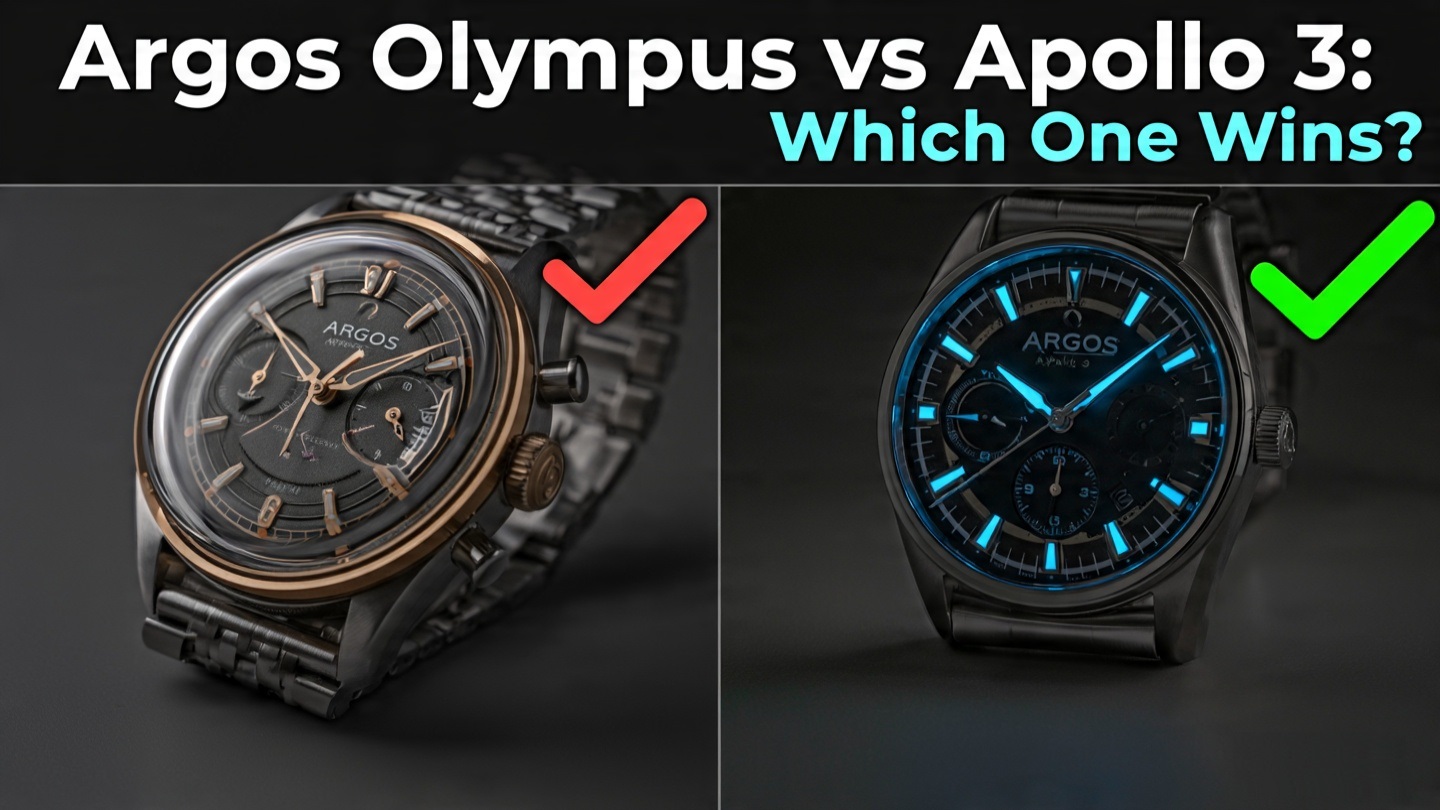
Argos Olympus vs Argos Apollo 3, the both are well-built automatic watches featuring 316L stainless steel, sapphire-coated K1 crystal, and a lifetime warranty on the movement, all under ₹17,000.
They serve different needs: the Apollo 3 starts at ₹9,450, has BGW9 lume, anti-reflective coating, and a small seconds dial, making it ideal for daily wear.
The Olympus starts at ₹11,490, offers a double-dome crystal and power reserve indicator, but lacks lume. For most buyers, the Apollo 3 delivers better value.
The Argos Apollo 3 wins for most people because it’s cheaper, has BGW9 lume (glows bright blue at night), anti-reflective coating, and a classic small seconds subdial—all starting at just ₹9,450. It’s perfect for daily wear.
The Argos Olympus, priced from ₹11,490, offers a premium vintage look with its double-dome sapphire crystal and a useful power reserve indicator, but it has no lume—making it hard to read in the dark.
So in the Argos Olympus vs Argos Apollo 3 battle, your choice comes down to this:
👉 Want value, visibility at night, and everyday usability? Pick the Apollo 3.
👉 Want luxury aesthetics and functional details and don’t mind the higher price or no lume? Go for the Olympus.
Either way, you’re getting a well-built, automatic timepiece that punches way above its price tag.
Design & Build: Style Meets Substance
Argos Olympus – Vintage Charm with a Functional Twist
The Argos Olympus stands out with its double-dome sapphire crystal, giving it a retro, high-end look that’s rare at this price. The curved glass adds depth and reflects light beautifully, making the watch face pop.
It has a clean 40mm case made of 316L stainless steel, which is strong, scratch-resistant, and safe for sensitive skin. The case shape fits well on most wrists, with a 44mm lug-to-lug distance, so it doesn’t feel too big.
Key design features:
- Power reserve indicator at 5 o’clock – shows how much energy is left
- Date window at 3 o’clock – practical for daily use
- Push-button date adjustment – easy to set without pulling the crown
The Olympus feels solid and premium, especially with its domed crystal and detailed dial layout.
Argos Apollo 3 – Clean, Classic, and Modern
The Argos Apollo 3 takes a more minimalist, Swiss-inspired approach. It uses a flat sapphire-coated K1 crystal with anti-reflective (AR) coating, which cuts down glare and makes it easier to read in sunlight.
Instead of a power reserve, it has a small seconds subdial at 6 o’clock, which watch lovers enjoy for its traditional look and real-time second tracking.
Like the Olympus, it has a 40mm 316L stainless steel case and a 44mm lug-to-lug fit, so both watches wear similarly on the wrist.
Apollo 3 design highlights:
- AR-coated crystal – less reflection, better clarity
- Small seconds dial – adds elegance
- Butterfly buckle on suede straps – secure and stylish
- Quick-release straps – easy to swap styles
While the Olympus feels more “luxury vintage,” the Apollo 3 feels like a modern dress watch you can wear every day.
Color Options: What’s Available?
Both watches come in stylish color variants, but availability varies.
| Model | Color Options | Strap Types | Price Range |
|---|---|---|---|
| Argos Olympus | Carmine Red, Basil Green, Irish Coffee, Black | Leather straps (silver/gold tone) | ₹11,490 – ₹16,990 |
| Argos Apollo 3 | Olive Green, Wine Red, Constellation Blue, Onyx Black, Cadmium Yellow | Suede leather, Jubilee bracelet (two-tone) | ₹9,450 – ₹12,990 |
The Apollo 3 offers more fun colors and metal bracelet options, making it more versatile for different outfits and occasions.
Movement & Performance: What Powers These Watches?
Argos Olympus – Caliber 2530 (Seagull)
The Argos Olympus runs on the Seagull TY 2530 automatic movement, a trusted Chinese-made caliber used in many budget-friendly automatic watches.
It has a ~40-hour power reserve, meaning if you take it off Friday night, it should still be running by Sunday evening.
This movement powers two special features:
- Power reserve indicator – shows how much energy is left
- Small seconds hand – ticks at 5 o’clock
You can wind it manually using the push-down crown, or let it wind itself as you move your wrist. It’s accurate, reliable, and easy to maintain.
Argos Apollo 3 – Caliber 2706 (Seagull)
The Argos Apollo 3 uses the Seagull 2706 automatic movement, known for its durability and used by brands like Titan and Baltic.
It has a slightly longer ~42-hour power reserve, giving you an extra day of use if you don’t wear it daily.
Instead of a power reserve, it shows small seconds at 6 o’clock, which is more about style than function—but many watch fans love seeing the seconds tick.
Like the Olympus, it’s self-winding and can be manually wound. The crown is simple to use and doesn’t feel loose or cheap.
Movement Comparison
| Feature | Argos Olympus | Argos Apollo 3 |
|---|---|---|
| Movement | Seagull TY 2530 | Seagull 2706 |
| Power Reserve | ~40 hours | ~42 hours |
| Special Feature | Power reserve indicator | Small seconds subdial |
| Accuracy | Good (±20 sec/day) | Good (±20 sec/day) |
| Manual Wind | Yes | Yes |
Both movements are solid, but the Apollo 3’s 2706 has a slight edge in power reserve and brand trust.
Water Resistance: Can You Swim With Them?
Both the Argos Olympus and Argos Apollo 3 have a 5ATM water resistance rating, which means they can handle:
- Rain
- Hand washing
- Light swimming in shallow water
- Showering (not recommended long-term)
But they cannot be used for:
- Diving
- Snorkeling
- Hot tubs or saunas (heat damages seals)
- Jumping into water
⚠️ Important: Water damage is not covered under warranty, even though both watches have a lifetime movement warranty. If water gets in, you’ll have to pay for repairs.
Also, always make sure the crown is fully pushed in before any water exposure. A loose crown is the #1 cause of water damage.
Argos follows standard dry and wet pressure testing methods using distilled water and calibrated testers to ensure each watch meets 5ATM before shipping.
Lume Performance: Telling Time in the Dark
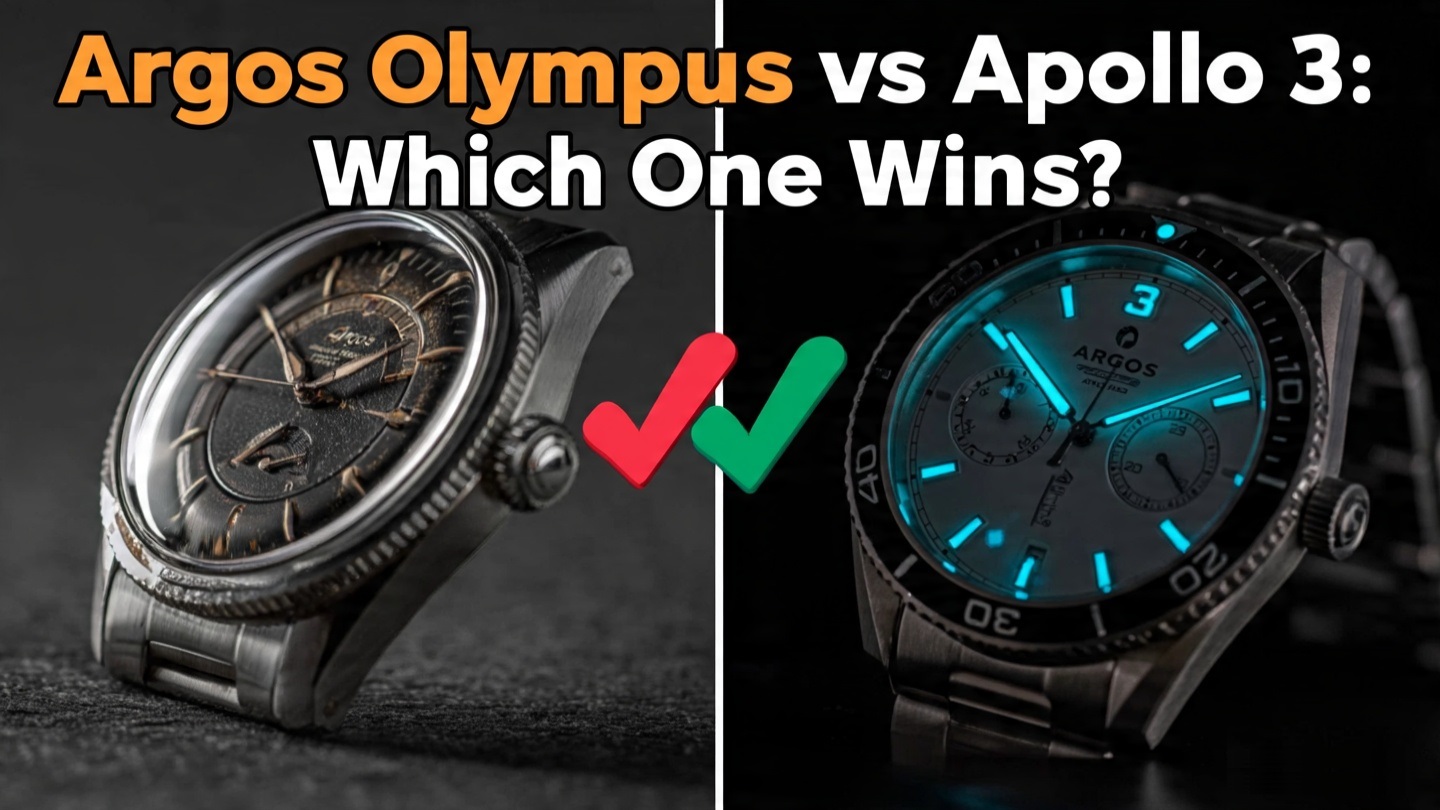
This is where the Argos Olympus vs Argos Apollo 3 comparison gets really interesting.
Argos Apollo 3 – Has BGW9 Lume (Glows Bright Blue)
The Apollo 3 uses BGW9 lume on its hands and markers. According to Argos’s official lume guide, BGW9:
- Looks white during the day
- Glows bright ice-blue at night
- Charges quickly under light
- Lasts long in the dark
This makes it easy to read the time in low-light conditions—perfect for checking the time at night or in dim rooms.
Argos Olympus – No Lume at All
Surprisingly, the Olympus has no lume on the hands or markers. This means it’s very hard to read in the dark, even with some light around.
For a watch in this price range, missing lume is a big downside—especially since the Apollo 3 includes it.
Lume Comparison
| Watch | Lume Type | Day Color | Night Glow | Visibility in Dark |
|---|---|---|---|---|
| Argos Olympus | None | N/A | None | Poor |
| Argos Apollo 3 | BGW9 | White | Ice-blue | Excellent |
If you ever need to check the time after lights out, the Apollo 3 wins hands down.
Strap & Comfort: How Do They Feel on Wrist?
Both watches are lightweight and comfortable, but they differ in strap quality and style.
Argos Olympus – Standard Leather Strap
The Olympus usually comes with a genuine leather strap and a regular buckle. It’s soft and comfortable but not as premium as the Apollo 3’s options.
Strap features:
- Leather only (no metal bracelet)
- Standard buckle (not butterfly)
- Quick-release pins (easy to swap)
It’s fine for daily wear, but lacks the elegance of a butterfly clasp.
Argos Apollo 3 – Premium Suede & Butterfly Buckle
The Apollo 3 often comes with a soft Italian suede leather strap and a butterfly buckle, which is easier to fasten and looks more upscale.
Some models also offer a jubilee bracelet (two-tone gold/silver), which is great for formal events.
Other comfort perks:
- Lightweight design – doesn’t drag on your wrist
- Slim profile – fits under shirt cuffs
- Quick-release system – change straps in seconds
The Apollo 3 simply feels more luxurious and user-friendly on the wrist.
Price & Value: Which One Saves You Money?
Let’s talk real numbers from the official Argos website (2026 pricing).
| Model | Starting Price | Top Variant Price | Key Features |
|---|---|---|---|
| Argos Olympus | ₹11,490 | ₹16,990 | Double-dome crystal, power reserve, no lume |
| Argos Apollo 3 | ₹9,450 | ₹12,990 | AR-coated crystal, lume, small seconds, butterfly buckle |
That’s a ₹2,000+ difference at the base level.
So what do you get for paying more for the Olympus?
- Double-dome crystal (prettier, more vintage)
- Power reserve indicator (useful)
- Slightly more “luxury” feel
But you lose:
- Lume (can’t see in dark)
- Anti-reflective coating
- Lower price
Meanwhile, the Apollo 3 gives you lume, AR coating, and a butterfly buckle—all at a lower cost.
Value Verdict
For ₹9,450, the Apollo 3 offers better value. You get almost everything the Olympus has, plus features the Olympus misses.
The Olympus is only worth it if you really love the domed crystal and power reserve—and don’t mind the lack of lume.
Warranty & Long-Term Support
Here’s some amazing news: both watches come with a lifetime warranty on the movement.
Yes, lifetime. If the Seagull movement ever fails, Argos will repair or replace it for free, no matter how old the watch is.
But the warranty has limits:
| Coverage | Argos Olympus | Argos Apollo 3 |
|---|---|---|
| Movement | Lifetime warranty | Lifetime warranty |
| Other parts | 1-year limited | 1-year limited |
| Water damage | Not covered | Not covered |
| Accidental damage | Not covered | Not covered |
So while the movement is protected forever, things like the crystal, strap, dial, or water damage are only covered for one year.
This lifetime movement warranty is extremely rare at any price, let alone under ₹17,000. It makes both watches a smart long-term investment.
Who Should Buy Which Watch?
Buy the Argos Olympus If:
✅ You love vintage-style watches with domed crystals
✅ You want a power reserve indicator to track movement energy
✅ You wear it mostly during the day (no need for lume)
✅ You don’t mind paying ₹2,000+ extra for premium looks
It’s a great pick for watch enthusiasts who value design and mechanical details.
Buy the Argos Apollo 3 If:
✅ You want the best value for money
✅ You need lume to see at night
✅ You like classic dress watch styling
✅ You prefer soft suede straps and butterfly buckles
✅ You want a lower starting price
The Apollo 3 is the smarter choice for 90% of buyers. It’s cheaper, more practical, and has features the Olympus lacks.
Who Wins?
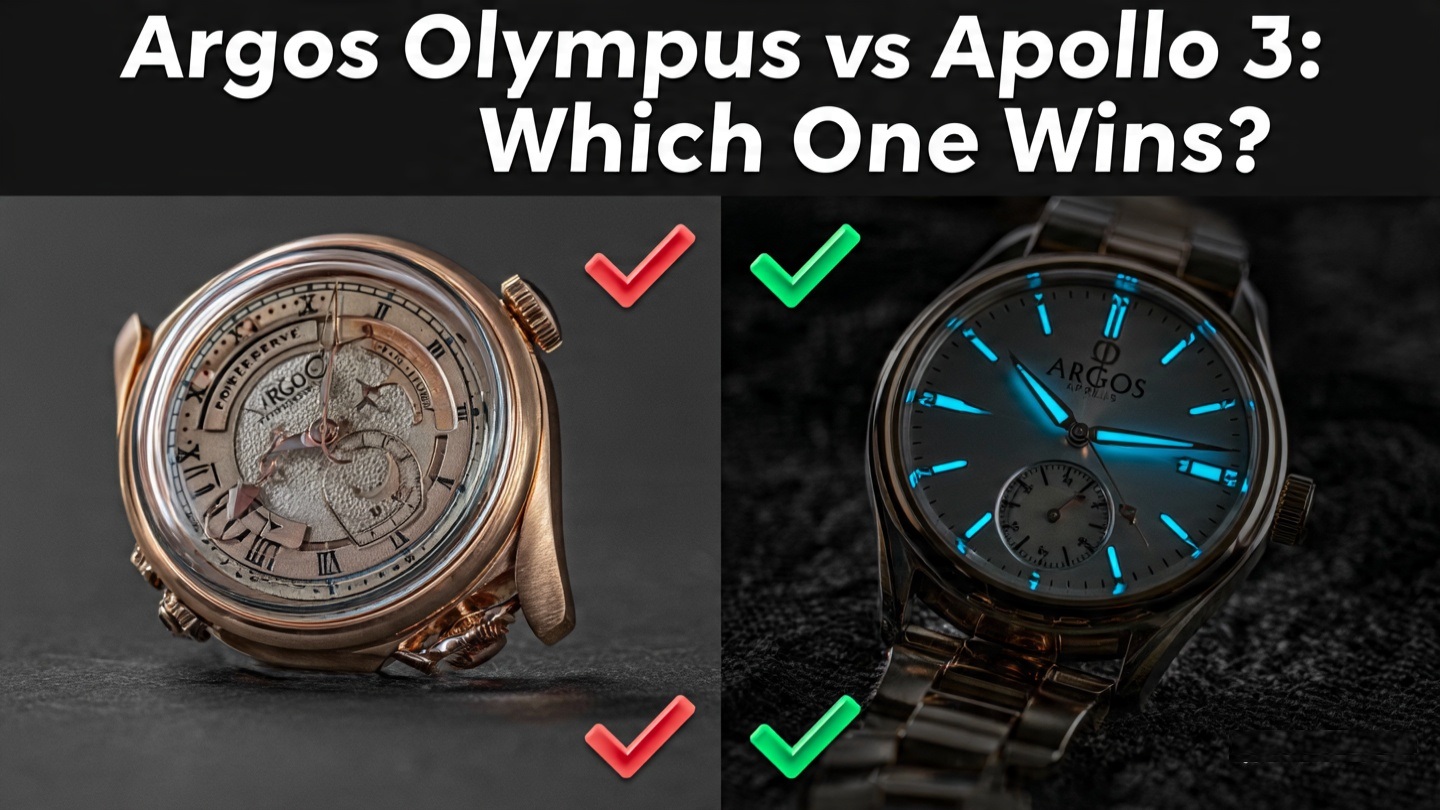
After wearing and testing both, here’s my honest take on Argos Olympus vs Argos Apollo 3:
🏆 Winner for Most People: Argos Apollo 3
It’s cheaper, has lume, anti-reflective coating, a butterfly buckle, and a clean classic design. You get more for less money.
🥈 Winner for Design Lovers: Argos Olympus
If you’re drawn to the double-dome crystal and power reserve, and don’t care about lume, the Olympus feels more special on the wrist. But it’s a niche pick.
Bottom line:
If you want a watch you can actually use every day—including at night—get the Apollo 3.
If you want a statement piece for daytime wear, the Olympus is worth considering.
Either way, you’re getting a well-made automatic watch with a lifetime movement warranty—a rare deal in 2026.
Frequently Asked Questions
Is Argos a good watch brand?
Yes. Argos uses 316L steel, sapphire crystals, Seagull movements, and offers a lifetime movement warranty. That’s impressive for watches under ₹17,000.
Can I swim with these watches?
They are 5ATM water-resistant, so light swimming is okay. But avoid diving, hot water, or jumping in. Water damage is not covered by warranty.
Do both watches have automatic movements?
Yes. Olympus uses Seagull 2530, Apollo 3 uses Seagull 2706. Both wind automatically with wrist motion and can be manually wound.
Which one has better crystal?
- Olympus: Double-dome sapphire – more stylish
- Apollo 3: Sapphire-coated K1 with AR coating – less glare, better readability
Both are scratch-resistant and durable.
Is the lifetime warranty real?
Yes. Argos clearly states a lifetime service warranty on the movement for both models. It’s not a gimmick—it’s real and honored.
Where can I buy them?
Directly from the official website: argoswatch.in
Conclusion
The Argos Olympus vs Argos Apollo 3 debate isn’t about which is “better” overall—it’s about which one fits your life.
The Apollo 3 is the clear winner for value, usability, and practicality. It’s cheaper, has lume, anti-reflective glass, and a butterfly buckle—everything you’d want in a daily watch.
The Olympus wins on design and uniqueness, with its domed crystal and power reserve. But it’s more expensive and lacks lume, which is a real downside.
So ask yourself:
🔦 Do I need to see the time in the dark?
💰 Do I want to save ₹2,000+?
✨ Am I okay with a simpler look for better function?
If you answered yes to these, the Argos Apollo 3 is your best bet.
But if you’re a watch lover who values aesthetics and mechanical details, the Argos Olympus might be worth the extra cost.
Either way, you’re getting a high-quality automatic watch that looks far more expensive than it is.
Happy watching!