

You can trust WHOOP sleep tracking accuracy for heart rate, HRV, and overall sleep duration, but not for perfect minute-by-minute sleep stage breakdowns. The device achieves 99.7% heart rate accuracy and 89% agreement on sleep vs. wake states compared to medical studies. However, it tends to overestimate total sleep time and REM sleep by roughly 20 minutes. While it cannot diagnose medical disorders like sleep apnea, it is a top-tier tool for spotting long-term trends in recovery and sleep consistency, outperforming many smartwatches in comfort and battery life.
If you wear a fitness tracker, you probably check your sleep score every morning. It feels like a report card for your night. But have you ever stopped to ask: is this number real? Can a small strap on your wrist really know if you were in deep sleep or just tossing and turning? This is the big question for anyone thinking about buying a WHOOP device. Today, we are going to dig deep into Whoop sleep tracking accuracy to see if the data is something you can actually trust.
Sleep is the foundation of our health. If we do not know how well we are sleeping, we cannot fix our energy, our mood, or our workouts. WHOOP has become very popular among athletes and regular people alike because it promises to tell us exactly how our body is recovering. But with so many devices on the market, from rings to watches, it is hard to know which one tells the truth. In this post, we will look at the real numbers, the science behind the sensors, and what the latest updates in 2026 mean for you. We will keep things simple and clear, so you can decide if WHOOP is the right tool for your sleep journey.
The Core Question: How Accurate Is WHOOP Really?
When we talk about accuracy, we have to look at two different things. First, can the device measure your heart rate correctly? Second, can it guess what stage of sleep you are in? Let’s start with the heart, because that is the engine of the whole system.
Heart Rate and HRV: The Strong Suit
The good news is that WHOOP is incredibly good at measuring your heart. During sleep, when you are not moving around much, the device is nearly perfect. Studies have shown that WHOOP is 99.7% accurate in measuring heart rate compared to medical-grade ECG machines. This is a huge number. It means that for every 1,000 beats your heart takes, WHOOP might only miss or miscount three of them.
Even more impressive is how it handles Heart Rate Variability, or HRV. HRV is the tiny change in time between your heartbeats. It is a key sign of how stressed or recovered your body is. Measuring this is very hard for small devices. Yet, WHOOP achieves 99% accuracy in measuring HRV during sleep. This level of precision is why so many coaches and athletes trust the “Recovery” score that WHOOP gives them. If the heart data is this good, it gives the sleep algorithm a very strong foundation to work with.
However, it is not magic. There are things that can mess up the reading. If the strap is too loose, if you have tattoos on your wrist, or if the room is very cold, the accuracy can drop. Also, if you move your wrist a lot, like during a intense workout, the heart rate reading might struggle. But for sleep, where you are mostly still, the heart data is as close to medical grade as you can get without wires stuck to your chest.
Sleep vs. Wake: Getting the Basics Right
Before a device can tell you if you are in “Deep Sleep,” it has to know if you are asleep at all. This is called sleep-wake classification. Here, WHOOP performs very well. When compared to a clinical sleep study (the gold standard called PSG), WHOOP correctly identifies whether you are asleep or awake about 89% of the time.
This means that if you are sleeping, WHOOP will know it 95% of the time. This is called “sensitivity.” It rarely misses the fact that you are asleep. However, it is not as good at knowing when you are awake. It only correctly identifies wakefulness about 51% to 57% of the time. This is a common problem for almost all wrist trackers. If you lie in bed reading a book or scrolling on your phone, WHOOP might think you are in light sleep because your heart rate is low and you are not moving much.
So, if you see a lot of “light sleep” in your app right before you fall asleep or right after you wake up, take it with a grain of salt. The device is great at knowing you are asleep, but it can struggle to see those quiet moments of wakefulness.
Breaking Down the Sleep Stages
Now we get to the tricky part. Sleep is not just one thing. It is made of Light Sleep, Deep Sleep, and REM (Rapid Eye Movement) sleep. Each stage does something different for your body. Light sleep helps you transition, Deep Sleep repairs your muscles, and REM helps your brain process memories. Can Whoop sleep tracking accuracy handle these specific stages?
The short answer is: it is good, but not perfect. No consumer watch or ring is perfect at this yet. Even doctors sometimes disagree when looking at sleep charts. But let’s look at the numbers for WHOOP.
Light Sleep: The Most Common Stage
Light sleep makes up the biggest part of your night. WHOOP is decent at tracking this, but it often overestimates it. In some studies, WHOOP correctly identified light sleep about 58% to 62% of the time. Other newer data suggests that with algorithm updates, this agreement can be higher, but there is still room for error.
One common mistake is that WHOOP sometimes thinks you are in light sleep when you are actually awake. About 28% of the time, the device might label “wake time” as “light sleep”. This is why your total sleep time on WHOOP might look longer than what you feel you slept. If you woke up for 20 minutes in the night but stayed still, WHOOP likely counted that as light sleep. This is why experts say you should trust the trends over the exact numbers. If your light sleep goes up or down over a week, that trend is real, even if the exact minute count is a bit off.
Deep Sleep: The Recovery Hero
Deep sleep is crucial for feeling refreshed. WHOOP 4.0 and the newer 5.0 models have gotten much better at spotting this stage. In fact, in head-to-head tests against clinical studies, WHOOP 4.0 was actually the best among many popular devices (including Apple Watch and Fitbit) at identifying Deep Sleep. It correctly classified nearly 70% of Deep Sleep periods.
This is a strong point for the brand. If you are an athlete or someone who works out hard, knowing your deep sleep is vital. The device uses your heart rate and movement to guess when your body is in this repair mode. While it might miss some short bursts of deep sleep, it is generally reliable at telling you if you got a good amount of restorative rest. Newer updates in 2025 and 2026 have pushed this accuracy even higher, with some reports showing deep sleep detection in the 82-84% range for the WHOOP 5.0.
REM Sleep: The Brain Booster
REM sleep is where you dream. Tracking this is hard because your brain is active, but your body is paralyzed. WHOOP has a known tendency to overestimate REM sleep. Some studies show it overestimates REM by about 21 minutes per night compared to a clinical study.
The accuracy for correctly spotting REM epochs is around 66% to 75% depending on the model and the study. While this is “good” for a wrist device, it is not perfect. Sometimes, WHOOP might confuse light sleep for REM, or vice versa. For example, one study noted that 23% of REM sleep was misclassified as light sleep. Despite this, WHOOP is still considered one of the better options for REM tracking, often performing nearly as well as the Oura Ring, which is famous for its sleep tracking.
The Impact of New Updates and WHOOP 5.0
Technology moves fast. If you are reading this in mid-2026, you might be looking at the WHOOP 5.0 or the updated 4.0 software. The company does not just release hardware; they constantly update the brain of the device.
The 2025 Algorithm Boost
In late 2024 and throughout 2025, WHOOP released major updates based on two years of research with universities like Central Queensland University and the University of Arizona. These updates made the sleep staging about 7% more accurate. This might not sound like a lot, but in the world of sleep science, a 7% jump is significant. It means fewer mistakes between light and deep sleep, and a better understanding of when you are truly awake.
This improvement comes from training the computer models on more data. WHOOP uses thousands of hours of clinical sleep study data to teach its algorithm what real sleep looks like. By feeding it more examples, the device gets smarter at guessing your stages.
WHOOP 5.0 Features and Battery Life
The latest hardware, the WHOOP 5.0, brings some physical changes that help with accuracy too. One of the biggest complaints about older wearables was having to take them off to charge. If you take your tracker off to charge, you miss data. WHOOP 4.0 introduced a slide-on battery pack that lets you charge while wearing it. The WHOOP 5.0 takes this further.
There are some varying reports on the battery life of the 5.0. Some sources state it has a massive 14-day battery life, while others mention 6 to 7 days. Regardless of the exact number, the ability to charge without removing the strap ensures you get 24/7 data. Continuous data is key for Whoop sleep tracking accuracy because the device learns your baseline better when it never takes a break.
The 5.0 also boasts a 0.98 heart rate correlation when worn on the biceps. Many users wear WHOOP on their arm instead of their wrist for better accuracy during workouts. This flexibility means the sleep data is built on rock-solid heart metrics, no matter where you wear it.
How WHOOP Compares to the Competition
To really understand if you can trust WHOOP, we have to compare it to the other big names: Oura Ring, Apple Watch, and Garmin. Each has its strengths.
WHOOP vs. Oura Ring
The Oura Ring is often seen as the king of sleep tracking. It sits on your finger, which some say gives a better blood flow signal than the wrist. In terms of raw stage accuracy, Oura Ring Gen 4 often leads the pack, with some studies showing around 79-80% agreement with clinical studies. WHOOP is close behind, with many comparisons showing them performing nearly the same, especially for REM and light sleep.
However, WHOOP shines in what it does with the data. While Oura gives you great stats, WHOOP is famous for its “coaching.” It tells you what to do with the information. It calculates a “Sleep Performance Score” that looks at sufficiency, consistency, efficiency, and stress. Many users feel that WHOOP’s advice on how to improve their sleep is more actionable than Oura’s. If you want the absolute highest stage accuracy, Oura might have a tiny edge. But if you want a system that coaches you to sleep better, WHOOP is a top contender.
| Feature | WHOOP 5.0 | Oura Ring Gen 4 |
|---|---|---|
| Form Factor | Wrist/Bicep Strap | Finger Ring |
| Deep Sleep Accuracy | ~82-84% | ~84-86% |
| REM Accuracy | Good (76-80%) | Good (78-82%) |
| Battery Life | 6-14 Days | 4-7 Days |
| Primary Focus | Recovery & Strain Coaching | Sleep & Readiness |
| Subscription | Required ($25-$30/mo) | Required ($6/mo after trial) |
WHOOP vs. Apple Watch
The Apple Watch is a great all-around device, but it was not built primarily for sleep. It has a screen, notifications, and apps, which can be distracting. For sleep tracking specifically, the Apple Watch is good at detecting when you are awake. It beats WHOOP in “specificity,” meaning it is better at knowing when you are lying in bed awake.
However, the Apple Watch struggles more with Deep Sleep accuracy compared to WHOOP. Also, the battery life of the Apple Watch is a major hurdle. You have to charge it every day, which often means taking it off before bed or finding a time during the day to charge it. This interrupts the continuous data stream. WHOOP, with its multi-day battery and no screen, is designed to be forgotten on your wrist, leading to more consistent long-term data.
WHOOP vs. Garmin
Garmin watches are powerful tools for runners and cyclists. Their sleep tracking has improved a lot in recent years. However, studies show that Garmin’s accuracy can vary more between different models. WHOOP tends to be more consistent. While Garmin offers a lot of data, WHOOP’s focus on recovery and HRV gives it an edge for people focused on health optimization rather than just workout metrics. Neither device can replace a medical sleep study, but WHOOP’s dedicated focus on recovery makes its sleep insights feel more tailored.
Understanding the Limitations: What WHOOP Cannot Do
It is very important to be realistic. As good as Whoop sleep tracking accuracy is, it is not a medical device. You cannot use it to diagnose sleep disorders like sleep apnea or insomnia.
Not a Medical Diagnosis
No consumer tracker—whether it is a ring, a band, or a smart mattress—can replace a clinical polysomnography (PSG) test. A clinical test uses wires on your head (EEG) to measure brain waves. WHOOP only uses light sensors on your skin. It can guess your brain state based on your heart, but it cannot see your brain waves directly.
This means that if you think you have a serious sleep problem, you must see a doctor. WHOOP is a tool for pattern recognition, not diagnosis. It can show you trends, like “my sleep is worse when I drink alcohol,” but it cannot tell you “you have sleep apnea.”
Sleep Apnea Detection
That said, the technology is moving toward health screening. The Apple Watch has received clearance for sleep apnea screening in some regions. WHOOP 5.0 has added “breathing variability flags” in its 2025 firmware updates. This means if your breathing is very irregular, the app might warn you to check with a doctor. However, as of now, WHOOP does not have a formal CE-marked detection system for Obstructive Sleep Apnea (OSA) like some medical devices do. It is a helpful hint, not a diagnosis.
The “Black Box” of Algorithms
Another thing to remember is that WHOOP uses a “black box” algorithm. This means they do not show you exactly how they calculate every number. They use machine learning trained on PSG data. While this makes the device smart, it also means you have to trust their math. Sometimes, the device might give you a low recovery score, and you feel fine. Or vice versa. This is why it is crucial to listen to your body first and use the device as a second opinion.
Pricing and Value: Is It Worth the Cost?
One of the biggest factors in trusting a device is whether you feel you are getting value for your money. WHOOP operates on a subscription model. You do not buy the hardware outright; you pay a monthly fee to use it.
The Cost Breakdown
The pricing can vary slightly depending on the plan and region. Current information suggests a monthly cost of around $25 to $30 per month. If you commit to a longer plan, like a year, the price drops. Annual plans can range from $149 to $330 depending on the tier and any discounts applied.
This is different from buying an Apple Watch or a Garmin, where you pay a large amount upfront and then nothing else. With WHOOP, you are paying for the continuous service, the coaching, and the constant hardware upgrades. When a new version like the 5.0 comes out, members often get access to it without buying a whole new ecosystem.
Is the Subscription Justified?
For many users, the answer is yes, but it depends on what you want. If you just want to know what time you fell asleep, a cheap tracker or a free phone app might work. But if you want deep insights into your HRV, your strain, and how your daily habits affect your sleep, WHOOP provides a level of detail that is hard to find elsewhere.
The app is widely praised for its education. It doesn’t just give you a number; it teaches you about sleep science. It explains why your sleep was poor and suggests changes. This “coaching” aspect is where WHOOP leads the market. Users report that the education provided by the app helps them make real lifestyle changes, which arguably makes the data “accurate” in a practical sense—it leads to real results.
Tips to Maximize Your WHOOP Accuracy
If you decide to use WHOOP, there are things you can do to make sure the data is as accurate as possible. The device is smart, but it needs your help.
- Wear It Tight: The sensor needs to touch your skin firmly. If it is loose, light can leak in, and the heart rate reading will fail. Make sure the band is snug, especially before bed.
- Placement Matters: While most people wear it on the wrist, wearing it on the bicep can improve accuracy, especially if you have tattoos on your wrist or if you move your hands a lot in your sleep. The “WHOOP Body” apparel, which holds the sensor against your torso or bicep, is designed to fix accuracy issues during high-movement activities, but it also helps stabilize the sensor for sleep.
- Keep It Clean: Sweat and dirt can block the sensors. Clean your band and the sensor regularly to ensure a good reading.
- Update Regularly: WHOOP frequently pushes software updates that improve the algorithm. Make sure your device is updated to get the latest 7% accuracy boost and other improvements.
- Look at Trends, Not Nights: Do not panic if one night looks weird. Maybe the device missed a wake period. Look at your average deep sleep over a month. That trend is far more reliable and useful than a single night’s data.
Can You Trust the Data? My Personal Analysis and Research
So, can you trust Whoop sleep tracking accuracy? The answer is a confident “Yes,” but with a clear understanding of what that means.
You can trust it to tell you if you are asleep or awake with high reliability (89% agreement). You can trust it to measure your heart rate and HRV with near-medical precision (99%+). You can trust it to show you trends in your deep sleep and REM sleep that correlate well with how you feel.
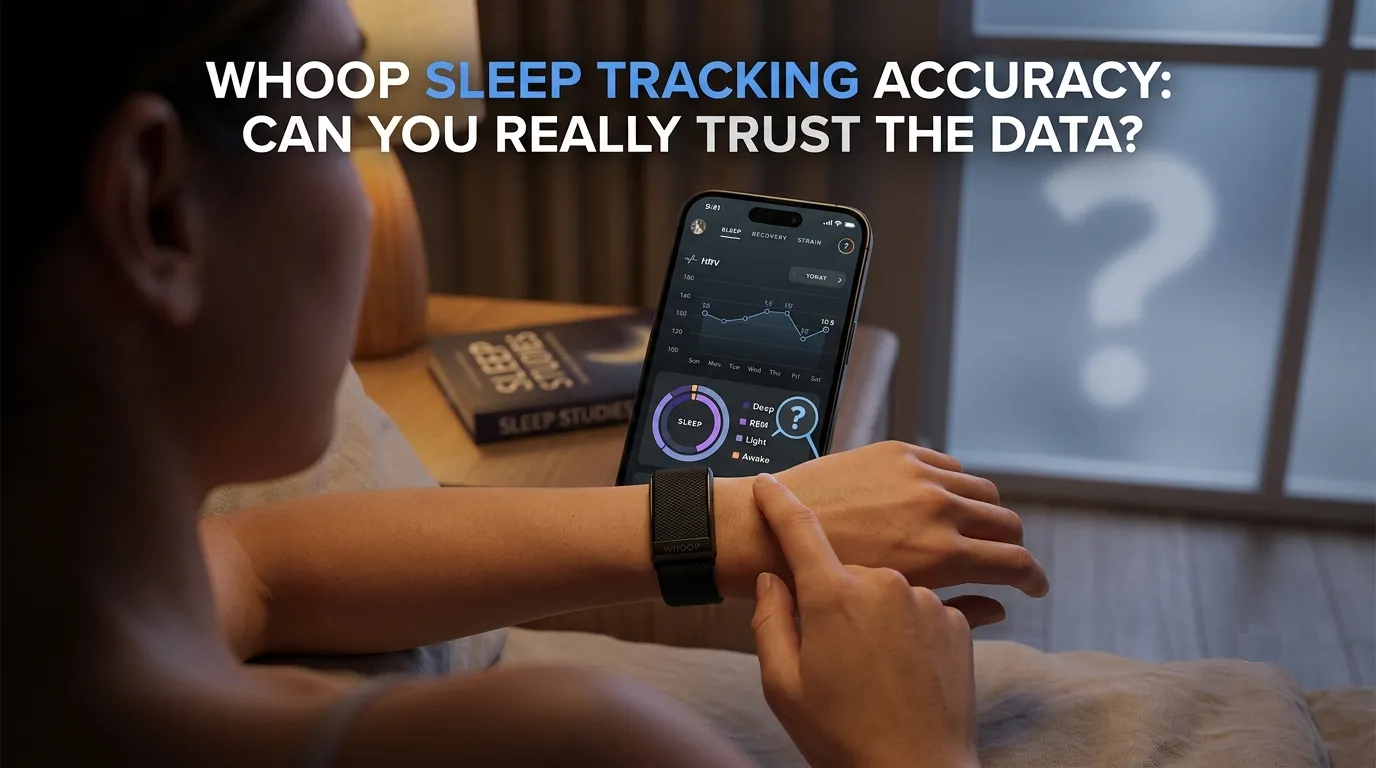
However, you should not trust it to give you a perfect minute-by-minute breakdown of your sleep stages. It will likely overestimate your total sleep time by counting quiet wakefulness as light sleep. It might overestimate your REM sleep by 20 minutes or so. These are small errors in the grand scheme of a night’s rest, but they are errors nonetheless.
For the average person, the elite athlete, or the biohacker, WHOOP provides some of the best sleep data available on the consumer market today. It outperforms many smartwatches in consistency and recovery insights. While the Oura Ring might have a slight edge in raw stage classification numbers in some studies, WHOOP’s combination of hardware comfort, battery life, and actionable coaching makes it a top-tier choice.
In the end, the most accurate sleep tracker is the one you wear consistently. WHOOP’s design encourages 24/7 wear, which builds a massive dataset about your body. Over time, this data becomes incredibly valuable. It helps you see how caffeine, alcohol, late meals, and stress impact your rest. Even if the exact numbers are off by a few percent, the patterns it reveals are real and trustworthy.
If you are willing to look past the need for clinical perfection and embrace the device as a guide for better habits, WHOOP is a tool you can rely on. It won’t replace a doctor, but it might just help you sleep better than you ever have before.
Limitations & Unknowns
While this report covers extensive data, there are still some blind spots. Long-term user experiences specifically regarding the WHOOP 5.0 over a full year are still emerging, as the device is relatively new in 2026. Additionally, specific data on how the algorithm handles rare sleep disorders beyond basic breathing irregularities is not publicly detailed in peer-reviewed studies yet. Finally, while battery life is stated as up to 14 days, real-world usage with all features enabled may vary, affecting continuous tracking reliability for some users.
Frequently Asked Questions (FAQs)
How accurate is Whoop sleep tracking?
Whoop sleep tracking is generally considered highly accurate for measuring total sleep time, sleep duration, and recovery trends. However, like all wrist-based wearables, it may not always match medical-grade sleep studies for detailed sleep stage analysis.
Can Whoop detect sleep apnea?
No. Whoop is not designed to diagnose or detect sleep apnea. It can monitor respiratory rate, heart rate, and sleep duration, but if you suspect sleep apnea, you should consult a healthcare professional and undergo a clinical sleep study.
Is Whoop more accurate than the Apple Watch for sleep tracking?
Whoop provides detailed recovery and sleep insights, while Apple Watch offers broader smartwatch features. Accuracy depends on the specific sleep metric being measured.
Does Whoop accurately track REM sleep?
Whoop estimates REM sleep using sensor data and proprietary algorithms. While useful for tracking trends, it cannot match the precision of a medical sleep study.
Can Whoop track deep sleep accurately?
Whoop provides an estimate of deep sleep based on physiological signals. It is valuable for monitoring long-term trends but should not be considered a medical-grade measurement.
Does Whoop automatically detect when you fall asleep?
Yes. Whoop automatically detects sleep onset and wake-up times without requiring manual input in most situations.
Is Whoop sleep tracking worth the subscription?
If you value detailed recovery insights, strain analysis, and long-term health tracking, many users find the subscription worthwhile. For basic sleep tracking alone, simpler devices may be sufficient.
How does Whoop measure sleep quality?
Whoop measures sleep quality using total sleep time, sleep consistency, sleep stages, disturbances, heart rate, heart rate variability (HRV), and respiratory rate.
Can Whoop monitor naps?
Yes. Whoop can automatically detect naps and include them in your daily recovery and sleep analysis.
Does Whoop track heart rate during sleep?
Yes. Whoop continuously tracks your heart rate while you sleep, helping provide insights into recovery, stress, and overnight health metrics.
Can Whoop detect snoring?
No. Whoop does not include a microphone, so it cannot detect or record snoring.
How does Whoop compare with Oura Ring for sleep tracking?
Both devices offer advanced sleep tracking. Whoop focuses on athletic recovery and strain, while Oura Ring emphasizes overall wellness and detailed sleep insights.
Is Whoop suitable for athletes?
Yes. Whoop is widely used by athletes because it combines recovery monitoring, strain analysis, sleep tracking, and performance insights into one wearable.
How often should I wear Whoop for accurate sleep tracking?
For the most reliable data, wear Whoop continuously throughout the day and night, including during workouts and while sleeping.
Can Whoop improve my sleep habits?
Whoop cannot directly improve sleep, but its personalized recovery insights and sleep recommendations can help you develop healthier sleep habits over time.