

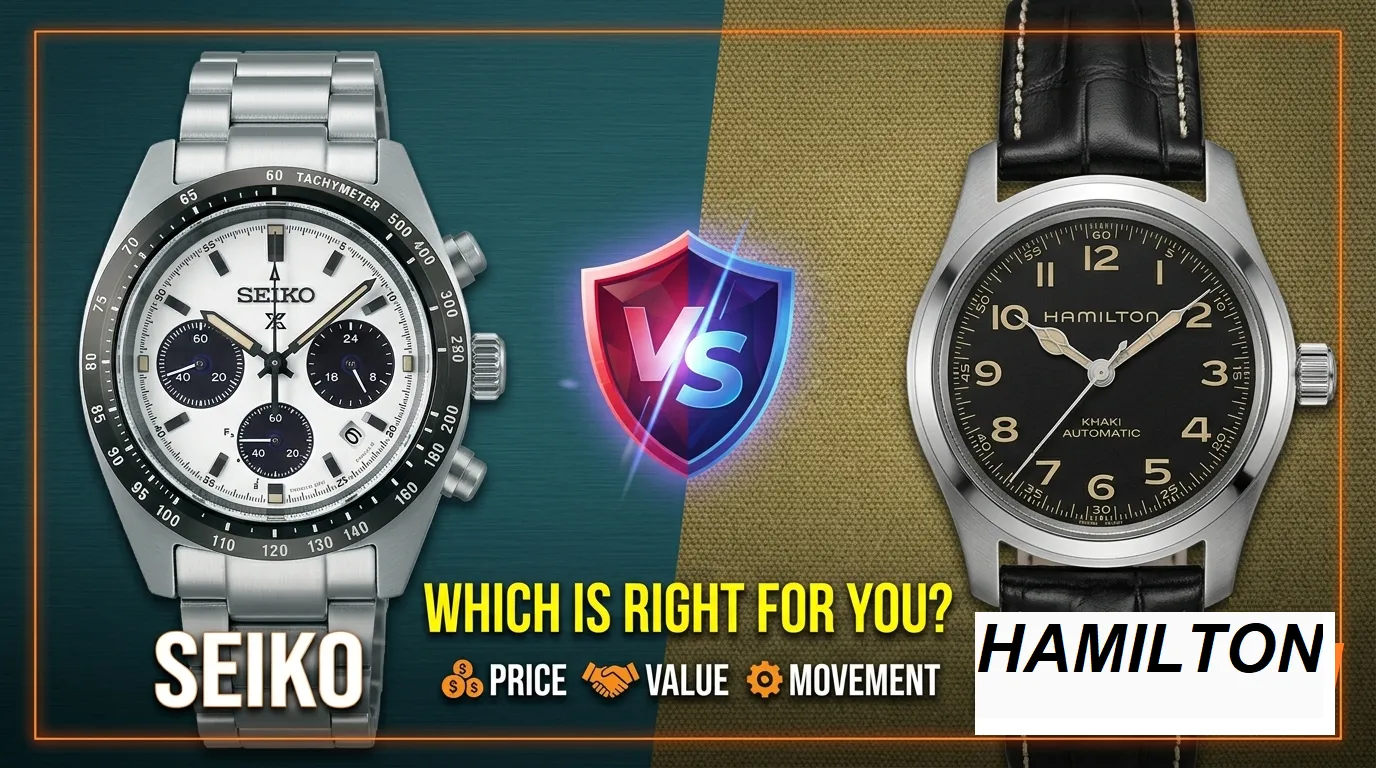
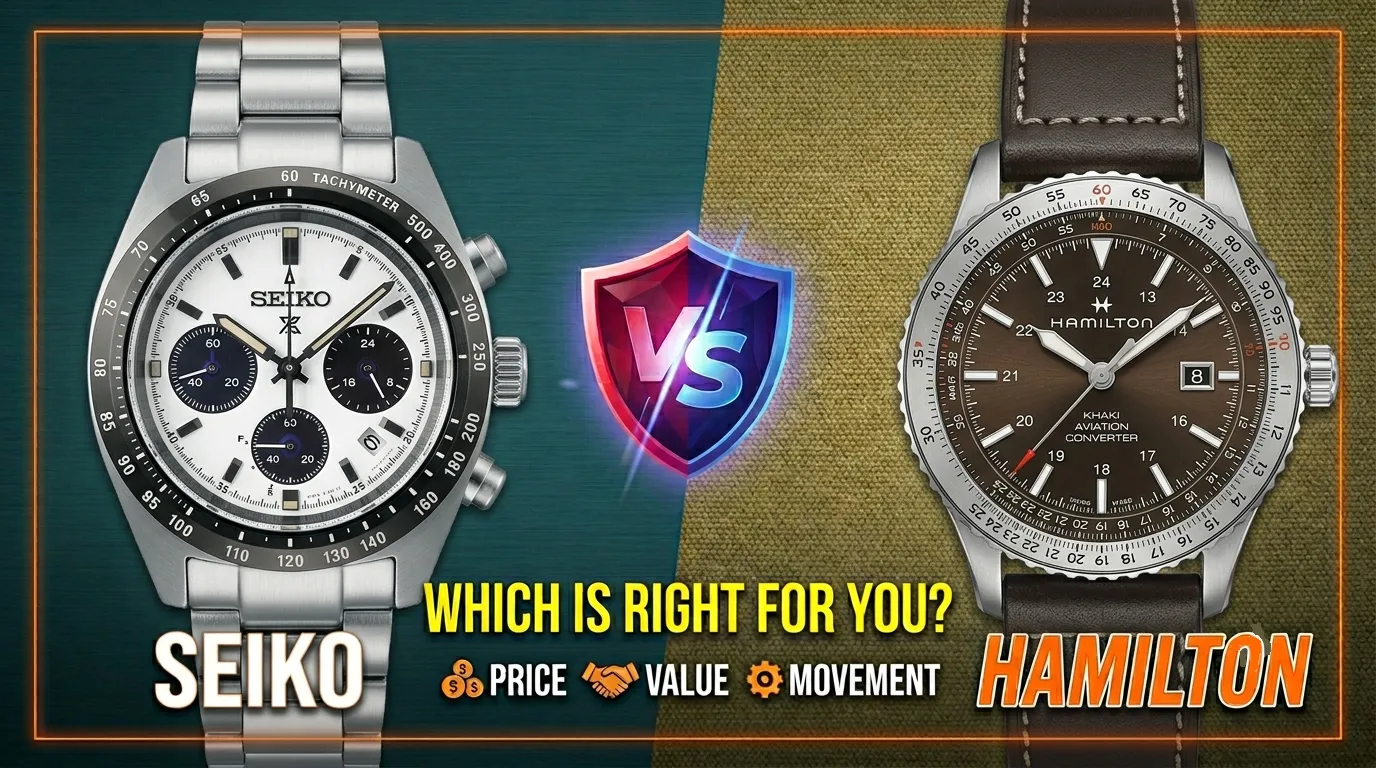
Choosing between Seiko and Hamilton is one of the toughest decisions for watch lovers. Both brands offer amazing history and great value, but they serve different needs. If you need a quick answer: Seiko wins on affordability, water resistance, and variety, while Hamilton wins on movement finishing, Swiss heritage, and design elegance.
This guide breaks down the Seiko vs Hamilton Watch debate using real data on price, quality, features, and owner experiences. We will help you decide which brand deserves a spot on your wrist based on facts, not just marketing.
Executive Summary
The Seiko vs Hamilton Watch battle comes down to what you value most in a timepiece. Seiko dominates the entry-level market with models under $100 and offers superior water resistance (often 200m) compared to Hamilton’s standard 100m. Hamilton counters with Swiss-made movements featuring an 80-hour power reserve and better accuracy ratings (-10/+15s/d vs Seiko’s -15/+25s/d).
While Seiko provides better lume and dial craftsmanship in its mid-range lines, Hamilton shows stronger short-term value retention (+2.7% average return over one year). However, Seiko’s high-end Presage and Grand Seiko lines can outperform Hamilton in long-term appreciation. Potential buyers should note recent user reports regarding Hamilton’s quality control issues with water resistance and straps, whereas Seiko faces criticism for wider accuracy variances.
The Core Difference: Japanese Precision vs. Swiss-American Heritage
Understanding the soul of each brand is the first step in the Seiko vs Hamilton Watch comparison.
Seiko is a Japanese powerhouse known as a “watch industry gamechanger.” They are famous for total self-sufficiency, making every part of their watches in-house, from the spring to the case. This vertical integration allows them to innovate rapidly, including creating the world’s first quartz wristwatch.
Hamilton is an American cultural staple with deep Swiss manufacturing roots. It holds the title of the most featured watch brand in cinema, with over 500 film appearances. This gives Hamilton a “swanky, luxurious” reputation focused on storytelling and “American-Swiss design” rather than total industrial self-sufficiency.

Price Comparison: Who Offers Better Value?
When discussing Seiko vs Hamilton Watch pricing, the difference is stark, with Seiko offering a much lower entry point.
Seiko’s Affordability
Seiko dominates the budget-friendly market. You can find reliable Seiko models for under $100, a price point where few competitors can match their quality. The brand delivers excellent timepieces across a full price bracket, meaning you get good value whether you spend $200 or $2,000. For example, the Seiko 5 series offers similar reliability to entry-level Hamiltons but at a significantly lower price.
Hamilton’s Pricing Strategy
Hamilton competes well in the sub-$500 range, but their sweet spot is often higher. While they have models under $500, many popular pieces, like the Khaki Field, sit around the $1,500 mark depending on the specific reference. Data shows that 94.1% of Hamilton listings are under $2,000. In contrast, Grand Seiko (Seiko’s luxury line) has a much higher median market value of $4,961 compared to Hamilton’s $895.
If you are spending full price, some enthusiasts argue that Hamilton offers a better sense of luxury for the money. However, you will almost always pay more for a Hamilton than a comparable Seiko. Seiko is considerably cheaper than Hamilton across the board.
Movement and Accuracy: The Heart of the Watch
The engine inside the watch is where the Seiko vs Hamilton Watch battle gets technical. Both brands use automatic movements, but their specifications differ significantly.
Hamilton’s H-10 Movement
Hamilton is renowned for its H-10 movement (and the Powermatic 80 family). This Swiss-made movement boasts an impressive 80-hour power reserve, meaning you can take the watch off on Friday and put it back on Monday without it stopping.
- Accuracy: The H-10 movement typically has an accuracy rating of -10 to +15 seconds per day.
- Technology: It includes a silicon hairspring, which provides excellent resistance to magnetic fields—a common issue that can ruin a watch’s timekeeping.
- Finish: Hamilton movements are often praised for their superior finishing quality and Swiss-made credentials.
Seiko’s 6R35 and 4R35 Movements
Seiko uses its in-house 6R35 platform in mid-range models like the Prospex and Presage.
- Power Reserve: The 6R35 offers a solid 70-hour power reserve, which is slightly less than Hamilton’s 80 hours but still very competitive.
- Accuracy: The standard accuracy for the 6R35 is -15 to +25 seconds per day, which is wider (less precise) than Hamilton’s range.
- Reliability: The Seiko 4R35/NH35 platform has proven its performance across millions of units, making it incredibly reliable despite the lower accuracy spec.
- Frequency: The Seiko 6R35 beats at 21,600 vibrations per hour (3Hz), while high-end Grand Seiko movements beat faster at 28,800 vph (4Hz) for a smoother sweep.
Winner: If you want better accuracy and magnetic resistance, Hamilton takes the lead. If you want a proven, workhorse movement that is easy to service, Seiko is a strong contender.
Build Quality and Features
When comparing physical features, the Seiko vs Hamilton Watch debate reveals distinct strengths for different lifestyles.
Water Resistance
Seiko is the undisputed king of water resistance in this matchup.
- Seiko: Many popular models, especially in the Prospex line, offer 200m water resistance. Even the entry-level Seiko 5 Sports often comes with 100m water resistance.
- Hamilton: Most standard Hamilton field and pilot watches, such as the Khaki Field, offer only 100m water resistance. Some entry-level Hamiltons may only have 50m.
This difference matters. There are user reports of Hamilton watches taking on water after being immersed in just 30cm of water, leading to a preference for Seiko among those who need genuine durability in wet conditions. Seiko is widely preferred for water resistance.
Crystal and Materials
Both brands have stepped up their game regarding materials.
- Crystals: Both Seiko (in mid-to-high range models) and Hamilton typically feature sapphire crystals with anti-reflective coating, which is highly scratch-resistant.
- Dial Craftsmanship: Seiko is noted for superior dial craftsmanship, especially in the Presage line where artisanal dials help the watches hold their value better.
- Lume: Seiko is famous for its luminous paint. Users note that Seiko has better lume than Hamilton field watches, making it easier to read in the dark.
Design and Aesthetics
Hamilton wins on “finishing, movement quality, and understated credibility”. Their designs are often described as fitting “like a glove” and being very easy to read. The brand leans heavily into its military and aviation history.
Seiko offers a wider variety of styles, from the dressy Presage to the rugged Prospex dive watches. Seiko SPB models, for instance, offer Japanese dive watch heritage with robust builds. However, some users feel Seiko’s recent quality control (QC) reputation is not stellar, with occasional issues in fit and finish.
Value Retention and Resale Market
Does your watch hold its value? This is a crucial part of the Seiko vs Hamilton Watch analysis.
| Metric | Hamilton | Seiko (Standard) | Grand Seiko |
|---|---|---|---|
| 1-Year Performance | +2.7% average return | N/A | N/A |
| 3-5 Year Retention | N/A | 40-60% of retail | N/A |
| Presage/Artisanal | N/A | 50-70% of retail | N/A |
| Appreciation Rate | 50% of references | N/A | 60.6% of references |
| Median Market Value | $895 | N/A | $4,961 |
- Hamilton: Surprisingly, Hamilton shows stronger short-term value retention in some metrics. Data indicates Hamilton has a stronger 1-year average return of +2.7%.
- Seiko: Standard Seiko models tend to retain 40-60% of their retail value after 3-5 years. However, specific lines like the Presage hold value better, at 50-70%, especially those with artisanal dials.
- Grand Seiko: If you move up to Grand Seiko, the story changes. 60.6% of Grand Seiko references have appreciated in value, compared to 50% for Hamilton.
Overall, Hamilton has a slight edge in the sub-$2,000 market for immediate resale stability, but Seiko’s higher-end lines can outperform in long-term appreciation.
Warranty and Customer Service
Ownership experience is defined by what happens when something goes wrong.
Warranty Coverage
- Seiko: Offers a warranty that varies by region, typically ranging from 1 to 3 years, though some sources state Seiko offers a four-year warranty. Specific Prospex models may have a 2-3 year warranty.
- Hamilton: Generally offers a two-year international warranty.
Customer Service Reality
This is where the waters get murky. While both brands have established reputations for support, user experiences vary wildly.
- Hamilton Issues: There are significant complaints on consumer review sites regarding Hamilton. Users have reported receiving watches with non-working seconds hands, date functions, or even crowns falling off shortly after purchase. Some users mention poor customer service with long reply times and straps cracking within six months. One user cited a service quote of $370 after just one year of ownership.
- Seiko Issues: Seiko also faces criticism. Some owners feel Seiko does not have a stellar reputation for QC lately. However, the Seiko 5 series is recognized for exceptional build quality at its price point, suggesting that lower-cost models are quite robust.
Both brands have fans who swear by their customer support, stating that “customer service is good” and watches “keep great time”. However, the volume of negative reviews regarding Hamilton’s QC and service response on third-party sites is notable.
Specific Model Showdowns
To make the Seiko vs Hamilton Watch choice easier, let’s look at direct competitors.
Seiko SPB121 Alpinist vs. Hamilton Murph 38
This is a classic battle of the field/explorer styles.
- Movement: Hamilton H-10 (80h power, -10/+15s/d) vs. Seiko 6R35 (70h power, -15/+25s/d).
- Water Resistance: Seiko wins with 200m vs. Hamilton’s 100m.
- Verdict: Choose the Hamilton for better timekeeping accuracy and Swiss prestige. Choose the Seiko if you need a watch that can handle swimming and rougher outdoor activities.
Seiko Prospex vs. Hamilton Khaki Field
- Price: A Seiko Prospex Alpinist (SPB197J1) can be found around $1,000, while a comparable Hamilton Khaki Field (H71626735) might list at $1,500.
- Specs: Seiko brings 200m water resistance and a 70-hour reserve. Hamilton brings the 80-hour reserve and Swiss finishing.
- Value: The Seiko 5 Sports delivers a sporty aesthetic and 100m water resistance at half the price of many Hamilton entries.
Entry Level: Seiko 5 vs. Hamilton Khaki
- Seiko 5: Robust, reliable, in-house movement, 100m water resistance, very affordable.
- Hamilton: Often features higher-end materials like sapphire crystals even at entry levels, but may lack the water resistance and come at a higher price point.
Common Problems and User Feedback
Real-world ownership tells a story that spec sheets cannot.
Hamilton Concerns:
- Water Intrusion: A serious concern raised by users is water resistance failure. One owner reported water entering a Hamilton watch after light immersion in only 30cm of water.
- QC Failures: Reports of second hands not working, dates failing, and crowns detaching have been logged on consumer trust sites.
- Strap Quality: Some users experienced strap cracking within six months of normal wear.
Seiko Concerns:
- Accuracy Variance: The wider accuracy tolerance (-15/+25s/d) means some units may run noticeably fast or slow out of the box compared to the tighter Swiss standards.
- QC Consistency: While generally reliable, there are forum discussions noting that Seiko’s QC has not been perfect recently, with some units having alignment issues.
Despite these issues, both brands have massive followings. Hamilton owners often praise the “fit like a glove” comfort and readability. Seiko owners appreciate the “exceptional build quality” relative to the low price.
Which One Should You Buy? (My Final Point of View)
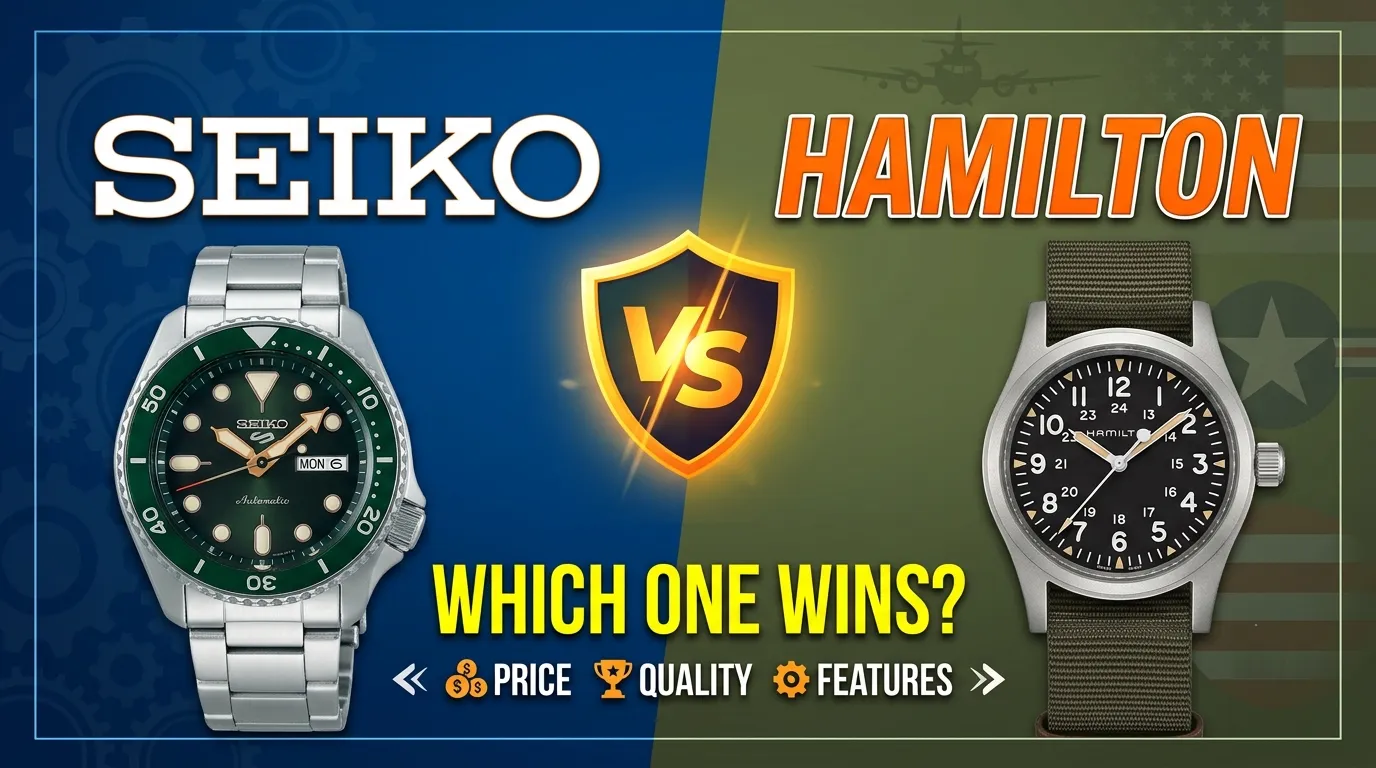
The answer to “Seiko vs Hamilton Watch: Which one wins?” depends entirely on what you value most.
Choose Seiko if:
- Budget is key: You want the best watch for under $500 or even under $100.
- You need durability: You require 200m water resistance for swimming or diving.
- You love variety: You want access to a huge range of styles from dress to dive.
- You value lume: You need a watch that glows brightly in the dark.
- You prefer Japanese innovation: You appreciate a brand that makes everything in-house.
Choose Hamilton if:
- You want Swiss prestige: You care about the “Swiss Made” label and heritage.
- Accuracy matters: You want a movement with tighter accuracy tolerances (-10/+15s/d) and a silicon hairspring.
- You love design: You prefer the American military aesthetic and refined finishing.
- Power reserve is priority: You want the maximum 80-hour power reserve to keep the watch running over the weekend.
- You plan to resell soon: You are interested in the slightly stronger 1-year value retention seen in market data.
Limitations & Unknowns
While this report covers extensive data, there are blindspots regarding latest 2026 model releases and regional price variations for the current year, as specific 2026 catalogs and localized pricing data were not fully available in the research context. Additionally, customer service comparisons rely on aggregated user reviews which can be subjective and may not reflect every individual experience.
In the Seiko vs Hamilton Watch showdown, there is no single loser. It is a clash of philosophies. Seiko offers unbeatable value, ruggedness, and technical innovation at accessible prices. They are the people’s champion, offering features like 200m water resistance and sapphire crystals at prices where Hamilton cannot compete.
Hamilton, however, offers a touch of luxury, superior movement finishing, and a cinematic history that appeals to those who view a watch as a piece of art or history. If you can stretch your budget and prioritize accuracy and style over rugged utility, Hamilton is a fantastic choice.
For the average buyer looking for a daily beater that can survive anything, Seiko is the practical winner. For the enthusiast who wants a refined Swiss automatic with a story to tell, Hamilton takes the crown. Both brands represent the best of their respective nations’ watchmaking traditions, and owning either is a mark of good taste.
Remember, the best watch is the one you enjoy wearing every day. Whether it’s the rugged reliability of a Seiko Prospex or the classic elegance of a Hamilton Khaki, you are getting a timepiece with a legacy of excellence.