

When people talk about luxury watches, two names always come up first. You hear them in offices, at dinner parties, and in online forums. The debate of Patek Philippe vs Rolex is one of the most famous conversations in the world of timepieces. Most buyers think they know the difference. They think it is just about price. They think one is for showing off and the other is for keeping safe. But the truth is much deeper. There are hidden differences that most people never notice until they have owned both.
This blog post is written for you, the buyer who wants to know the real story. We are not going to use hard words or confusing technical terms. We will look at simple facts. We will look at how these watches are made, how they feel on your wrist, and what happens when you need to fix them. We will also look at the real prices in 2026. By the end of this, you will understand why these two brands are so different, even though they both cost a lot of money.
The Secret of How Many Are Made
The first hidden difference is about numbers. You might think that because both brands are hard to buy, they make the same amount of watches. This is not true. The gap between them is huge.
Rolex makes a very large number of watches every year. Some reports say Rolex produces around 800,000 watches per year. Other sources suggest the number could be as high as 1.15 million watches annually. This is a massive amount. It means that while a Rolex is still special, there are many of them out there. In the United States alone, there are millions of Rolex owners. This high production volume is why you see Rolexes everywhere. It is also why Rolex is known as a symbol of achievement that many people can reach.
On the other hand, Patek Philippe makes very few watches. They produce approximately 60,000 to 72,000 watches per year. This is a tiny number compared to Rolex. When you buy a Patek, you are joining a much smaller club. With Patek, you are one of relatively few owners. This scarcity is a big reason why Patek feels so exclusive. It is not just about the price; it is about how hard it is to find one. The cultural imprint of this difference is strong. Rolex is built to feel inevitable, like something everyone should have. Patek Philippe watches are built to feel private, like a secret between you and the watch.
What Happens Inside the Watch
When you look at the back of a watch, you see a big difference that many buyers miss. This is about the movement, which is the engine that makes the watch work.
The Hidden Engine of Rolex
Rolex prioritizes reliable movements above all else. They want their watches to work perfectly every day, no matter what. Because of this focus on protection, the movement of a Rolex watch is not visible. The case back is solid metal. You cannot see the inside. Rolex believes that the movement should be safe from dust, water, and shocks.
Rolex makes their own engines, called calibers. For example, the Caliber 3235 is used in the Datejust, and the Caliber 4130 is used in the Daytona. These engines are known for being very strong and accurate. Rolex tests them very hard. They are certified as Superlative Chronometers. This means they are accurate to within +2 or -2 seconds per day. This is even better than the standard Swiss test, which allows for -4 to +6 seconds. Rolex does this to ensure maximum precision and durability.
The Art Inside Patek Philippe
Patek Philippe takes a different approach. They present their movements as true works of art. Most Patek Philippe watches have a sapphire case back. This is a clear glass on the back of the watch. It allows you to see the movement inside. You can admire the tiny wheels and springs.
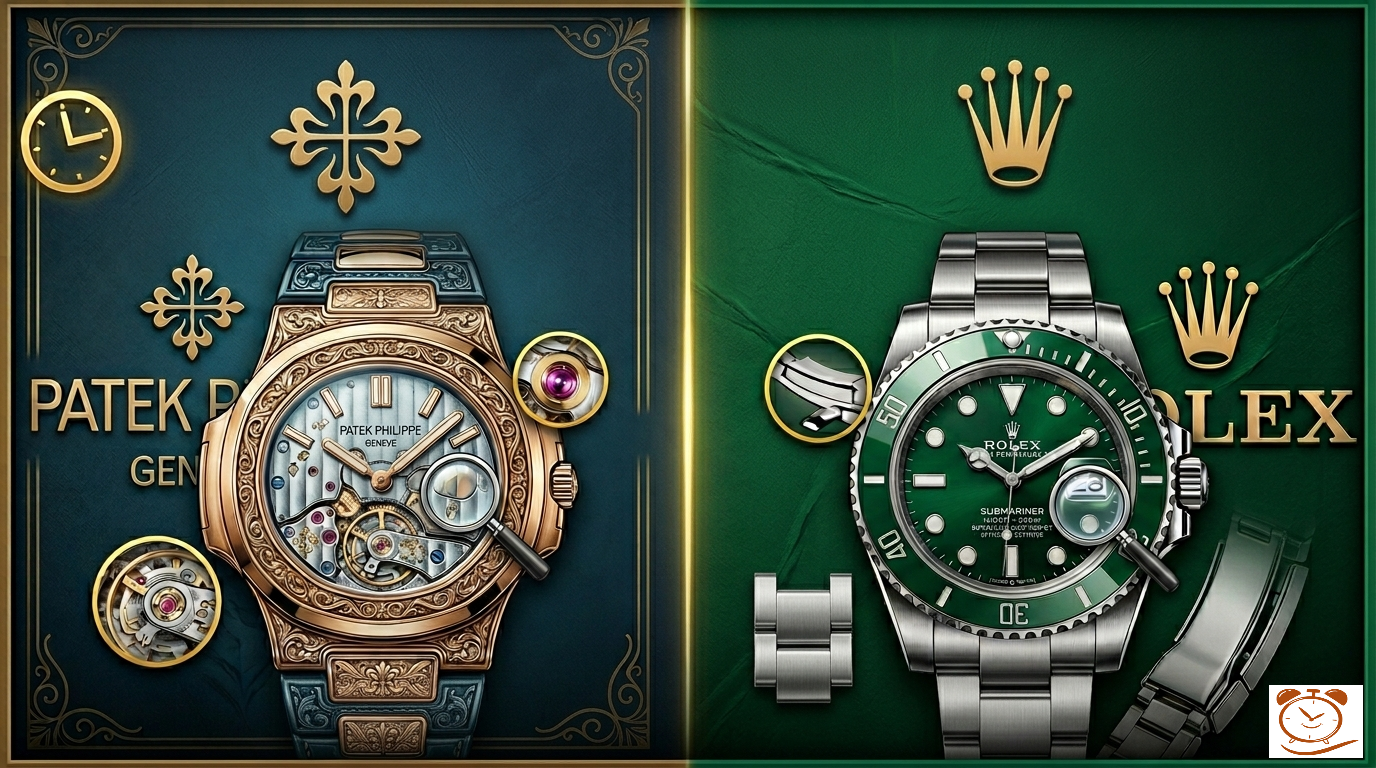
Patek Philippe focuses on hand-finishing. Even the parts you cannot see are finished by hand. This takes a lot of time and skill. The price of a Patek is linked to the amount of work done in finishing these movements. They use special innovations like the Gyromax Balance, which helps the watch keep time better, and the Silinvar Escapement, which is made of silicon and does not need oil.
While Rolex focuses on everyday practicality, Patek Philippe excels in creating complex features. These include perpetual calendars that know when leap years happen, and minute repeaters that chime the time. Rolex does not make these complex features; they stick to simpler, more robust designs. Patek is considered the pinnacle of watch art, while Rolex dominates in global recognition.
Built for Different Worlds: Water and Wear
Another hidden difference is how these watches handle the real world. Many people assume all luxury watches are tough. But there is a clear divide in how they are built for water and daily wear.
Water Resistance
If you plan to swim or dive, this matters a lot. The Rolex Submariner is famous for its water resistance. It can go down to 300 meters underwater. This is very deep. It offers bulletproof reliability for divers.
In contrast, Patek Philippe sports models like the Aquanaut and Nautilus have lower water resistance. The Patek Philippe Aquanaut has 120 meters of water resistance. The highest water resistance for a Patek is generally 120 meters, while the Rolex Submariner has 300 meters. This does not mean the Patek will break in the pool. It just means the Rolex is built more like a tool for extreme conditions. The Rolex is designed to be worn as equipment.
How the Case Feels
There is also a difference in how the metal case feels and wears over time. Patek Philippe cases often wear thinner than their numbers suggest. This means a 40mm Patek might feel smaller and slimmer on the wrist than a 40mm Rolex. This balance is deliberate. It makes the watch feel elegant and light. The crown action on a Patek feels precise without feeling industrial.
Rolex wears like equipment. The bracelet engineering is brutally good. It feels heavy and solid. Rolex focuses on steel models for their sports lines, making them very durable. Patek Philippe uses precious materials like gold and platinum more often, even in their sports models. This makes the Patek feel more like jewelry and the Rolex feel more like a machine.
| Feature | Rolex Submariner | Patek Philippe Aquanaut |
|---|---|---|
| Water Resistance | 300 meters | 120 meters |
| Case Material Focus | Steel (Oystersteel) | Steel, Gold, Platinum |
| Design Philosophy | Tool / Equipment | Elegant / Jewelry |
| Case Back | Solid Metal | Sapphire Crystal (Visible) |
The Real Price Tag in 2026
When discussing Patek Philippe vs Rolex, money is always a topic. But the prices can be confusing. There is the price you see in the store, and the price you actually pay. In 2026, these differences are very clear.
Entry Level Prices
If you want to buy a new Rolex, the average entry price starts at around $5,000. You can find models like the Oyster Perpetual in this range. However, for the popular sports models, the price is higher. The Rolex Submariner is considered relatively accessible, with prices starting around $8,000 for new models. In the UK, the Submariner Date has a retail price between £9,000 and £10,500. In the US, retail prices range from $9,100 for the no-date version to $10,250 for the date version.
For Patek Philippe, the entry point is much higher. The average entry price starts at $20,000. This gets you a simple time-only model like the Calatrava. In Singapore, Calatrava models start between S$20,000 and S$35,000. If you want a steel sports model from Patek, the price jumps significantly. The Patek Philippe Aquanaut starts at $23,070 for steel models.
The Sports Model Gap
The biggest shock for buyers is the price of the famous steel sports watches. For the Rolex Submariner, you can find pre-owned models for under $10,000. In the UK, pre-owned Submariners range from £9,500 to £12,000. They hold their value well, but they are still within reach for many luxury buyers.
For the Patek Philippe Nautilus, the situation is different. At retail, a ladies’ steel Nautilus starts at $39,264, and a men’s white gold model is $89,767. But few people can buy them at retail. On the open market, the prices are much higher. You can expect to pay a minimum of $70,000 for a ladies’ watch. For popular men’s steel models like the discontinued 5711, prices range from $120,000 to $160,000 or more. In the UK, a steel Nautilus retails for £35,000 to £50,000, but pre-owned prices range from £80,000 to £160,000.
In 2026, Patek Philippe is celebrating 50 years of the Nautilus. They have released limited anniversary editions. The new ref. 5810G-001 is priced at CHF 60,000, which is about $76,621. The platinum ref. 5610/1P-001 is marked at CHF 90,000, or approximately $114,928. These prices show that even the “new” models from Patek cost more than the most expensive Rolex models.
| Model | Retail Price (Approx.) | Pre-Owned / Market Price (Approx.) |
|---|---|---|
| Rolex Submariner (Steel) | $9,100 – $10,250 | $9,500 – $12,000 |
| Patek Philippe Aquanaut (Steel) | $23,070+ | $40,000 – $70,000 |
| Patek Philippe Nautilus (Steel) | $39,000+ (Ladies) | $120,000 – $160,000+ |
| Patek Nautilus 50th Ed. (Gold) | $76,621 (CHF 60k) | Market Dependent |
Service and Ownership: A Long-Term Commitment
Buying the watch is just the start. What happens when you need to service it? This is a hidden difference that affects your wallet years later.
Explore the thrilling world of Canada casino, from diverse gaming options to the latest regulations. Discover tips for responsible gambling and how to enjoy the best of Canada’s casino experience. Explore the thrilling world of Canada casino, from diverse gaming options to the latest regulations. Discover tips for responsible gambling and how to enjoy the best of Canada’s casino experience. Explore the thrilling world of Canada casino, from diverse gaming options to the latest regulations. Discover tips for responsible gambling and how to enjoy the best of Canada’s casino experience. Explore the thrilling world of Canada casino, from diverse gaming options to the latest regulations. Discover tips for responsible gambling and how to enjoy the best of Canada’s casino experience. Explore the thrilling world of Canada casino, from diverse gaming options to the latest regulations. Discover tips for responsible gambling and how to enjoy the best of Canada’s casino experience.
Rolex Service
Rolex has an extensive global service network. It is relatively easy to maintain and service your watch almost anywhere in the world. In the UK, a typical full service for a Rolex costs around £700 to £1,100. This is straightforward.
Rolex comes with a five-year international warranty. This warranty covers manufacturing defects and movement accuracy. It is transferable to new owners if you have the original warranty card. However, the warranty does not cover normal wear and tear, accidents, or unauthorized repairs. If you modify the watch yourself, you void the warranty.
Patek Philippe Service
Patek Philippe service is more specialized. Servicing can be more expensive and time-consuming due to the watches’ complexity. In the UK, a Patek Philippe service can cost between £1,500 and £4,000. This is much higher than Rolex.
However, Patek offers something unique. They guarantee service for every watch they have ever made, which is a remarkable commitment. They have been doing this since 1839. This is part of their slogan: “You never actually own a Patek Philippe. You merely look after it for the next generation”.
The service process at Patek is very strict. They describe a full mechanical service as “mandatory”. During service, they often mandate mechanical upgrades, such as changing wheel profiles, to keep the watch running well. A full service process takes over 200 hours on average. Only the main center in Geneva can service very complex chiming watches and models made before 1960.
Patek Philippe’s warranty is valid for two years from the purchase date. After a service, your watch gets an additional two-year service warranty. Like Rolex, the warranty follows the watch and not the original owner, but if the ownership certificate is damaged, they can refuse coverage. Leather straps are not covered under the warranty.
Investment Potential: Short Term vs Long Term
Many people buy these watches as investments. But Patek Philippe vs Rolex offers two different types of investment potential.
Rolex: Quick Liquidity
Rolex excels in short-term resale value due to high demand. Rolex watches are great for quick resale because many people want them. On average, Rolex watches tend to maintain strong resale value. Many coveted models sell for above their original retail price on the secondary market. Because Rolex produces so many watches, there are many units circulating in the resale market at any time. This makes it easy to sell one quickly if you need cash.
Patek Philippe: Long Term Value
Patek Philippe offers better long-term investment potential with its exclusivity and craftsmanship. Patek keeps its value longer, perfect for serious collectors. A pre-owned Patek in excellent condition routinely commands a higher percentage of its retail price compared to a comparable Rolex.
The resale premium for Patek can be huge. For rare models, the premium can reach 300% or more. While Patek’s average resale premium may be lower on common models, the ceiling is undeniably higher. Patek Philippe is known for record-shattering auction results. For example, the Patek Philippe Grandmaster Chime sold for $31 million in 2019. This shows that while Rolex is a safe bet, Patek has the potential for much higher gains if you have a rare piece.
Brand Image: Old Money vs New Money
Finally, there is a hidden difference in how people see these brands. This is about status and perception.
In Europe, Patek Philippe has been quite successful at presenting themselves as the watch for “old money” types. They represent heritage, sophistication, and fine artistry. The brand feels private and understated.
Rolex, on the other hand, sometimes suffers from a “new money” image in these same circles. But this is not a bad thing. Rolex is a cultural symbol of achievement, status, and endurance. It is built to be seen. It tells the world you have made it. As one source says, “Rolex is built to feel inevitable”.
The cultural imprints of both brands magnify their appeal. They are not just tools for telling time; they are powerful symbols of status, taste, and personal legacy. Choosing between them is choosing which story you want to tell. Do you want to be part of the millions who recognize the Rolex? Or do you want to be one of the few who understand the art of the Patek?
My Final Point of View
When you look closely at Patek Philippe vs Rolex, you see that they are not really competitors. They are serving different purposes. Rolex is the king of reliability, durability, and global recognition. It is a tool that works perfectly, costs less to service, and is easy to sell. It is for the person who wants a watch that can do anything.
Patek Philippe is the king of art, exclusivity, and heritage. It is a piece of history that you look after for the next generation. It costs more to buy, more to service, and requires more care. But it offers a level of finishing and complexity that Rolex does not try to match.
Most buyers never notice these hidden differences. They just see the logo. But now you know. You know about the 300m vs 120m water resistance. You know about the hidden movement vs the visible art. You know about the £700 service vs the £4,000 service. And you know the real prices in 2026.
Whether you choose the “equipment” of Rolex or the “private” art of Patek, both are incredible achievements. The best choice depends on what you value more: the reliability of a machine built for the world, or the artistry of a treasure built for time.
Limitations & Unknowns
While this report covers the major differences, exact 2026 pricing for all specific models can vary by region and authorized dealer availability. Detailed after-sales service cost breakdowns for every specific complication (like minute repeaters) are not publicly listed and require direct consultation with service centers. Cultural perceptions can also vary significantly between different cities and social circles within Asia and Europe.