

The Casio Pro Trek Hiker isn’t just another rugged-looking digital watch—it’s a true outdoor tool designed for hikers, campers, and adventurers who need reliability over flash. While not an official model name, “Pro Trek Hiker” commonly refers to the Casio Pro Trek Hiker Line PRJ-B001B-2JF, a solar-powered, feature-packed watch priced around $180. It offers Tough Solar charging, 100m water resistance, Bluetooth connectivity, and essential outdoor functions like world time and alarms.
Though it likely includes the signature Pro Trek triple sensors (altimeter, barometer, compass), this isn’t confirmed in all sources, and it does not have built-in GPS—a key limitation for serious navigation. Still, with a solar battery lasting up to 7 months in darkness and a durable, lightweight design, it delivers exceptional value for those who want a long-lasting, no-nonsense companion in the mountains. This is a watch built to survive, not to impress.
What Is the Casio Pro Trek Hiker?
The Casio Pro Trek Hiker is not a standalone model in Casio’s official lineup, but a widely used term for watches in the Hiker Line, specifically the PRJ-B001B-2JF. It’s part of Casio’s legendary Pro Trek series, known for rugged, functional timepieces built for outdoor use. This watch is designed for real-world adventure—not just for wearing on a weekend hike to post on social media.
It’s not a smartwatch with notifications or fitness tracking. Instead, it focuses on durability, solar power, and essential tools that help you navigate and survive in the wild. Think of it as your reliable co-pilot when the trail gets tough and your phone dies.
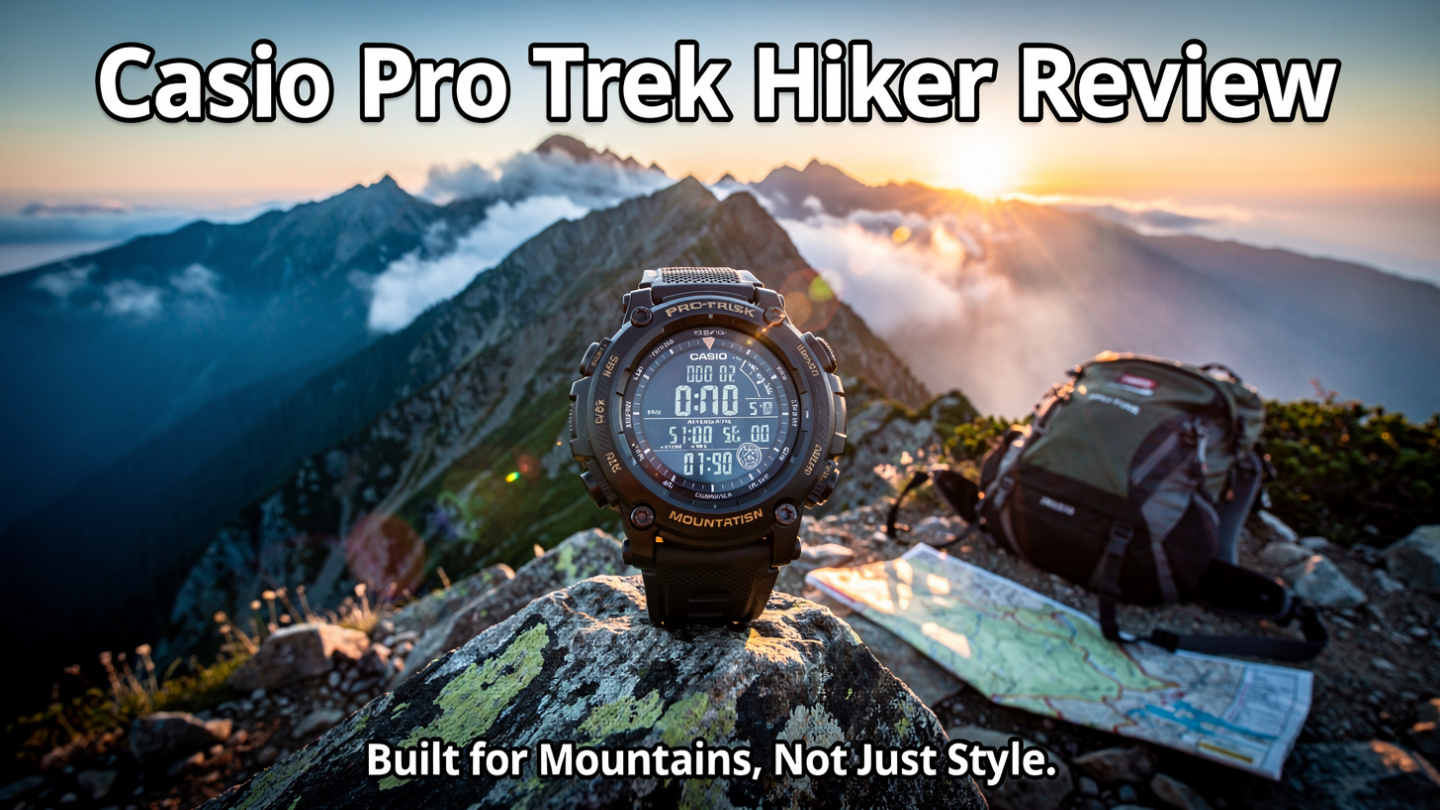
Simple Design, Tough Build
The Casio Pro Trek Hiker has a 46mm case and is 13.6mm thick—compact enough to wear daily but large enough for easy reading. It’s made from biomass-based resin, a type of eco-friendly plastic that’s both lightweight and strong. This material helps reduce environmental impact without sacrificing toughness.
It comes with a bungee cord band, which is stretchy, comfortable, and perfect for wearing over jackets or in cold weather. Unlike metal or leather straps, it won’t freeze, crack, or rust. The band is simple but secure, ideal for long treks where you don’t want to fiddle with adjustments.
The watch face is protected by mineral glass, which is durable but can scratch over time—especially the metal bezel on some Pro Trek models. While not as scratch-resistant as sapphire, it holds up well under normal outdoor use. For nighttime visibility, it features glowing hands and markers, so you can check the time during midnight camp setup or early morning hikes.
Price: Is the Casio Pro Trek Hiker Worth It?
Yes—the Casio Pro Trek Hiker offers excellent value at $180 USD (approximately ¥25,300 JPY). For that price, you’re getting a solar-powered, water-resistant, feature-rich outdoor watch that outlasts most smartwatches on a single charge.
Compared to other outdoor watches, this is a sweet spot. You could spend over $600 on a Casio WSD-F30 smartwatch, which includes GPS and color maps but needs daily charging. Or you could go for a PRW-3000, priced at $300 (often on sale for $150), which lacks Bluetooth but includes triple sensors. The Hiker model balances price, modern features, and outdoor readiness.
What You Get for $180
For under $200, the Casio Pro Trek Hiker delivers a robust set of features that matter in the wild:
| Feature | Detail |
|---|---|
| Price | $180 USD |
| Solar Battery Life | 7 months without light, 18 months in power-saving mode |
| Water Resistance | 100m (10 ATM) – suitable for swimming, snorkeling |
| Weight | Lightweight resin construction |
| Connectivity | Bluetooth via Mobile Link app |
| Time Functions | World time (38 cities), 5 daily alarms, hourly time signal |
| Environmental Resistance | Cold-resistant to -10°C |
| Lighting | Dual LED lights for night use |
| Calendar | Full auto calendar (valid until 2100) |
This isn’t a list of gimmicks. Every feature serves a purpose—whether it’s syncing time across time zones, setting camp alarms, or reading the dial in the dark.
Features That Make It a Real Outdoor Watch
The Casio Pro Trek Hiker stands out because it’s built with real outdoor needs in mind. It’s not just a digital watch with a mountain logo. It’s packed with tools that help you stay safe, on time, and aware of your environment.
Solar Power That Lasts
The standout feature is Tough Solar technology. The watch charges in any light—sunlight or indoor lighting. Once fully charged, it can run for 7 months in total darkness. In power-saving mode, that jumps to 18 months. That means you could store it in a drawer for over a year and it’d still work.
Charging takes about 23 hours in direct sunlight. Avoid leaving it in hot environments (above 60°C), as extreme heat can damage the battery. The internal battery (CTL1616, 18 mAh) is designed to last 10–12 years, and many users report their Pro Trek watches lasting over a decade without battery issues.
This is a game-changer for long trips where you can’t charge devices. Unlike smartwatches that die in a day, the Casio Pro Trek Hiker keeps going—rain, snow, or shine.

Water Resistance: Ready for Rain, Rivers, and Dives
With 100m water resistance (10 ATM), this watch is built for serious outdoor use. You can swim, snorkel, or dive with it—though it’s not rated for deep scuba diving. More importantly, it handles rainstorms, river crossings, and sweaty hikes without a problem.
This level of protection means you never have to take it off. Whether you’re washing your hands, caught in a downpour, or jumping into a lake, the Casio Pro Trek Hiker won’t blink. It’s a true all-weather companion.
Bluetooth and Smart Features
The Casio Pro Trek Hiker includes Bluetooth connectivity via the Mobile Link app. This lets you:
- Sync time automatically with atomic clocks for perfect accuracy
- Find your phone if it’s misplaced
- Trigger the watch to beep if you’ve lost it
It doesn’t support notifications, calls, or apps—so it’s not a smartwatch. But this simplicity is a strength. You get useful tech without distractions or battery drain. For hikers who want reliability over constant pings, this is ideal.
World Time and Alarms
Traveling across time zones? The Casio Pro Trek Hiker supports world time for 38 cities, so you can switch between zones with a button press. Great for international trips or long-distance hikes near borders.
It also has 5 daily alarms—perfect for setting wake-up calls, rest breaks, or camp setup times. The hourly time signal can beep every hour, helping you track elapsed time on long trails. And the full auto calendar adjusts for leap years and runs until 2100, so you’ll never need to set the date manually.
Built for Mountains: Does It Really Work Out There?
This is the real test. Is the Casio Pro Trek Hiker actually useful in the mountains—or just a stylish accessory?
Outdoor Sensors: Altimeter, Barometer, Compass?
Here’s the catch: while most Pro Trek models include triple sensors (altimeter, barometer, compass), the PRJ-B001B-2JF’s official specs don’t explicitly confirm them. Other models like the PRG-270, PRW-3000, and PRW-6000 do have them, and they’re highly accurate:
| Sensor | Accuracy | Use Case |
|---|---|---|
| Altimeter | ±1m (PRW-3000) | Track elevation gain, avoid altitude sickness |
| Barometer | Detects pressure changes | Predict weather shifts (storms, clearing) |
| Compass | ±5° with calibration | Navigate in low visibility or dense forest |
If the Casio Pro Trek Hiker includes these, it becomes a powerful navigation tool. But if not, you’ll need to rely on your phone or a separate device. Always check the box or manual before assuming these features are present.
GPS: Is It Built In?
No. The Casio Pro Trek Hiker does not have built-in GPS. This is a major limitation for serious hikers who rely on real-time mapping.
GPS is available in smart Pro Trek models like the WSD-F20 and WSD-F30, which support GPS, GLONASS, and QZSS for accurate tracking. They even offer offline color maps. But these models cost over $600 and last only 1–2 days on a charge.
The Casio Pro Trek Hiker uses your phone’s GPS via Bluetooth for time sync, but it can’t map your route independently. For long backpacking trips without phone service, this is a dealbreaker for some.
Real-World Use: What Do Hikers Say?
User feedback on Pro Trek watches is overwhelmingly positive. On Reddit, users report PRW-3000 models lasting over 10 years with no battery issues. The barometer and compass are praised for reliability in mountainous terrain.
One user noted their watch survived two years of daily outdoor use without failure. Others highlight the lightweight design and long battery life as key advantages over smartwatches.
While specific reviews for the PRJ-B001B-2JF are limited, the broader Pro Trek reputation for durability and function is well-earned. These watches are built to endure.

How It Compares to Other Pro Trek Models
Casio offers several Pro Trek models. How does the Casio Pro Trek Hiker stack up?
PRW-3000: The Premium Choice
The PRW-3000 retails for $300 but often sells for $150 on sale. It has solar power, triple sensors, 100m water resistance, and a lightweight design (64g, 12mm thick). However, it lacks Bluetooth, which the Hiker model includes.
If you want navigation tools and don’t need phone sync, the PRW-3000 is a solid pick. But if Bluetooth connectivity matters, the Hiker wins.
WSD-F30: The Smart Option
The WSD-F30 is a full outdoor smartwatch with GPS, altimeter, barometer, compass, and offline color maps. It runs on Android Wear and supports navigation apps like Viewranger.
But it costs $607, needs charging every 1–2 days, and is bulkier. For multi-day trips without power, the Casio Pro Trek Hiker is far more practical.
PRW-6000: The Tough One
The PRW-6000 features stainless steel construction, mineral glass, and a 10-year warranty. It’s built for extreme conditions and praised for reliability.
But it’s heavier, more expensive, and lacks Bluetooth. The Casio Pro Trek Hiker offers a better balance of lightweight design, modern features, and affordability.
| Model | Price | GPS | Bluetooth | Triple Sensors | Battery Life |
|---|---|---|---|---|---|
| PRJ-B001B-2JF (Hiker) | $180 | ❌ | ✅ | Likely | 7 months (no light) |
| PRW-3000 | $300 ($150 on sale) | ❌ | ❌ | ✅ | 7 months |
| WSD-F30 | $607 | ✅ | ✅ | ✅ | 1–2 days |
| PRW-6000 | ~$400 | ❌ | ❌ | ✅ | 10+ years (solar) |
The Casio Pro Trek Hiker hits the sweet spot for most outdoor enthusiasts.
Who Should Buy the Casio Pro Trek Hiker?
The Casio Pro Trek Hiker is perfect for:
- Hikers who want a reliable, long-lasting watch
- Campers who need alarms, lighting, and weather awareness
- Travelers crossing time zones
- Minimalists who hate charging devices
- Outdoor lovers who value function over fashion
It’s not for:
- People who want GPS navigation on their wrist
- Smartwatch users who need notifications and apps
- Those looking for a slim, dressy design
This is a tool, not a toy.
A Watch That Works
The Casio Pro Trek Hiker isn’t flawless. We can’t confirm the triple sensors, and the lack of GPS is a real limitation. The resin case can scratch, and the mineral glass isn’t sapphire.
But it’s honest. It does what it promises: keep time, survive the elements, and help you stay on track—without needing a charger. At $180, it offers incredible value. It’s solar-powered, water-resistant, Bluetooth-enabled, and built for the mountains.
It’s not about style. It’s about survival, simplicity, and staying powered when it matters most.
If you want a watch that won’t quit—on the trail, in the rain, or in the cold—the Casio Pro Trek Hiker is one of the best choices you can make.
After all, the best gear isn’t the fanciest. It’s the one that’s always there when you need it.