

The Titan vs CrossBeats Smartwatch battle isn’t just about specs — it’s a clash of philosophy: brand legacy versus budget innovation. Titan, backed by the Tata Group, brings decades of trust, premium stainless steel builds, and elegant designs that resemble traditional watches. In contrast, CrossBeats storms in with aggressive pricing, long battery life, and fitness-packed features aimed at budget-conscious buyers.
When it comes to design and durability, Titan wins with 316L stainless steel cases that can last over 12 years. CrossBeats uses more plastic and silicone, making watches lighter but less luxurious. However, models like the CrossBeats Armour Pro push boundaries with rare IP69 + 5ATM water resistance and altimeter sensors.
For display quality, Titan leads with high-brightness AMOLED screens (up to 1000 nits) and sharp resolutions. CrossBeats matches up in some models — the Armour Pro hits 1200 nits — but many use lower-tier IPS LCDs.
In fitness tracking, both offer heart rate, SpO2, sleep, and step counting. But accuracy is a concern: CrossBeats has shown consistent lower heart rate readings and unreliable BP tracking. Titan’s sensors are better reviewed, though still not medical-grade.
Battery life is where CrossBeats dominates — with models offering 15–30 days. Titan ranges from 5 to 14 days, except the Connected X Hybrid, which claims 1.5 months.
Pricing reveals the core divide: CrossBeats starts at ₹2,999, while Titan models often exceed ₹7,000. You pay for Titan’s brand, materials, and polish — but not always better performance.
Ultimately, your choice depends on priorities:
- Choose Titan for premium style, durability, and brand trust.
- Choose CrossBeats for maximum features and battery life on a tight budget.
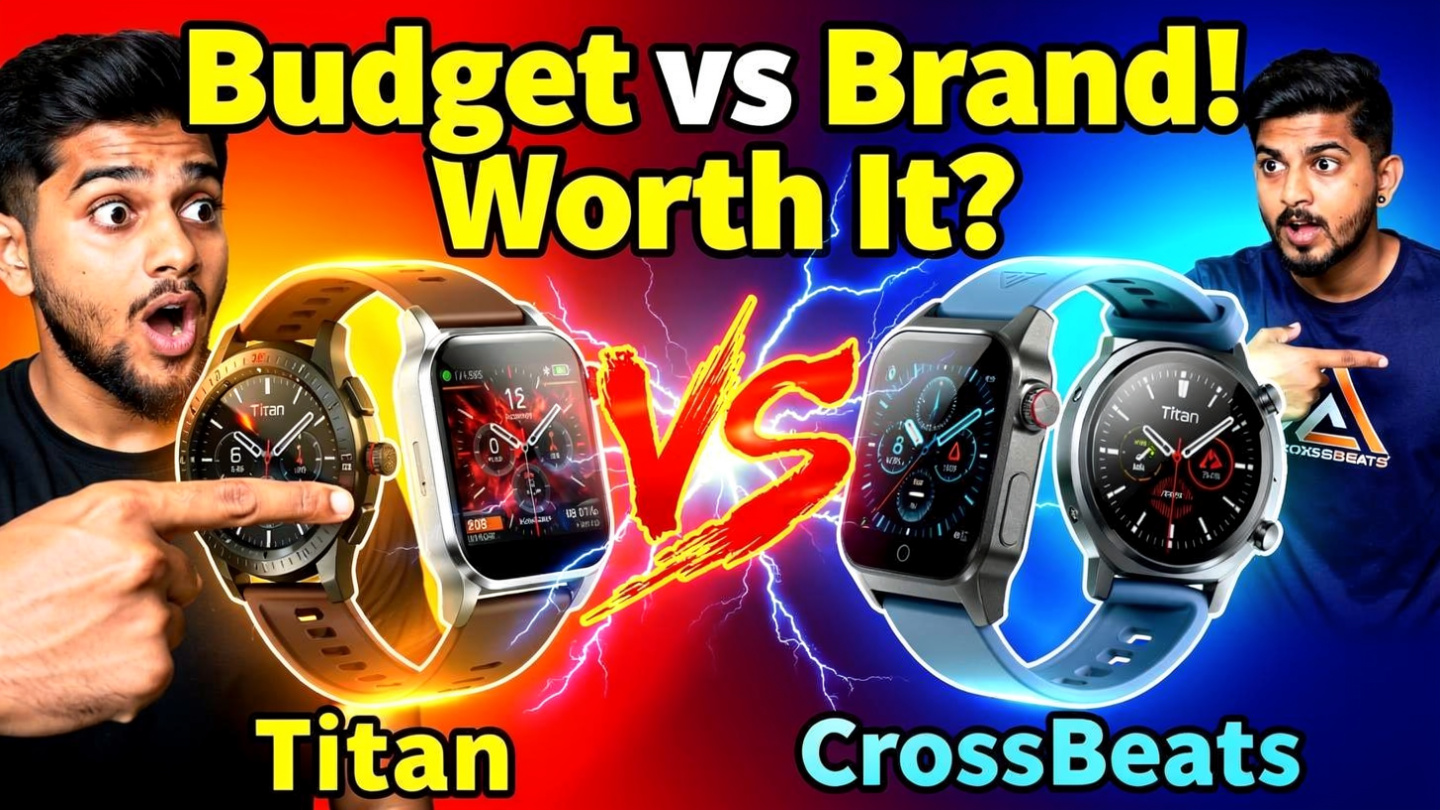
Neither is universally better. The real winner? You, with two strong Indian options in the wearable race.
Overview of Titan Smartwatch
Titan isn’t just entering the smartwatch market — it’s leveraging a 30+ year legacy in Indian timekeeping. As a subsidiary of the Tata Group, Titan brings brand credibility, retail reach, and design expertise to its smartwatches.
Models like the Titan Smart, Titan Evolution, and Titan Celestor 2.0 blend classic watch aesthetics with modern tech. They look more like real watches than gadgets — a big plus for professionals and style-conscious users.
Most Titan smartwatches feature:
- 5ATM water resistance (safe for swimming and showers)
- AMOLED displays with 360×360 or higher resolution
- Stainless steel or hybrid metal-silicone builds
- Compatibility with Android and iOS
The Titan Celestor 2.0 stands out with dual-band GPS, 1000 nits peak brightness, and built-in GPS for accurate outdoor tracking. It also supports Bluetooth calling and has a 300 mAh battery.
Battery life varies significantly:
- Titan Smart: Up to 14 days
- Titan Evolution: 8+ days
- Titan Maestro: 9 days (AOD off), 4 days (AOD on)
- Titan Connected X Hybrid: Claimed 1.5 months
Titan integrates with Alexa for voice commands and offers over 50 customizable watch faces via its app. However, user reviews highlight sluggish software and occasional app crashes.
Despite hardware strengths, Titan’s proprietary operating system lacks access to Wear OS apps, limiting functionality. Still, for users who value design, materials, and brand assurance, Titan delivers a compelling package.
Overview of CrossBeats Smartwatch
CrossBeats is the new challenger in India’s wearable arena — a brand built for the youth, fitness enthusiasts, and budget buyers. Unlike Titan’s legacy appeal, CrossBeats wins on features-per-rupee.
Its lineup includes the CrossBeats Orbit, Ignite, Armour Pro, and Everest 2.0 — each packed with capabilities rarely seen under ₹5,000.
Key features across models:
- Bluetooth calling with built-in mic and speaker
- Heart rate, SpO2, sleep, and step tracking
- Blood pressure monitoring (with accuracy caveats)
- 60+ sports modes on select models
- IP68 or higher water resistance
The CrossBeats Armour Pro is a standout: it boasts an 800 mAh battery (30-day claim), 1.43” AMOLED display (466×466), and even includes altimeter, barometer, and compass — features usually found in premium Garmin watches.
Battery life across the range:
- Armour Pro: Up to 30 days
- Everest 2.0: 15 days
- Ignite Spectra Plus: 15 days
- Orbit: 7–10 days
CrossBeats supports both Android and iOS, and some models allow manual number dialing — a small but useful feature.
However, accuracy issues plague health tracking. Multiple reviews report:
- Heart rate readings consistently lower than actual
- Step tracking with ~5% margin of error
- Blood pressure data unreliable for medical use
Software experience is basic, with limited app ecosystem and no Google Play Store support. But for users who want a rugged, long-lasting fitness companion without breaking the bank, CrossBeats makes a strong case.
Design & Build Quality Comparison
Design isn’t just about looks — it’s about how a watch feels on your wrist and how long it lasts.
Titan: Premium Materials, Timeless Appeal
Titan smartwatches prioritize elegance. Many models use 316L stainless steel, a corrosion-resistant alloy known to last 12+ years with proper care. This gives Titan watches a solid, luxurious heft.
The Titan Connected X Hybrid combines stainless steel with interchangeable straps, letting users switch between leather, metal, or silicone. The Titan Maestro features a 3.6 cm AMOLED display with a 3D interactive module — sleek but heavy at over 50g.
This weight can be uncomfortable during sleep or intense workouts. Still, the premium finish appeals to office-goers and formal wearers.
Water resistance is typically 5ATM, allowing swimming and shower use. However, long-term durability beyond manufacturer claims remains unverified.
CrossBeats: Sporty, Lightweight, and Rugged
CrossBeats opts for practicality. Most models use silicone, polymer, or lightweight metal bodies. The CrossBeats Orbit Apex features 3D glass and a metal frame, but many are plastic-based.
This keeps costs low and weight minimal — ideal for gym sessions and outdoor runs. The Armour Pro is a standout with IP69 + 5ATM rating, surviving high-pressure water jets and dust immersion.
While less luxurious, CrossBeats builds are designed for toughness. The Armour Dive is built for swimmers, and the Fury series targets extreme conditions.
| Feature | Titan | CrossBeats |
|---|---|---|
| Primary Material | 316L Stainless Steel | Silicone / Polymer / Lightweight Metal |
| Water Resistance | 5ATM (most models) | IP68 (common), IP69 + 5ATM (Armour Pro) |
| Weight | 50g+ (e.g., Maestro) | Lighter, more ergonomic |
| Strap Options | Interchangeable (metal, leather, silicone) | Fixed or limited interchangeability |
| Longevity Claim | 12+ years (stainless steel) | Not specified |
Verdict: Titan wins on premium feel and long-term durability. CrossBeats wins on lightweight comfort and extreme ruggedness.
Display & User Experience
A smartwatch is only as good as its screen — especially in sunlight.
Titan: Bright, Sharp, and Sunlight-Ready
Titan uses AMOLED displays across most models, ensuring deep blacks and vibrant colors. The Titan Evolution has a 1.85” curved AMOLED, while the Celestor 2.0 offers 1000 nits peak brightness — excellent for outdoor visibility.
Resolution varies:
- Titan Smart Pro: 449 ppi
- Titan Celestor 2.0: 360×448
- Titan Crest 2.0: 1.43” AMOLED
High pixel density makes text and icons crisp. The immersive crystal display on the Titan Smart enhances readability.
However, software performance drags the experience down. Users report laggy touch response and app crashes. The interface is functional but not fluid.
CrossBeats: Mixed Display Quality
CrossBeats uses AMOLED in higher-end models:
- Armour Pro: 1.43” AMOLED, 1200 nits (brightest in class)
- Orbit X: 1.3” AMOLED, 600 nits
- Ignite S4: 1.8” 3D curved touchscreen
But budget models like the basic Orbit use 1.3” IPS LCD, which is less vibrant and harder to read in direct sun.
Touch response is generally responsive, but the UI feels basic. No Wear OS means limited app support — just fitness tracking, notifications, and calling.
| Model | Display Type | Brightness | Resolution | PPI |
|---|---|---|---|---|
| Titan Celestor 2.0 | AMOLED | 1000 nits | 360×448 | ~326 |
| Titan Smart Pro | AMOLED | Not specified | Not specified | 449 |
| CrossBeats Armour Pro | AMOLED | 1200 nits | 466×466 | ~328 |
| CrossBeats Orbit | IPS LCD | Not specified | 1.3” HD | Not specified |
Verdict: Titan leads in overall display quality and design polish. CrossBeats matches in brightness on flagship models but lags in software smoothness.
Features Comparison
Let’s break down what really matters: health tracking and smart functionality.
Health & Fitness Tracking
Both brands offer core health metrics:
- Heart rate monitoring
- Blood oxygen (SpO2)
- Sleep tracking
- Step counting
- Calorie estimation
But accuracy varies widely.
Titan
- Sensors are generally reliable for trends, not medical diagnosis
- Titan Celestor 2.0 includes GPS for accurate run tracking
- Sleep and step data align well with user logs
- No major reports of consistent under/over-reading
CrossBeats
- Heart rate often reads lower than actual (per NewsBytes review)
- Step tracking has ~5% margin of error
- Blood pressure readings are inconsistent — not recommended for health decisions
- SpO2 readings return in under 30 seconds but lack clinical validation
According to broader testing (2026 data):
- Apple Watch: <1% heart rate error
- Garmin: 3–5% error
- Most smartwatches: 90–98% step accuracy
- CrossBeats falls below this range in independent tests
For casual users, both are usable. For athletes or health-focused users, neither replaces a chest strap or medical device.
Smart Features (calling, notifications, etc.)
Bluetooth calling is a major selling point — and both deliver.
CrossBeats
- Built-in mic and speaker on Orbit, Armour Dive, Ignite
- Supports Google Assistant and Siri
- Dial pad for manual number entry
- Music control and notifications work reliably
Titan
- Titan Smart Talk and Celestor 2.0 support calling with good audio
- Built-in storage for 50 music tracks (great for workouts)
- Integrated Alexa for voice commands
- Notifications sync well, but app bugs can cause delays
Neither uses Wear OS, so no third-party apps. But both offer 50+ watch faces and customization.
| Feature | Titan | CrossBeats |
|---|---|---|
| Bluetooth Calling | Yes (Smart Talk, Celestor) | Yes (Orbit, Armour, Ignite) |
| Voice Assistant | Alexa | Google Assistant, Siri |
| Music Storage | Up to 50 tracks | No built-in storage |
| Notification Sync | Good (with occasional lag) | Reliable |
| App Ecosystem | Proprietary (limited) | Proprietary (limited) |
Verdict: CrossBeats wins on voice assistant flexibility. Titan wins on music storage and Alexa integration.
Battery Life & Performance
Battery life is a key differentiator in the Titan vs CrossBeats Smartwatch battle.
Titan: Solid, But Not Class-Leading
Titan battery life varies by model:
- Titan Smart: 14 days
- Titan Evolution: 8+ days
- Titan Smart 3 Premium Metal: Only 5 days
- Titan Connected X Hybrid: Claims 1.5 months (hybrid tech)
Real-world usage depends on settings:
- Always-on display (AOD) cuts Maestro battery from 9 to 4 days
- GPS and frequent calls reduce life significantly
Charging is fast — the Celestor 2.0 charges fully in about 60 minutes.
CrossBeats: The Battery King
CrossBeats dominates here:
- Armour Pro: 30 days (800 mAh battery)
- Everest 2.0: 15 days
- Ignite Spectra Plus: 15 days
- Orbit: 7–10 days
Even with Bluetooth calling, the Orbit lasts two days of active use.
Charging takes ~90 minutes for most models.
| Model | Claimed Battery Life | Real-World Estimate (Moderate Use) |
|---|---|---|
| Titan Smart | 14 days | 10–12 days |
| Titan Connected X Hybrid | 1.5 months | ~30–40 days |
| CrossBeats Armour Pro | 30 days | 20–25 days |
| CrossBeats Everest 2.0 | 15 days | 12–14 days |
| CrossBeats Orbit | 10 days | 7–8 days |
Performance-wise, both use basic processors. No heavy lag, but app switching isn’t snappy. Neither handles multitasking well.
Verdict: CrossBeats wins on raw battery life. Titan’s Connected X Hybrid is the only real competitor.
Price & Value for Money
This is where the Titan vs CrossBeats Smartwatch divide becomes clearest.
CrossBeats: Budget Powerhouse
CrossBeats wins on value:
- Ignite Stellr, Everest 2.0: ₹2,999
- Diva model: ₹3,999
- Armour Pro: Under ₹5,000
For under ₹3,000, you get Bluetooth calling, AMOLED (on some), and 15-day battery — features that cost double elsewhere.
Titan: Premium Pricing
Titan commands higher prices:
- Titan Smart Watch 3.0: ₹7,995
- Titan Evolution: ~₹8,000
- Titan Celestor 2.0: ~₹9,000
You’re paying for:
- Stainless steel build
- Brand trust and service network
- Better display quality
- Alexa integration
But specs don’t always justify the price. The Smart Watch 3.0 has similar features to the ₹3,499 CrossBeats Ignite S5, yet costs over twice as much.
| Feature | CrossBeats Ignite S5 (₹3,499) | Titan Smart Watch 3.0 (₹7,995) |
|---|---|---|
| Display | 1.96” Super AMOLED | 1.96” AMOLED |
| Battery Life | 7 days | 5 days |
| Water Resistance | IP68 | IP68 |
| Bluetooth Calling | Yes | Yes |
| Material | Silicone strap | Stainless steel |
Value Verdict: CrossBeats offers twice the features per rupee. Titan sells prestige, not performance.
Pros and Cons
Titan Smartwatch: Pros & Cons
Pros:
- Premium 316L stainless steel build
- Long-lasting materials (12+ years)
- High-brightness AMOLED displays
- Up to 14-day battery life (1.5 months on hybrid)
- Trusted brand with wide service network
- Supports GPS, Alexa, Bluetooth calling
- Elegant design suitable for formal wear
Cons:
- Expensive compared to rivals
- Software can be sluggish
- App compatibility issues reported
- Some models have short battery life (5 days)
- Limited third-party app support
CrossBeats Smartwatch: Pros & Cons
Pros:
- Very affordable (from ₹2,999)
- Long battery life (up to 30 days)
- Many models with AMOLED and Bluetooth calling
- IP68/IP69 water resistance
- 60+ sports modes on some models
- Supports Google Assistant and Siri
- Lightweight and sporty design
Cons:
- Inaccurate heart rate and BP tracking
- Plastic/silicone build feels less premium
- Software needs improvement
- Limited after-sales support data
- No built-in music storage
Which One Should You Buy?
Still undecided? Let’s simplify.
✅ Buy Titan If:
- You want a premium, stylish watch that looks like a real timepiece
- You value brand trust and durable materials
- You work in a corporate environment or attend formal events
- You want Alexa integration and music storage
- You don’t mind paying more for better build quality
Best for: Office professionals, fashion-conscious users, gift buyers.
✅ Buy CrossBeats If:
- You’re on a tight budget (under ₹5,000)
- You want long battery life and fitness features
- You work out frequently and need a rugged, water-resistant watch
- You want Bluetooth calling and voice assistants
- You’re okay with average accuracy and basic software
Best for: Students, fitness beginners, budget buyers, outdoor enthusiasts.
There’s no single “best” smartwatch. The best smartwatch under budget is CrossBeats. The best premium Indian smartwatch is Titan.
Choose based on your lifestyle — not just specs.
My final Conclusion
The Titan vs CrossBeats Smartwatch battle isn’t about who wins — it’s about who wins for you.
Titan stands for premium design, brand trust, and long-term durability. It’s the smartwatch you wear when you want to look sharp at a meeting or a wedding. You’re paying for materials, aesthetics, and peace of mind — but not always better performance.
CrossBeats is the budget champion, packing features, battery life, and fitness tools into an affordable shell. It’s not perfect — the software is basic, and health tracking isn’t flawless — but for under ₹3,000, it’s hard to beat.
If you want the best smartwatch under budget, go CrossBeats.
If you want a premium wearable that feels like a real watch, choose Titan.
In the end, the best smartwatch isn’t the one with the most features.
It’s the one you’ll actually wear — every single day.
Frequently Asked Questions
1. Which smartwatch has better battery life: Titan or CrossBeats?
CrossBeats generally offers longer battery life. Models like the Armour Pro and Everest 2.0 claim 15–30 days. Titan ranges from 5 to 14 days, with the Connected X Hybrid being the exception at 1.5 months.
2. Are CrossBeats smartwatches accurate for health tracking?
They’re okay for basic tracking, but not medical-grade. Heart rate readings are often lower than actual, and blood pressure data is inconsistent. Use them for trends, not diagnosis.
3. Can Titan smartwatches take calls?
Yes. Models like the Titan Smart Talk and Celestor 2.0 support Bluetooth calling with good audio quality and built-in microphones.
4. Do both brands work with iPhone and Android?
Yes. Both Titan and CrossBeats are compatible with Android 4.4+ and iOS 9+, ensuring broad smartphone support.
5. Is Titan better than CrossBeats overall?
It depends. Titan wins in design and build quality. CrossBeats wins in price and battery life. Neither is universally better — choose based on your needs.